Does Folate Need to Be Taken With Food?
Folic acid is absorbed with or without a meal, so fasting isn’t necessary for most supplements.
You generally don’t need an empty stomach to take a folic acid supplement. NIH estimates that at least 85% of supplemental folic acid is bioavailable with food, compared with nearly 100% without it. That difference doesn’t mean you should fast, take extra after a meal, or change a prescribed regimen. Check your particular product’s directions, especially if it’s a prenatal vitamin with other ingredients. 2
What the food-and-absorption numbers mean
If you took folic acid with breakfast, you haven’t made the dose useless. The NIH Office of Dietary Supplements estimates that at least 85% of supplemental folic acid is bioavailable when taken with food and nearly 100% when taken without it. Bioavailable means available for the body to use. These are general estimates, not a measurement of what happened to your dose or evidence that fasting produces better pregnancy or other health outcomes. 2
That distinction matters because a percentage can sound like an instruction. It isn’t a reason to skip a meal, repeat a dose you took with food, or increase the amount on your own. If taking it with a meal makes the routine easier to keep, the absorption estimate alone doesn’t argue against that choice. The amount you need and the way you take a particular product are separate questions.
Check which form and product you have
“Folate” is the broad name for vitamin B9. It includes folate naturally present in foods and folic acid, the form used in fortified foods and many supplements. The with-food and without-food estimates above are for supplemental folic acid. They shouldn’t be applied automatically to every folate form on a label. NIH notes that formal conversion factors for supplements containing 5-MTHF, another folate form, haven’t been established. 2
A U.S. Supplement Facts label may show folate in mcg DFE (dietary folate equivalents) and, when folic acid is added, list the folic acid amount in parentheses. DFE is a way of accounting for differences in how folate forms are absorbed; it isn’t a second dose to add to the number in parentheses. Reading those two numbers as interchangeable can make a meal-timing question look like a dosing question. 2
Next, look at the directions for the product you’re actually using. A folic-acid-only supplement and a prenatal vitamin aren’t necessarily the same product, even if both contain folic acid. If you’re unsure whether your label’s food directions apply to the whole supplement, a pharmacist can help you interpret them. The NIH absorption estimates don’t override product-specific directions.
If taking it feels uncomfortable
If you notice discomfort after a supplement, check its full ingredient list as well as its food directions. The timing alone doesn’t establish which ingredient, if any, is responsible. If the label permits taking it with food, that may be a practical option to try, but the absorption figures don’t prove that a meal will relieve discomfort.
If the supplement was prescribed, or you’re taking it as part of a plan for a diagnosed deficiency, ask the prescriber or pharmacist how to handle the discomfort before changing the regimen. Some conditions, including celiac disease and inflammatory bowel disease, can reduce folate absorption; the general food estimates aren’t a substitute for an individualized plan in that situation. 2
Before and during pregnancy, keep the focus on the regimen
Getting enough folic acid before and during pregnancy helps prevent major birth defects of a baby’s brain or spine. 1 NIH guidance says people who could become pregnant should obtain folic acid from supplements and/or fortified foods in addition to folate from a varied diet. Folate requirements rise during pregnancy, and a prenatal vitamin is recommended for most pregnant women to help meet nutrient needs. None of that guidance makes an empty stomach a requirement. 2
If you’re planning a pregnancy or are pregnant, use the folate plan that applies to you rather than adjusting it based on whether you ate with a dose. In particular, don’t use a with-food absorption percentage to recalculate your supplement amount. It describes a general difference in bioavailability, not a replacement for the recommended or prescribed regimen. 2
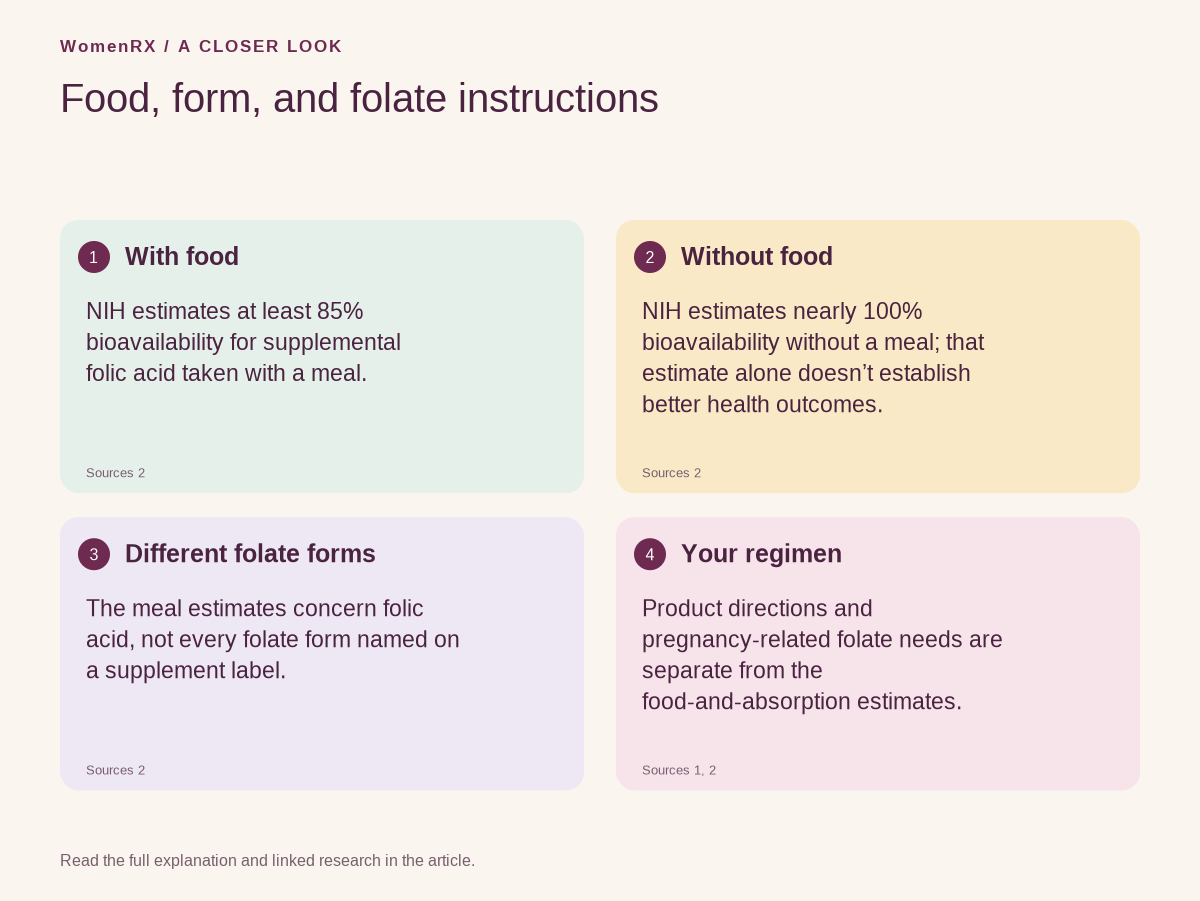
Food, form, and folate instructions
With food: NIH estimates at least 85% bioavailability for supplemental folic acid taken with a meal.2
Without food: NIH estimates nearly 100% bioavailability without a meal; that estimate alone doesn’t establish better health outcomes.2
Different folate forms: The meal estimates concern folic acid, not every folate form named on a supplement label.2
Your regimen: Product directions and pregnancy-related folate needs are separate from the food-and-absorption estimates.12
Read the figure as text
These distinctions show what the absorption estimates answer and what they don’t.- With food: NIH estimates at least 85% bioavailability for supplemental folic acid taken with a meal.2
- Without food: NIH estimates nearly 100% bioavailability without a meal; that estimate alone doesn’t establish better health outcomes.2
- Different folate forms: The meal estimates concern folic acid, not every folate form named on a supplement label.2
- Your regimen: Product directions and pregnancy-related folate needs are separate from the food-and-absorption estimates.12
More questions, answered
Should I take another tablet if I took folic acid with food?
No. Taking supplemental folic acid with food doesn’t mean the dose was lost: NIH estimates at least 85% bioavailability with food. Keep to your product directions or prescribed regimen rather than repeating a dose because you ate. 2
Sources you can check
- Folic Acid: MedlinePlusAccessed 2026-09-25Return to first citation
- Folate - Health Professional Fact SheetAccessed 2026-09-25Return to first citation