Folate for Women: When Supplements Matter
Folic acid has a clear role around pregnancy, but that doesn’t make extra folate a proven benefit for every woman.
The strongest reason to take folic acid is to reduce the risk of neural tube defects in a pregnancy: women who could become pregnant are advised to get 400-800 mcg daily, starting at least a month before conception and continuing through early pregnancy. Folate also matters when a deficiency is diagnosed or likely. For other uses, including general heart, brain, or mood benefits, routine supplementation isn’t established. 1
The clearest benefit is before and early in pregnancy
Folate helps the body make DNA and support cell division. That role becomes especially relevant early in pregnancy, when the embryo’s neural tube is forming. Neural tube defects, including spina bifida and anencephaly, develop very early, sometimes before you know you’re pregnant. Adequate folic acid around conception prevents a substantial proportion of these defects. In the United States, neural tube defect rates declined after folic acid fortification of grain products began, though fortification doesn’t prevent every case. 1
For women and adolescents who could become pregnant, the National Institutes of Health Office of Dietary Supplements summarizes guidance to get 400 micrograms (mcg) of folic acid daily from a supplement, fortified foods, or both, alongside folate from a varied diet. The U.S. Preventive Services Task Force recommends a daily supplement containing 400-800 mcg, starting at least one month before conception and continuing through the first two to three months of pregnancy. The practical reason to start before pregnancy is timing: the neural tube closes early. 1
This guidance applies even if you eat folate-rich foods or have an MTHFR gene variant. The CDC recommends folic acid, rather than a different folate form, for people who could become pregnant, including those with the common 677C>T variant. 1
Needs change with life stage
For adults who aren’t pregnant or breastfeeding, the recommended intake is 400 mcg dietary folate equivalents (DFE) per day. It rises to 600 mcg DFE during pregnancy and is 500 mcg DFE while breastfeeding. DFE accounts for the fact that folic acid from fortified food and supplements is more readily absorbed than naturally occurring food folate; the numbers in DFE aren’t interchangeable with the amount of folic acid listed on a supplement label. 1
Folate is found in foods such as leafy greens, beans, peas, and citrus. In the United States, folic acid is also added to many enriched grain products. These foods contribute to everyday intake, but the specific folic acid guidance for people who could become pregnant is meant to help reduce risk before pregnancy is recognized. 12
If you’ve previously had a pregnancy affected by a neural tube defect, or take a medication that affects folate, your needs may differ from the general guidance. Don’t assume a standard supplement amount is right for you: higher amounts may be recommended in some situations, but should be managed with a clinician. Folate can interact with medicines such as methotrexate and some anti-seizure medicines, and sulfasalazine can reduce folate absorption. 1
Deficiency is a separate reason to supplement
Folate deficiency can interfere with normal red blood cell formation and cause megaloblastic anemia. Fatigue, weakness, difficulty concentrating, a sore tongue, or shortness of breath can occur, but symptoms alone don’t establish that folate is the cause. Deficiency is uncommon in the United States and may occur alongside other nutritional problems; poor diet, alcohol use disorder, and conditions that limit absorption, including celiac disease and inflammatory bowel disease, can increase the risk. 1
When deficiency is found, correcting it is different from taking folate as a general wellness boost. A clinician can interpret testing and consider whether another issue, including vitamin B12 deficiency, may also be involved. Large amounts of folate can improve the anemia associated with vitamin B12 deficiency without correcting its neurological effects, so unexplained anemia isn’t a reason to self-treat with high-dose supplements. 1
Beyond pregnancy: proposed benefits aren’t all proven
Folate supplements can lower homocysteine, a blood marker involved in folate metabolism. But changing a marker doesn’t necessarily prevent disease. In a large trial of women at high risk of cardiovascular disease, a combination of folic acid and vitamins B6 and B12 lowered homocysteine but did not reduce major cardiovascular events. Research suggests folic acid may reduce stroke risk in some settings, especially where folate intake is low, but that doesn’t establish it as a routine heart-health supplement for women in the United States. 1
Studies of folate and cancer, memory, and depression are mixed. For example, associations between folate intake and some outcomes don’t show that taking a supplement prevents or treats them. Trials have generally not found improved cognitive function from folic acid in most groups, and findings on supplements as an add-on treatment for depression are limited and inconsistent. These proposed benefits aren’t a substitute for a specific diagnosis or treatment plan. 1
A useful way to decide is to ask what the supplement is for: preventing neural tube defects around a possible pregnancy, treating a confirmed or likely deficiency, or addressing another clinical indication. The first two have a clearer rationale than taking extra folate for broad health benefits.
Folate: benefit depends on the reason
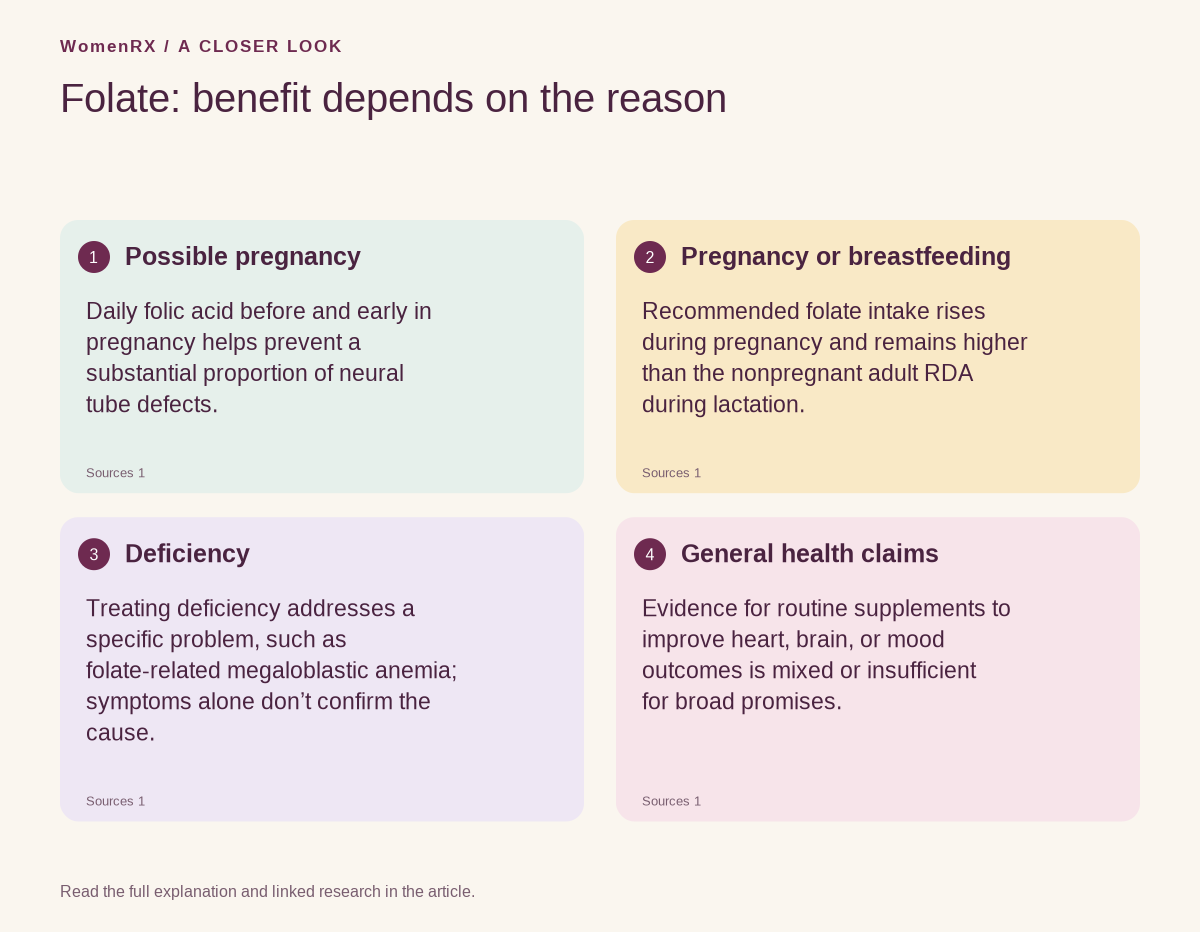
Possible pregnancy: Daily folic acid before and early in pregnancy helps prevent a substantial proportion of neural tube defects.1
Pregnancy or breastfeeding: Recommended folate intake rises during pregnancy and remains higher than the nonpregnant adult RDA during lactation.1
Deficiency: Treating deficiency addresses a specific problem, such as folate-related megaloblastic anemia; symptoms alone don’t confirm the cause.1
General health claims: Evidence for routine supplements to improve heart, brain, or mood outcomes is mixed or insufficient for broad promises.1
Read the figure as text
Compare the life stage or indication with the outcome the evidence supports, rather than treating folate as a general-purpose supplement.- Possible pregnancy: Daily folic acid before and early in pregnancy helps prevent a substantial proportion of neural tube defects.1
- Pregnancy or breastfeeding: Recommended folate intake rises during pregnancy and remains higher than the nonpregnant adult RDA during lactation.1
- Deficiency: Treating deficiency addresses a specific problem, such as folate-related megaloblastic anemia; symptoms alone don’t confirm the cause.1
- General health claims: Evidence for routine supplements to improve heart, brain, or mood outcomes is mixed or insufficient for broad promises.1
More questions, answered
Is folate the same as folic acid?
Folate is the general name for forms of vitamin B9. It includes naturally occurring food folate as well as folic acid, the form used in many fortified foods and supplements. 1
Does a common MTHFR variant mean I need a different form?
The CDC recommends 400 mcg of folic acid daily for people who could become pregnant, even if they have the common 677C>T MTHFR variant. 1
Sources you can check
- Folate - Health Professional Fact SheetAccessed 2026-09-25Return to first citation
- Folic Acid: MedlinePlusAccessed 2026-09-25Return to first citation