Folate and Folic Acid: Who Needs a Supplement?
Folic acid helps prevent neural tube defects when you get it before pregnancy, but a deficiency or certain medicines can call for a different plan.
If you could become pregnant, U.S. guidance recommends 400 mcg of folic acid daily from supplements, fortified foods, or both, alongside food folate. For people planning pregnancy, the U.S. Preventive Services Task Force recommends a daily supplement with 400-800 mcg, starting at least one month before conception. A previous pregnancy affected by a neural tube defect, diagnosed deficiency, or certain medicines calls for an individualized plan. 1
Why the recommendation starts before pregnancy
Folic acid helps prevent neural tube defects, serious conditions affecting the developing brain or spine. The neural tube closes about 21-28 days after conception, sometimes before you know you’re pregnant. That’s why the prevention recommendation starts before a positive test. 12
Two U.S. recommendations describe the routine amount in slightly different ways. The Food and Nutrition Board advises women and adolescents who could become pregnant to get 400 micrograms (mcg) of folic acid daily from supplements, fortified foods, or both, in addition to folate from a varied diet. The U.S. Preventive Services Task Force recommends a daily supplement containing 400-800 mcg of folic acid for people planning pregnancy or capable of becoming pregnant, beginning at least one month before conception and continuing through the first two to three months of pregnancy. 1
If you’re already pregnant and weren’t taking folic acid beforehand, check what your prenatal vitamin contains now. The early window explains why starting beforehand is best; it isn’t a reason to try to make up for missed time with extra tablets. Most pregnant women are advised to take a prenatal vitamin to help meet folic acid and other nutrient needs. 1
The pregnancy intake target is a different number
You may also see 600 mcg DFE per day listed as the folate recommended dietary allowance during pregnancy, compared with 400 mcg DFE for a nonpregnant adult woman. DFE stands for dietary folate equivalents. It accounts for the fact that folic acid in supplements and fortified foods is absorbed differently from folate naturally present in food. The pregnancy RDA describes total folate intake, not the amount of folic acid you need in a separate pill. 1
For example, beans and leafy greens provide natural folate, while enriched breads, cereals, pasta, and other grain products can provide added folic acid. Food remains part of the picture whether or not you take a supplement. If you’re not pregnant and pregnancy isn’t possible, your decision about a supplement is generally about meeting your folate needs through your diet, not following the neural tube defect prevention recommendation. If pregnancy could happen even though you aren’t planning it, that early prevention recommendation still applies. 1
How to check a supplement label
On a U.S. label, find the serving size first. Then look for “Folate” in mcg DFE. If the product contains added folic acid, its mcg of folic acid must also be shown, typically in parentheses. Compare that folic acid amount, for the stated serving, with the prevention recommendation. Don’t read a larger DFE figure as though it were the same number of mcg of folic acid. 1
Folic acid is the form used in most supplements and the form named in the neural tube defect prevention guidance. Some products instead contain 5-MTHF, also called methylfolate. It’s a form of folate, but evidence that it offers a greater benefit for people with the common MTHFR 677C>T variant is inconclusive. The CDC recommendation reported by NIH remains 400 mcg of folic acid daily for people who could become pregnant, including those with that variant. 1
If you take a prenatal vitamin, multivitamin, and separate folic acid product, check all three labels before combining them. For adults age 19 and older, the usual upper limit is 1,000 mcg per day of folate from supplements and fortified foods; it does not count folate naturally present in food. This limit doesn’t apply to a higher dose taken under medical supervision. 1
When the usual amount may not fit
A previous pregnancy affected by a neural tube defect changes the discussion before another pregnancy. NIH reports that some experts recommend 4,000-5,000 mcg of supplemental folic acid daily, starting before conception and continuing into early pregnancy. That range exceeds the usual upper limit and is a medically supervised plan, not a reason to add several prenatal vitamins. A Canadian clinical guideline likewise distinguishes high-dose care after a previous affected pregnancy from routine low-dose prevention. 14
A diagnosed folate deficiency needs its own assessment. Folate deficiency can cause anemia with fatigue, weakness, or shortness of breath, but vitamin B12 deficiency can cause a similar anemia. Large amounts of folate can improve the anemia without correcting neurological damage from B12 deficiency. That’s why treating a suspected deficiency isn’t simply a matter of choosing the highest-dose supplement on the shelf. Conditions that can reduce folate absorption, including celiac disease and inflammatory bowel disease, may also affect the plan. 1
Medicines matter for different reasons. Phenytoin, carbamazepine, and valproate can lower folate levels, while folate supplements may lower blood levels of these medicines. Sulfasalazine can reduce folate absorption. Methotrexate requires particular care: folate supplements could interfere with methotrexate used for cancer, while they may ease gastrointestinal side effects when low-dose methotrexate is used for rheumatoid arthritis or psoriasis. The right folate plan depends on the medicine and why you take it. 1
If pregnancy is possible or planned while you take one of these medicines, review both the prescription and your supplement with the clinician managing the treatment. Don’t stop a needed medicine on your own: leaving a condition untreated can carry risks, too. 13
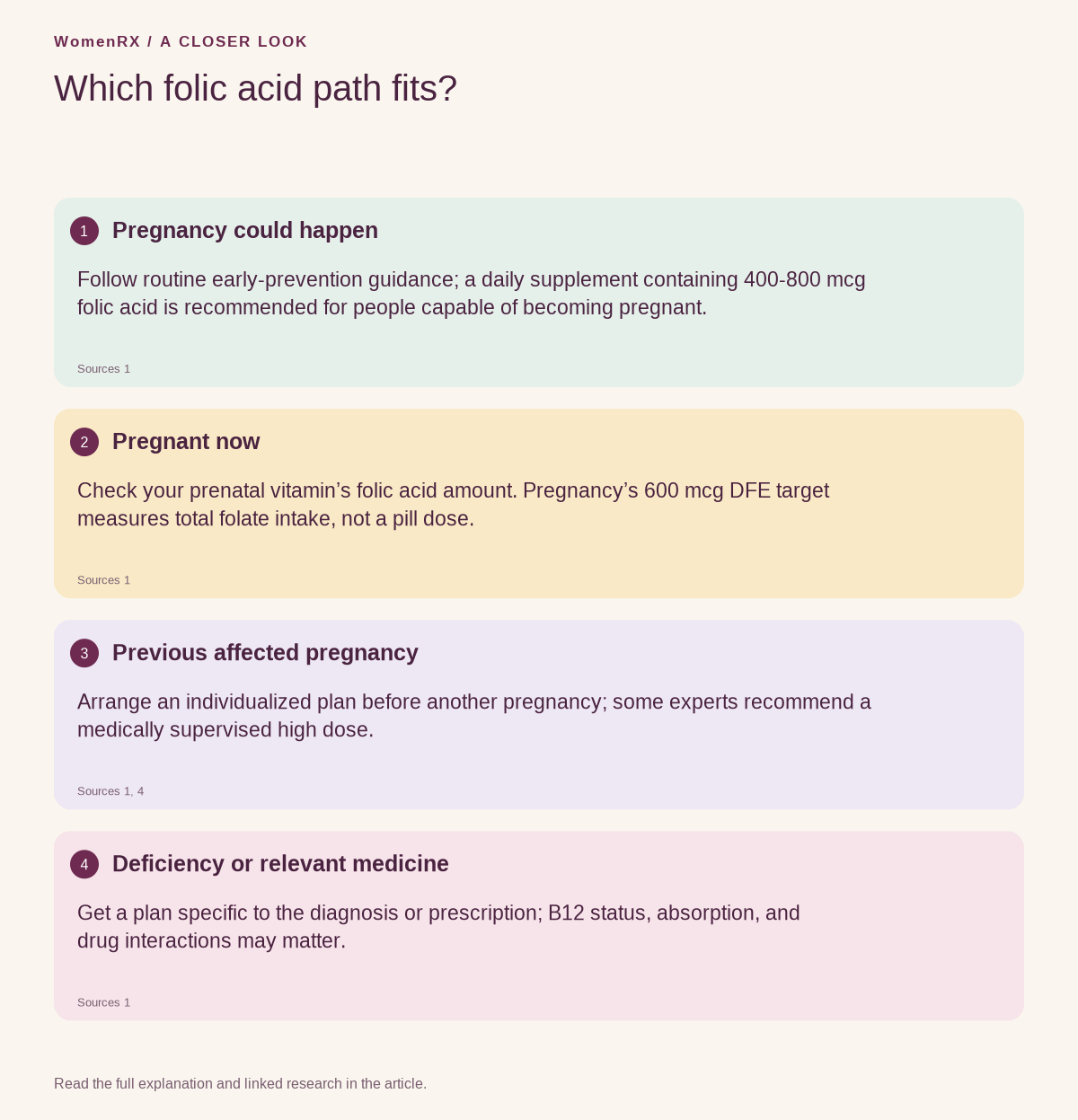
Which folic acid path fits?
Pregnancy could happen: Follow routine early-prevention guidance; a daily supplement containing 400-800 mcg folic acid is recommended for people capable of becoming pregnant.1
Pregnant now: Check your prenatal vitamin’s folic acid amount. Pregnancy’s 600 mcg DFE target measures total folate intake, not a pill dose.1
Previous affected pregnancy: Arrange an individualized plan before another pregnancy; some experts recommend a medically supervised high dose.14
Deficiency or relevant medicine: Get a plan specific to the diagnosis or prescription; B12 status, absorption, and drug interactions may matter.1
Read the figure as text
Start with pregnancy possibility, then check whether your history or medicines call for a different plan.- Pregnancy could happen: Follow routine early-prevention guidance; a daily supplement containing 400-800 mcg folic acid is recommended for people capable of becoming pregnant.1
- Pregnant now: Check your prenatal vitamin’s folic acid amount. Pregnancy’s 600 mcg DFE target measures total folate intake, not a pill dose.1
- Previous affected pregnancy: Arrange an individualized plan before another pregnancy; some experts recommend a medically supervised high dose.14
- Deficiency or relevant medicine: Get a plan specific to the diagnosis or prescription; B12 status, absorption, and drug interactions may matter.1
More questions, answered
Do I need methylfolate if I have an MTHFR variant?
The common MTHFR 677C>T variant alone doesn’t change the CDC recommendation reported by NIH: people who could become pregnant should get 400 mcg of folic acid daily. Research on whether 5-MTHF offers a greater benefit for people with this variant is inconclusive. 1
Does the pregnancy target of 600 mcg DFE mean I need a 600 mcg folic acid pill?
No. The 600 mcg DFE figure is a target for total folate intake during pregnancy. DFE and the mcg of folic acid listed separately on a supplement label are different measures. 1
Sources you can check
- Folate - Health Professional Fact SheetAccessed 2026-09-25Return to first citation
- Folic Acid: MedlinePlusAccessed 2026-09-25Return to first citation
- Pregnancy and Medicines | MedlinePlusAccessed 2026-09-25Return to first citation
- Guideline No. 427: Folic Acid and Multivitamin Supplementation for Prevention of Folic Acid-Sensitive Congenital Anomalies.Wilson RD, O'Connor DL. · Journal of obstetrics and gynaecology Canada : JOGC = Journal d'obstetrique et gynecologie du Canada : JOGC · 2022Return to first citation