When to Take Folate or Folic Acid
For folic acid, the time of day matters less than finding a routine you can follow and checking the directions for your exact product.
Folic acid can generally be taken with or without food, in the morning or at night. NIH estimates that at least 85% is bioavailable with food and nearly 100% without, but those figures don’t establish a better time of day or health outcome. They’re specific to folic acid, not every supplement labeled folate. Check your product or prescription directions and ask a pharmacist about medicine-specific instructions. 2
The short answer: choose a time you can repeat
For a typical folic acid supplement, morning and night are both reasonable options. The NIH Office of Dietary Supplements describes folic acid’s bioavailability with and without food, but those figures don’t establish a preferred hour of the day. The practical choice is usually the time that best fits your routine, unless your product label or prescription gives different directions. 2
That distinction matters: a supplement can be absorbed whether you take it with breakfast or later in the day, but the available figures don’t compare health outcomes from morning versus evening use. There’s no need to delay a dose just to find a supposedly ideal time.
Food is optional for folic acid
Folic acid is the form used in many supplements and fortified foods. The NIH estimates that at least 85% of supplemental folic acid is bioavailable when taken with food, compared with nearly 100% when taken without food. These are absorption estimates, not evidence that taking it on an empty stomach leads to a better health outcome. If taking it with a meal helps it become part of your routine, that’s a practical reason to do so. 2
Check which form you have. A supplement label may say “folate” and list folic acid in parentheses, or the product may contain another form, such as 5-MTHF. The with-food and without-food estimates above are for folic acid; don’t apply those percentages to 5-MTHF. Follow the directions for your exact product. If you take a multivitamin or prenatal vitamin, look at its label rather than assuming its instructions are identical to those for a folic-acid-only supplement. 2
If you’re pregnant or trying to conceive
Folate is especially relevant before and during pregnancy: getting enough folic acid can help prevent major birth defects of a baby’s brain or spine. 1 The NIH Office of Dietary Supplements notes that folic acid from supplements and/or fortified foods is recommended for women who could become pregnant, and that prenatal vitamins are recommended by the American College of Obstetricians and Gynecologists for most pregnant women. 2
If folic acid is part of your pregnancy plan, focus on following the directions you’ve been given consistently, not on whether you take it at breakfast or bedtime. If a clinician has prescribed a particular product or regimen, keep to those instructions and ask before changing it.
When medicine-specific advice matters
If you take prescription medicine, especially medicine for seizures, ask a pharmacist or prescriber how your folic acid fits with your exact regimen. A systematic review describes one small randomized study in 18 adults with epilepsy taking phenytoin and carbamazepine; it reported no change in antiepileptic medicine concentrations or seizure frequency after folic acid. The study was small, so it doesn’t settle what’s right for every person or medication combination. Don’t change a prescribed medicine or folic acid regimen based on general advice about timing. 3
A useful question is: “Should I take this exact folic acid product with or without food, and does it affect any of my medicines?” A pharmacist can check the product and your medication list together.
A simple routine to try
- Check the label or prescription. Use the directions for the product and form you actually have.
- Choose a repeatable cue. For example, you might pair it with breakfast or your evening routine.
- Decide where food fits. Food isn’t required for folic acid, but taking it with a meal is reasonable. If your product contains another form, follow its own directions. 2
- Check medicine-specific instructions. Ask a pharmacist or prescriber if you take prescription medicines or have a prescribed folic acid regimen.
- Keep pregnancy guidance in view. If you’re pregnant or could become pregnant, follow the folic acid advice specific to your situation. 1 2
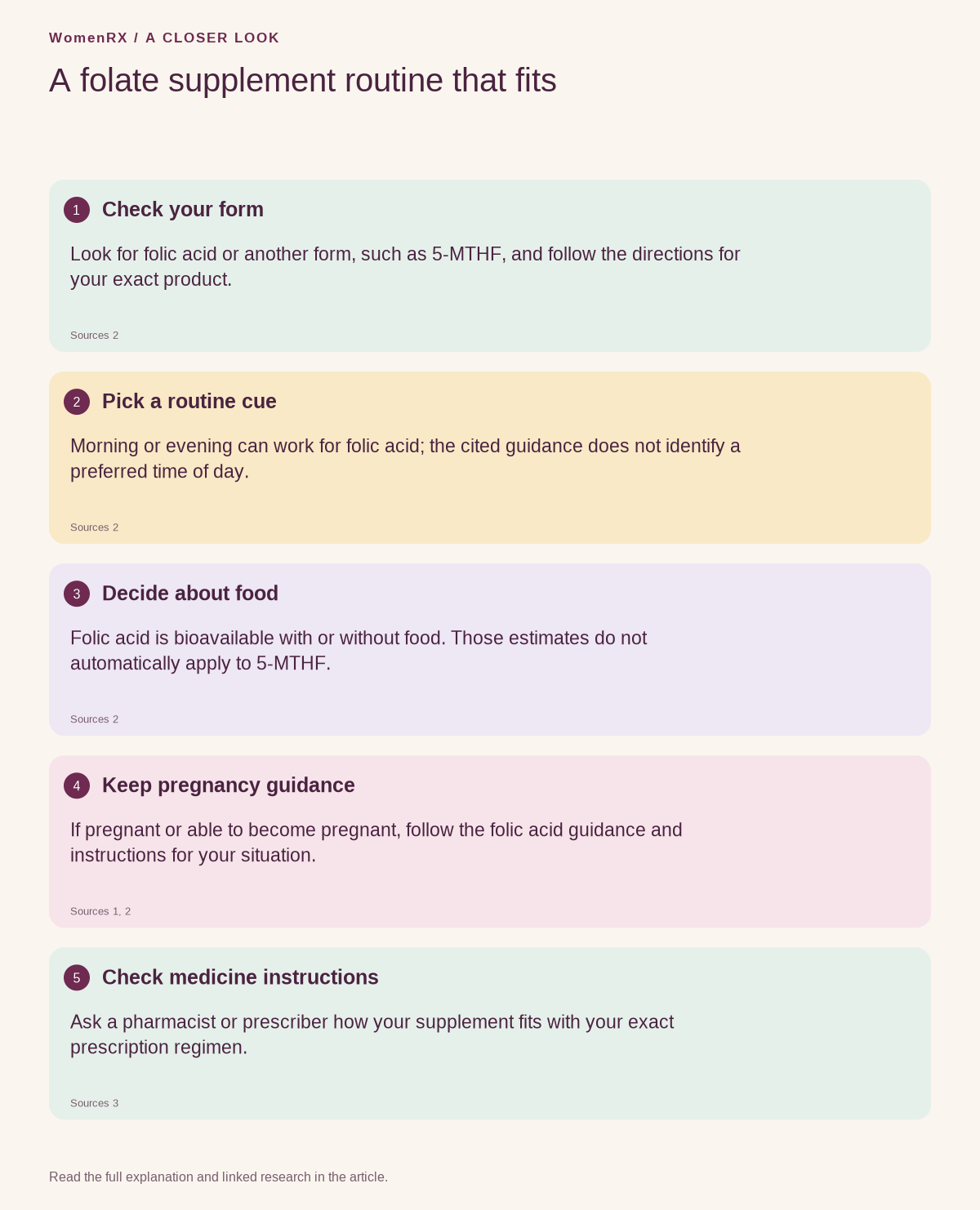
A folate supplement routine that fits
Check your form: Look for folic acid or another form, such as 5-MTHF, and follow the directions for your exact product.2
Pick a routine cue: Morning or evening can work for folic acid; the cited guidance does not identify a preferred time of day.2
Decide about food: Folic acid is bioavailable with or without food. Those estimates do not automatically apply to 5-MTHF.2
Keep pregnancy guidance: If pregnant or able to become pregnant, follow the folic acid guidance and instructions for your situation.12
Check medicine instructions: Ask a pharmacist or prescriber how your supplement fits with your exact prescription regimen.3
Read the figure as text
Use this checklist to separate flexible timing choices from directions that depend on the form of folate, pregnancy guidance, or medicines.- Check your form: Look for folic acid or another form, such as 5-MTHF, and follow the directions for your exact product.2
- Pick a routine cue: Morning or evening can work for folic acid; the cited guidance does not identify a preferred time of day.2
- Decide about food: Folic acid is bioavailable with or without food. Those estimates do not automatically apply to 5-MTHF.2
- Keep pregnancy guidance: If pregnant or able to become pregnant, follow the folic acid guidance and instructions for your situation.12
- Check medicine instructions: Ask a pharmacist or prescriber how your supplement fits with your exact prescription regimen.3
More questions, answered
Is folic acid better absorbed on an empty stomach?
The NIH estimates nearly 100% bioavailability without food and at least 85% with food. Those estimates don’t show that taking it on an empty stomach improves health outcomes, so choose the approach that fits your directions and routine. The percentages are for folic acid, not necessarily other folate forms. 2
Should I take folic acid at a particular time during pregnancy?
The guidance cited here emphasizes getting enough folic acid before and during pregnancy, not a particular time of day. Follow your prenatal vitamin label or prescribed instructions consistently. 1 2
Sources you can check
- Folic Acid: MedlinePlusAccessed 2026-09-25Return to first citation
- Folate - Health Professional Fact SheetAccessed 2026-09-25Return to first citation
- Optimizing phenytoin therapy: a systematic review of clinically relevant food and herb interactions.Orellana-Paucar AM, Mosquera-Lopez ET, Bustamante-Alvarez NM, Machado-Orellana MG, Vintimilla-Rojas DA, Atiencia-Palacios JD, Espinoza-Fajardo AC. · Frontiers in pharmacology · 2025Return to first citation