Folate or Folic Acid: Which Form Fits Your Situation?
For preventing neural tube defects, the evidence-backed choice is folic acid; a varied diet still matters, but a product labeled 5-MTHF isn’t proven superior.
Folate is the nutrient found naturally in foods; folic acid is the form used in supplements and many fortified foods. If you could become pregnant, U.S. guidance recommends getting 400 mcg of folic acid daily from supplements and/or fortified foods, in addition to a varied diet. Folic acid has the clearest evidence for preventing neural tube defects. 5-MTHF is another supplement form, but it hasn’t been established as a better substitute for that purpose. 2 3
The names describe different forms
Folate is the umbrella name for vitamin B9. It occurs naturally in foods such as spinach, beans, peas, asparagus, and citrus. Folic acid is a form used in supplements and added to many enriched grain products. 5-MTHF, also called methylfolate, is another form available in supplements. These names describe forms of the nutrient, not a ranking from “basic” to “better.” 2
The distinction matters most when you’re comparing a food pattern with a supplement for neural tube defect prevention. Folate supports cell growth, and adequate folate status before and during early pregnancy is associated with a lower risk of neural tube defects, which affect the developing brain or spine. 1 3
When pregnancy is possible, folic acid has the clearest evidence
Research syntheses include evidence from intervention studies that folic acid taken before and during early pregnancy can reduce the occurrence of neural tube defects. The evidence also supports folic acid for preventing recurrence in people with a prior affected pregnancy. 3
That’s why U.S. guidance recommends that women and adolescents who could become pregnant get 400 mcg of folic acid daily from supplements and/or fortified foods, in addition to folate from a varied diet. This recommendation applies even if pregnancy isn’t currently planned, because timing can be unexpected. It’s guidance for people who could become pregnant, not a reason everyone needs a separate folic acid supplement regardless of circumstance. 2
For an example of how this affects a label comparison: a person who could become pregnant might eat leafy greens and beans regularly and still check whether they’re getting the recommended folic acid from a supplement or fortified foods. Food folate contributes to overall intake, but the prevention evidence specifically supports folic acid. 2 3
What about 5-MTHF or “methylfolate”?
5-MTHF is a real folate form, and supplements containing it are available. But a different name or an “active” label doesn’t demonstrate better pregnancy outcomes. The NIH Office of Dietary Supplements says that formal conversion factors for expressing 5-MTHF in dietary folate equivalents (DFEs) have not been established. It also reports that CDC recommends 400 mcg of folic acid for people who could become pregnant, including those with a common MTHFR gene variant. 2
So, if your goal is neural tube defect prevention, don’t assume a methylfolate product is an evidence-backed upgrade or a direct equivalent to folic acid. If you’ve had a pregnancy affected by a neural tube defect, generic label comparisons don’t establish what’s right for your situation; evidence for folic acid also includes prevention of recurrence. 3
How to compare food and supplement labels
A folate-rich eating pattern can include leafy greens, beans and peas, asparagus, citrus, eggs, nuts, and other foods. In the United States, folic acid is also added to many enriched grain products, including some breads, cereals, pasta, and rice. A varied diet and fortified foods can therefore contribute different forms of folate. 2
On a label, look for the amount in mcg DFE and, when folic acid is added, the amount of folic acid listed in parentheses. Those numbers may differ because folic acid is more bioavailable than naturally occurring food folate. For example, the NIH conversion is 1 mcg DFE for 1 mcg of food folate, compared with 1 mcg DFE for 0.6 mcg of folic acid from fortified foods or a supplement taken with food. Don’t compare two products by the DFE number alone if your specific question is how much folic acid they contain. 2
If you’re pregnant, a prenatal supplement may help cover folic acid and other nutrients, but products can differ. 2
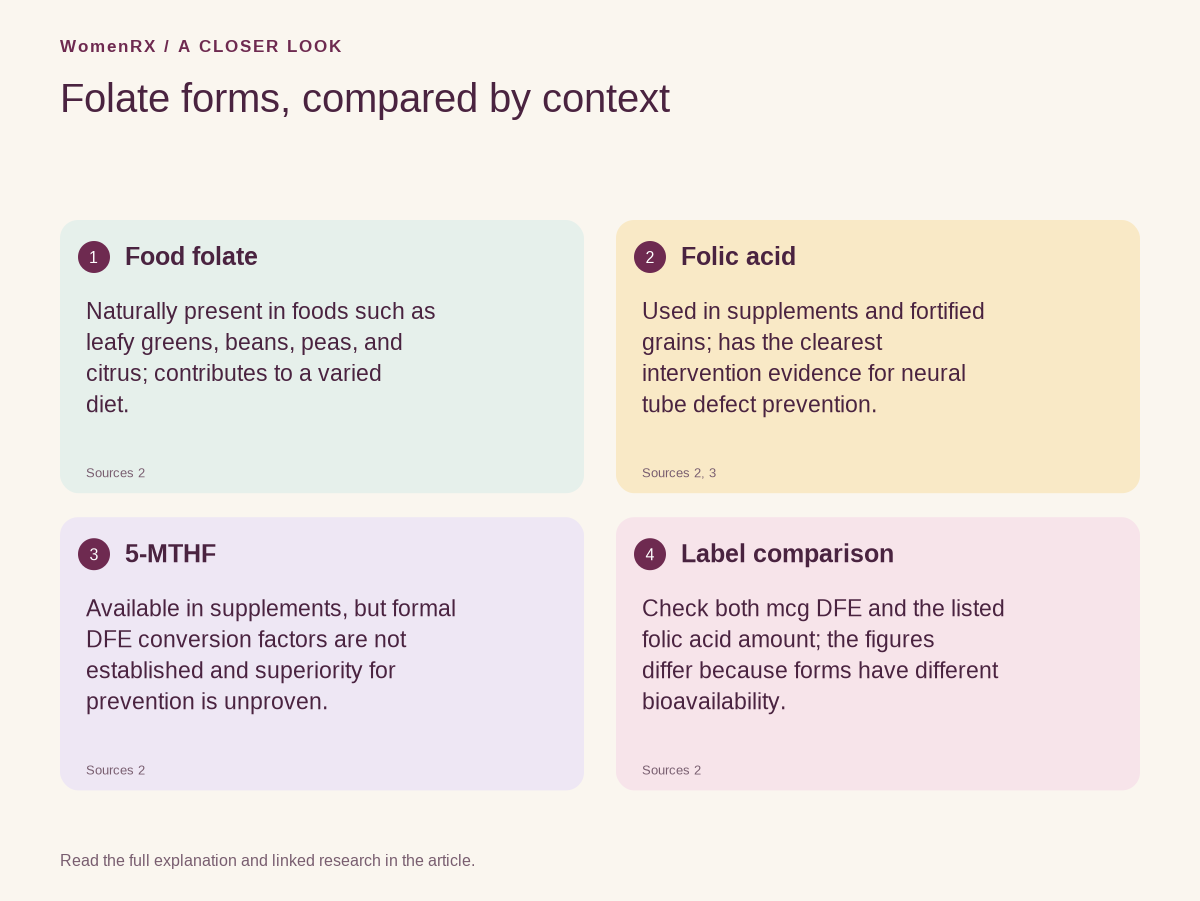
Folate forms, compared by context
Food folate: Naturally present in foods such as leafy greens, beans, peas, and citrus; contributes to a varied diet.2
Folic acid: Used in supplements and fortified grains; has the clearest intervention evidence for neural tube defect prevention.23
5-MTHF: Available in supplements, but formal DFE conversion factors are not established and superiority for prevention is unproven.2
Label comparison: Check both mcg DFE and the listed folic acid amount; the figures differ because forms have different bioavailability.2
Read the figure as text
The useful distinction is not which label sounds more advanced, but where each form comes from and what outcome evidence supports its use.- Food folate: Naturally present in foods such as leafy greens, beans, peas, and citrus; contributes to a varied diet.2
- Folic acid: Used in supplements and fortified grains; has the clearest intervention evidence for neural tube defect prevention.23
- 5-MTHF: Available in supplements, but formal DFE conversion factors are not established and superiority for prevention is unproven.2
- Label comparison: Check both mcg DFE and the listed folic acid amount; the figures differ because forms have different bioavailability.2
More questions, answered
Does an MTHFR gene variant mean I should take methylfolate instead?
Not necessarily. The NIH Office of Dietary Supplements reports that CDC recommends 400 mcg of folic acid daily for people who could become pregnant, including those with the common 677C>T MTHFR variant. Evidence that 5-MTHF is preferable for this group is inconclusive. 2
If I’m not planning pregnancy, do I need a folic acid supplement?
Not automatically. The specific 400 mcg folic acid recommendation is for women and adolescents who could become pregnant. For other situations, folate needs and supplement choices depend on your diet and health circumstances; a food-first pattern can include both naturally folate-rich foods and fortified grains. 2
Sources you can check
- Folic Acid: MedlinePlusAccessed 2026-09-25Return to first citation
- Folate - Health Professional Fact SheetAccessed 2026-09-25Return to first citation
- Folate and global health umbrella review series, part 1: methodological framework and syntheses on anaemia and neural tube defects.Yoo S, Montazeri A, Bennett D, Bo Y, Chen P, Duthie S, Jensen N, Kaminga A, Lai JS, Li X, MacFarlane AJ, Martinez H, McNulty H, Momoli F, Mossey P, Mullie P, Munger R, Parajuli RP,... · Journal of global health · 2026Return to first citation