Folate Supplements: How to Read Labels and Avoid Too Much
Before adding a separate folate pill, check both the folate form and the amount of folic acid already in your prenatal or multivitamin.
If you could become pregnant, guidance recommends 400 to 800 mcg of folic acid daily, starting at least a month before conception and continuing through early pregnancy. Folic acid helps prevent major birth defects of the baby’s brain and spine. Check the folic acid amount for pregnancy guidance, then review all supplemental folate forms and fortified foods before adding another product. A higher dose may be appropriate in some situations, but it should be individualized. 1 2
First, separate folate from folic acid
Folate is the umbrella name for vitamin B9 in foods and supplements. Folate naturally present in foods is different from folic acid, the form used in most supplements and in fortified grain products. Some supplements instead use 5-MTHF, also called methylfolate. These forms are related, but the label numbers do not always compare one-to-one. 1
On a US Supplement Facts label, look for the amount in mcg DFE, or dietary folate equivalents. If folic acid is used, the label also lists its amount in parentheses. For example, a label might say 680 mcg DFE (400 mcg folic acid). In this example, 400 mcg is the folic acid amount; the cited pregnancy-prevention guidance recommends 400 to 800 mcg of folic acid daily. 1
If pregnancy is possible, timing matters
Folic acid helps prevent neural tube defects, which affect the developing brain and spine. The neural tube closes very early, often before someone knows she is pregnant. That’s why guidance applies to women and adolescents who could become pregnant, not only to those already planning a pregnancy. 1 2
The US Preventive Services Task Force recommends a daily supplement containing 400 to 800 mcg of folic acid for people planning or capable of pregnancy. It recommends starting at least one month before conception and continuing through the first two to three months of pregnancy. Separately, the recommended dietary allowance during pregnancy is 600 mcg DFE per day. That pregnancy allowance includes folate from all sources and is not the same thing as the folic acid supplement recommendation. 1
If you’ve had a pregnancy affected by a neural tube defect, don’t simply copy the standard amount or choose a high-dose product on your own. Some experts recommend a much higher folic acid amount for a future pregnancy, but those amounts exceed the usual upper limit and should be managed with medical supervision. 1
Check for overlap before adding a pill
Folic acid can be present in a prenatal, a multivitamin, a B-complex, a stand-alone supplement, and fortified foods such as enriched bread, pasta, rice, and cereal. Read each supplement label and note the form and amount of supplemental folate. For pregnancy-prevention guidance, check the actual mcg of folic acid, not just the mcg DFE figures. If two products each list 400 mcg folic acid, for example, they provide 800 mcg folic acid before counting fortified foods. 1
For adults, the upper limit is 1,000 mcg per day of synthetic folate from supplements and fortified foods. It does not include naturally occurring folate in foods, and it does not apply to high-dose treatment under medical supervision. This limit is broader than folic acid alone. Because formal conversion factors for supplemental 5-MTHF to mcg DFE have not been established, adding the listed folic acid amounts alone does not check the upper limit when a product also contains 5-MTHF. This is a limit for routine intake, not a target to reach. 1
That limit is one reason to avoid stacking products without checking their labels. It also isn’t a reason to skip recommended folic acid before or during pregnancy. If your products contain more than one supplemental folate form and you’re unsure how their amounts relate to the upper limit, review them together with the clinician managing your care. 1
Methylfolate is not a simple label swap
Some supplements contain 5-MTHF instead of folic acid. The conversion factors used to express supplemental 5-MTHF as mcg DFE have not been formally established. And while people sometimes choose methylfolate because of an MTHFR gene variant, CDC guidance still recommends 400 mcg of folic acid daily for people who could become pregnant, including those with the common 677C>T variant. The established neural-tube-defect prevention guidance is specifically for folic acid, so don’t assume a different form is interchangeable for that purpose. 1
When the dose or combination needs review
High folate intake can improve the anemia caused by vitamin B12 deficiency without preventing its nerve damage. This is a particular reason to review folate and B12 together when B12 deficiency is a concern, rather than treating a blood-count problem with folate alone. 1
Some medicines also affect folate or interact with supplements. Methotrexate used for cancer treatment may be affected by folate supplements; low-dose methotrexate for conditions such as rheumatoid arthritis may be paired with folate to reduce digestive side effects, but the plan should be coordinated with the prescriber. Certain seizure medicines can lower folate, and folate supplements may lower levels of those medicines. Sulfasalazine can reduce folate absorption. If you take one of these medicines, review a new folate product with the clinician managing it. 1
For a routine label check, start with the prenatal or multivitamin you already use, note its folic acid amount and any other supplemental folate form, then check separate B vitamins or folate products. If pregnancy is possible, make sure your plan includes folic acid rather than assuming a total mcg DFE number or a methylfolate product answers the same question.
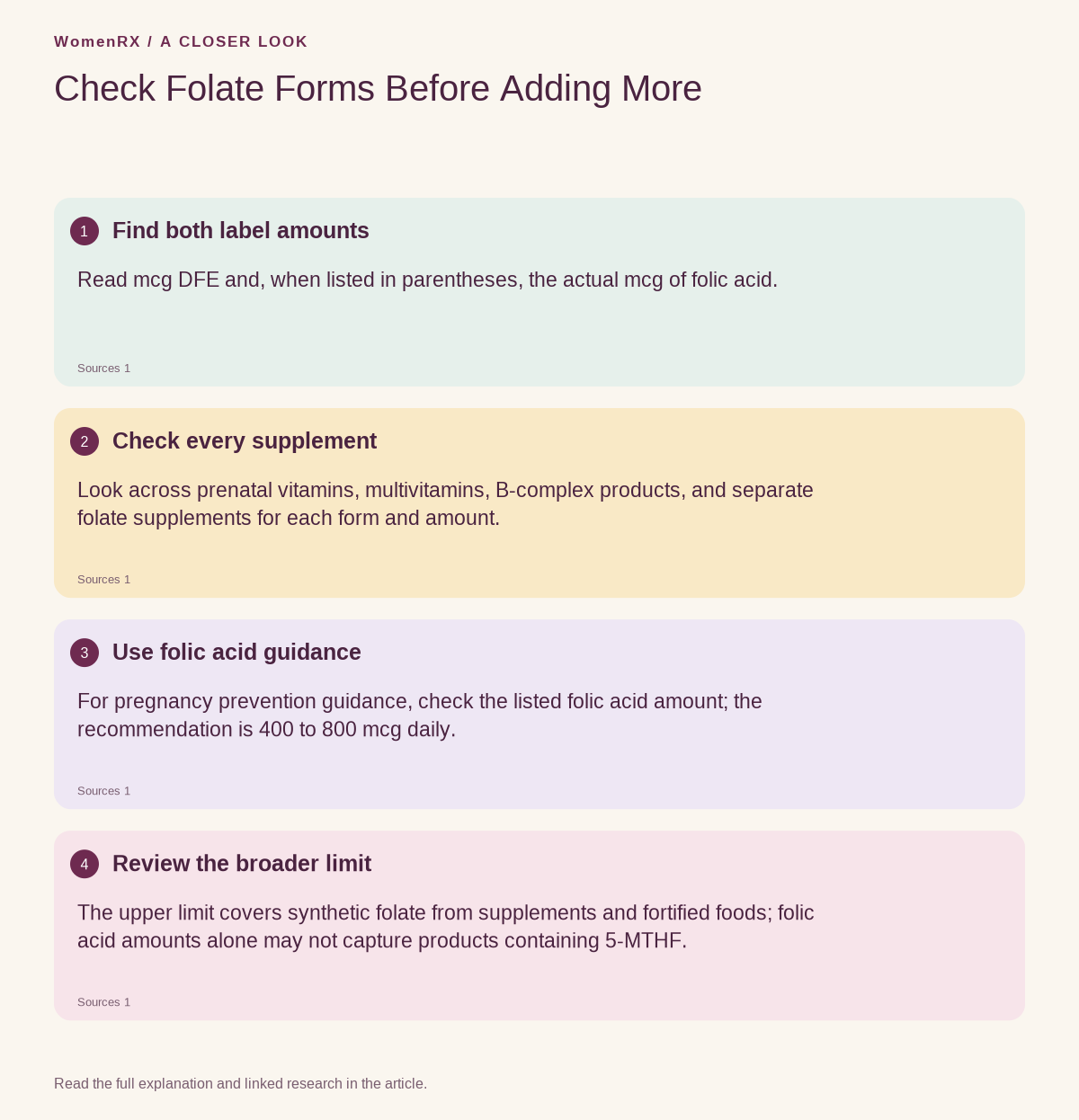
Check Folate Forms Before Adding More
Find both label amounts: Read mcg DFE and, when listed in parentheses, the actual mcg of folic acid.1
Check every supplement: Look across prenatal vitamins, multivitamins, B-complex products, and separate folate supplements for each form and amount.1
Use folic acid guidance: For pregnancy prevention guidance, check the listed folic acid amount; the recommendation is 400 to 800 mcg daily.1
Review the broader limit: The upper limit covers synthetic folate from supplements and fortified foods; folic acid amounts alone may not capture products containing 5-MTHF.1
Read the figure as text
Use these checks to distinguish the folic acid amount used in pregnancy guidance from the broader question of total supplemental folate.- Find both label amounts: Read mcg DFE and, when listed in parentheses, the actual mcg of folic acid.1
- Check every supplement: Look across prenatal vitamins, multivitamins, B-complex products, and separate folate supplements for each form and amount.1
- Use folic acid guidance: For pregnancy prevention guidance, check the listed folic acid amount; the recommendation is 400 to 800 mcg daily.1
- Review the broader limit: The upper limit covers synthetic folate from supplements and fortified foods; folic acid amounts alone may not capture products containing 5-MTHF.1
More questions, answered
Does folate in food count toward the upper limit?
No. The adult upper limit applies to synthetic folate from supplements and fortified foods, not the naturally occurring folate in foods such as beans and leafy greens. 1
Should I take folic acid if I have an MTHFR variant?
CDC guidance recommends 400 mcg of folic acid daily for people who could become pregnant, including those with the common 677C>T MTHFR variant. A genetic result alone is not a reason to replace that guidance with methylfolate or a higher dose. 1
Sources you can check
- Folate - Health Professional Fact SheetAccessed 2026-09-25Return to first citation
- Folic Acid: MedlinePlusAccessed 2026-09-25Return to first citation