Zinc Intake: How to Read Labels and Avoid Too Much
Your zinc target changes with pregnancy and breastfeeding, so check the elemental amount in every product and include food when estimating your daily total.
For most adult women, the recommended zinc intake is 8 mg a day; it’s 11 mg during pregnancy and 12 mg while breastfeeding. For teens ages 14-18, the amounts are 9 mg, 12 mg, and 13 mg, respectively. The upper limit is 40 mg a day for adults and 34 mg for teens, counting zinc from food and products together. 1
Zinc needs depend on life stage, but more isn’t automatically better. The recommended intake is a daily nutrition target, not a supplement dose. The tolerable upper intake level (UL) is a separate safety boundary for usual total intake from food and supplements. 1
Match the guidance to your life stage
| Life stage | Recommended intake per day | Upper limit per day |
|---|---|---|
| Adult, not pregnant or breastfeeding | 8 mg | 40 mg |
| Pregnant, ages 19 and older | 11 mg | 40 mg |
| Breastfeeding, ages 19 and older | 12 mg | 40 mg |
| Ages 14-18, not pregnant or breastfeeding | 9 mg | 34 mg |
| Pregnant, ages 14-18 | 12 mg | 34 mg |
| Breastfeeding, ages 14-18 | 13 mg | 34 mg |
These recommended amounts are RDAs, intended to meet the needs of nearly all healthy people in each group. The UL applies to total daily intake, including zinc in food as well as supplements. It is not a goal to aim for, and it isn’t an individual treatment plan. 1 The pregnancy guidance also lists 11 mg as the RDA and 40 mg as the UL for pregnant adults ages 19-50. 2
Find the elemental zinc on the label
Start with the Supplement Facts panel, not the front of the bottle. It lists zinc as an amount of elemental zinc, rather than the total weight of the zinc compound. For example, a product may contain zinc sulfate or zinc gluconate, but the amount declared on the panel is the zinc to count. Check the serving size too: the listed amount may be for more than one tablet or lozenge. 1
The label’s percent Daily Value (%DV) is another clue, but it isn’t the same as your personal recommended intake. The FDA’s Daily Value for zinc is 11 mg for adults and children ages 4 and older; a product’s %DV is a label-comparison reference, not a pregnancy-specific target. 1
Estimate zinc from food, then add products
To estimate a day’s zinc, first note the foods and portions you typically eat. Use zinc amounts printed on food labels when available; in the United States, food labels generally aren’t required to list zinc unless it has been added. For foods without a zinc listing, USDA FoodData Central can help you look up an estimate for the food and portion. 1
For example, the NIH fact sheet lists 3.8 mg in 3 ounces of roasted beef, 1 mg in 6 ounces of plain Greek yogurt, and 2.8 mg in one serving of breakfast cereal fortified with 25% of the Daily Value. Those are examples of food amounts, not a suggested menu. Add the amounts for the foods and portions you actually eat to get an estimated food contribution. 1
Then add the elemental zinc from each product you use that day. Check more than a standalone zinc bottle: a multivitamin or prenatal, a cold lozenge, and some over-the-counter cold products can all contain zinc. Some denture adhesives contain it too. 1
Estimated total = zinc from food + elemental zinc from each product. Compare that total with the RDA and UL for your age and life stage. Food zinc counts toward both your overall intake and the UL. Since food labels may not show zinc, a food database estimate can make the comparison more complete. 1
Know when a high total deserves a closer look
Too much zinc can cause nausea, dizziness, headache, stomach upset, vomiting, or loss of appetite. Taking 50 mg or more a day for weeks can interfere with copper absorption, reduce immune function, and lower HDL cholesterol. That 50 mg finding isn’t a replacement for the lower 40 mg adult UL: the UL is the daily total-intake limit for healthy people, while the longer-term effects are reported with sustained high doses. 1
If a clinician has prescribed zinc for a medical reason, don’t use the UL on its own to change that plan. The UL doesn’t apply to medically supervised zinc treatment. 1 Otherwise, if your estimated total from food and products approaches or exceeds the UL, or you’ve been using a high-dose product for weeks, bring the labels and your food estimate to a clinician or pharmacist and ask whether the amount and duration make sense for you.
Check medicines before you combine them
Zinc can bind with quinolone and tetracycline antibiotics in the gut, reducing absorption of the antibiotic and zinc when they’re taken at the same time. It can also reduce absorption and action of penicillamine. Ask a pharmacist about timing if you use one of these medicines; the right spacing depends on the medication instructions. Thiazide diuretics can increase zinc loss in urine and lower zinc concentrations. 1
Iron supplements containing 25 mg or more of elemental iron can also reduce zinc absorption when taken at the same time. If you take both, ask a pharmacist whether your schedule needs adjusting rather than changing a prescribed medicine or supplement yourself. 1
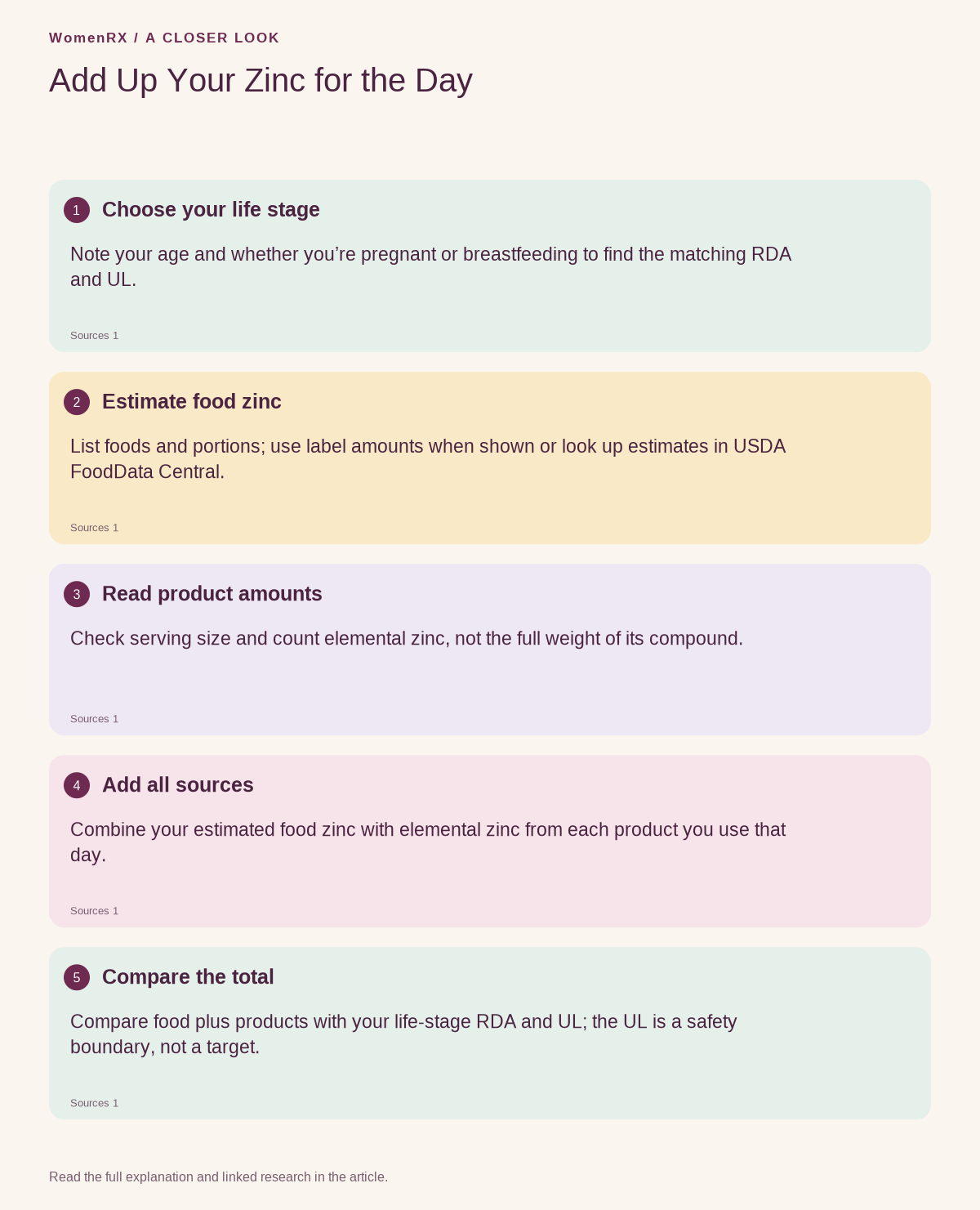
Add Up Your Zinc for the Day
Choose your life stage: Note your age and whether you’re pregnant or breastfeeding to find the matching RDA and UL.1
Estimate food zinc: List foods and portions; use label amounts when shown or look up estimates in USDA FoodData Central.1
Read product amounts: Check serving size and count elemental zinc, not the full weight of its compound.1
Add all sources: Combine your estimated food zinc with elemental zinc from each product you use that day.1
Compare the total: Compare food plus products with your life-stage RDA and UL; the UL is a safety boundary, not a target.1
Read the figure as text
Estimate zinc from the foods and portions you eat, add the elemental zinc from each product serving, then compare the combined amount with the guidance for your age and life stage.- Choose your life stage: Note your age and whether you’re pregnant or breastfeeding to find the matching RDA and UL.1
- Estimate food zinc: List foods and portions; use label amounts when shown or look up estimates in USDA FoodData Central.1
- Read product amounts: Check serving size and count elemental zinc, not the full weight of its compound.1
- Add all sources: Combine your estimated food zinc with elemental zinc from each product you use that day.1
- Compare the total: Compare food plus products with your life-stage RDA and UL; the UL is a safety boundary, not a target.1
More questions, answered
Does zinc from food count toward the upper limit?
Yes. The zinc UL applies to total intake from food and supplements. To estimate the food part, write down your usual foods and portions, then use food labels when zinc is listed or look up foods in USDA FoodData Central. Add that estimate to the elemental zinc from your products. 1
What if a clinician recommends more than the upper limit?
The UL is set for healthy people and does not apply to zinc used as medically supervised treatment. Ask the clinician or pharmacist who knows your treatment plan before changing the amount. 1