Glycine After 40: What the Evidence Actually Shows
Glycine has a limited, uncertain sleep signal in adults, but research doesn’t establish a special benefit for perimenopause or menopause.
Research hasn’t established that glycine works differently after 40 or treats menopause symptoms. A review of adult studies found some sleep improvements, but those studies were small and at high risk of bias, and the review doesn’t report a menopause-specific benefit. A postmenopausal study of rice germ can’t show that glycine itself caused the results. 3 4
The short answer: no proven midlife-specific payoff
If you’re considering glycine because you’re in perimenopause or menopause, adult research doesn’t establish a benefit unique to that life stage. The human research review covers glycine studies in adults, but its reported findings don’t identify a menopause-specific result. It also concludes that better-designed, larger, longer-term studies are needed before glycine can be considered a way to prevent, delay, or reverse aging. 3
That doesn’t prove glycine can’t help anyone. It means the available findings don’t answer the more specific question: whether taking glycine helps women with menopause-related sleep problems, hot flashes, or other midlife concerns.
Sleep is the most relevant general-adult signal
The 2024 systematic review found that longer-term glycine administration improved sleep in healthy populations. But the review describes those studies as having small sample sizes and a high risk of bias. That makes the result an early signal, not dependable evidence that glycine will improve your sleep. The review also doesn’t establish that any sleep effect is stronger after 40 or during menopause. 3
Sleep disruption in midlife can have more than one explanation. For example, trouble falling or staying asleep can be insomnia, while loud snoring, gasping, or pauses in breathing can point to a different sleep disorder. A supplement study in general adults can’t tell you which of these is behind your own sleep problem. 1 2
So if sleep is your reason for considering glycine, the fair takeaway is: there’s a tentative general-adult research signal, but not a demonstrated menopause-specific solution. The review doesn’t provide a basis for a particular dose or for assuming the benefit outweighs the uncertainties for you. 3
Menopause symptoms need their own evidence
A sleep finding isn’t evidence that glycine eases hot flashes or night sweats. The North American Menopause Society’s 2023 position statement reviewed nonhormonal approaches for vasomotor symptoms and did not recommend dietary supplements or herbal remedies as a category. The statement doesn’t single out glycine, so it shouldn’t be read as a glycine-specific trial result. It does mean supplement claims for hot flashes shouldn’t be treated as established treatment evidence. 6
For bothersome menopause symptoms, there are options with stronger evidence. The Society’s position statement identifies several evidence-supported nonhormonal treatments for vasomotor symptoms, and its hormone therapy statement describes hormone therapy as the most effective treatment for those symptoms. Which options fit depends on your circumstances and preferences. 5 6
Why a postmenopausal rice-germ study isn’t a glycine trial
One study did enroll obese postmenopausal women, but it tested rice germ, not glycine supplements. Twenty-seven participants followed a tailored reduced-calorie diet and were assigned to rice germ or placebo for four weeks. The researchers reported changes in several outcomes, including blood glycine levels. Because rice germ contains multiple nutrients and the intervention was the whole food supplement, the study can’t show that glycine itself produced those changes, much less that isolated glycine treats menopause symptoms. 4
This distinction matters whenever a supplement claim points to a study in women after menopause. A study can be relevant to the life stage without testing the ingredient being promoted. Here, the population was relevant, but the intervention doesn’t answer whether glycine supplements are useful for menopausal women. 4
A practical way to weigh the decision
If your goal is a menopause-specific benefit, the evidence doesn’t give glycine a clear case. If your goal is sleep, the adult research is suggestive but limited, and it doesn’t show a distinct advantage after 40. Either way, don’t mistake a general finding, a change in blood amino-acid levels, or an age-related theory for proof of a treatment effect in midlife women. 3 4
If sleep problems keep affecting your days, or you regularly wake gasping or very sleepy, it may be more useful to look into the sleep problem itself than to assume it’s a menopause-related need for a supplement. MedlinePlus describes persistent trouble falling or staying asleep and signs such as loud snoring, gasping, or daytime sleepiness as reasons to consider whether a sleep disorder is involved. 1 2
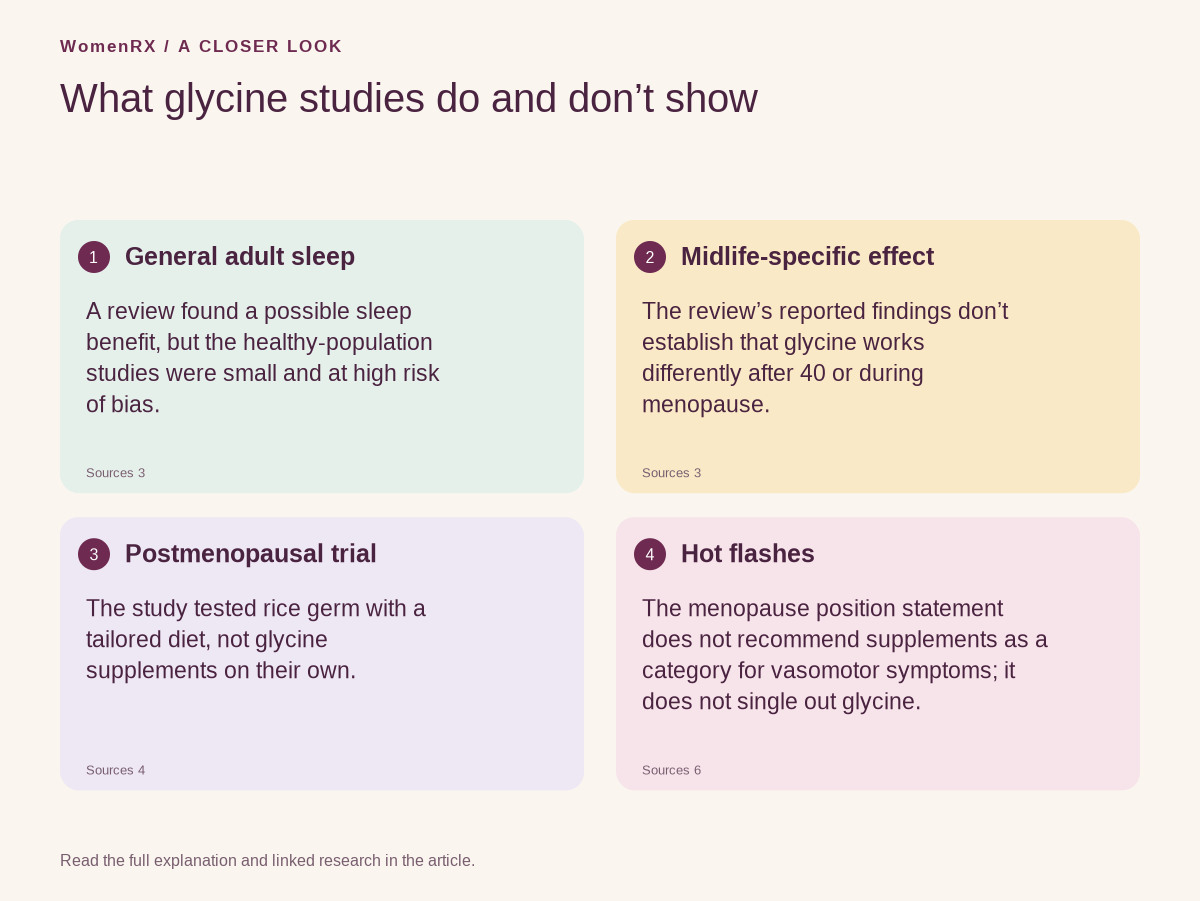
What glycine studies do and don’t show
General adult sleep: A review found a possible sleep benefit, but the healthy-population studies were small and at high risk of bias.3
Midlife-specific effect: The review’s reported findings don’t establish that glycine works differently after 40 or during menopause.3
Postmenopausal trial: The study tested rice germ with a tailored diet, not glycine supplements on their own.4
Hot flashes: The menopause position statement does not recommend supplements as a category for vasomotor symptoms; it does not single out glycine.6
Read the figure as text
Separate general-adult findings from research in postmenopausal women, and see what each study can actually support.- General adult sleep: A review found a possible sleep benefit, but the healthy-population studies were small and at high risk of bias.3
- Midlife-specific effect: The review’s reported findings don’t establish that glycine works differently after 40 or during menopause.3
- Postmenopausal trial: The study tested rice germ with a tailored diet, not glycine supplements on their own.4
- Hot flashes: The menopause position statement does not recommend supplements as a category for vasomotor symptoms; it does not single out glycine.6
More questions, answered
Does a study in postmenopausal women prove glycine supplements help?
No. The study tested rice germ, a multi-nutrient supplement, alongside a tailored diet. A change in blood glycine doesn’t isolate glycine’s effect or demonstrate that glycine supplements help menopausal women. 4
Does the general sleep research show glycine works better after 40?
The review reports sleep findings in healthy adults but doesn’t establish a stronger effect after 40 or a menopause-specific benefit. The studies were small and at high risk of bias. 3
Sources you can check
- Sleep Disorders | MedlinePlusAccessed 2026-09-25Return to first citation
- Insomnia | MedlinePlusAccessed 2026-09-25Return to first citation
- The effect of glycine administration on the characteristics of physiological systems in human adults: A systematic review.Soh J, Raventhiran S, Lee JH, Lim ZX, Goh J, Kennedy BK, Maier AB. · GeroScience · 2024Return to first citation
- Effectiveness of Rice Germ Supplementation on Body Composition, Metabolic Parameters, Satiating Capacity, and Amino Acid Profiles in Obese Postmenopausal Women: A Randomized, Controlled Clinical Pilot Trial.Rondanelli M, Peroni G, Giacosa A, Fazia T, Bernardinelli L, Naso M, Faliva MA, Tartara A, Gasparri C, Perna S. · Nutrients · 2021Return to first citation
- The 2022 hormone therapy position statement of The North American Menopause Society.“The 2022 Hormone Therapy Position Statement of The North American Menopause Society” Advisory Panel. · Menopause (New York, N.Y.) · 2022Return to first citation
- The 2023 nonhormone therapy position statement of The North American Menopause Society.Menopause (New York, N.Y.) · 2023Return to first citation