Glycine Supplements: What Human Studies Show
Glycine is a normal part of food and body chemistry, but research on taking it as a supplement is still limited.
Glycine is an amino acid your body can make and that you also get from protein foods, so being an amino acid doesn’t mean you need a supplement. Trials have explored glycine for sleep, and a small study examined metabolic effects, but they don’t establish a proven use, an ideal amount, or long-term safety. The findings also don’t tell us whether effects differ for women or whether it’s safe in pregnancy or while breastfeeding. 1 2 3
Glycine has real jobs in the body. It is used to build proteins, including collagen, and contributes to other metabolic processes. Your body can make it, and it is also found in foods such as meat, fish, dairy, legumes, nuts, and seeds. Those roles explain why researchers study glycine; they don’t show that taking extra glycine improves health. 1 2
Sleep: encouraging signals, not a settled treatment
Sleep is the most directly studied supplement claim in this evidence. A 2026 scoping review identified three trials of supplemental glycine that assessed sleep-related outcomes. All three reported a benefit on at least one outcome, but that pattern alone can’t show how reliable or meaningful the effects are. The review calls for larger studies using consistent sleep measures. 3
Those findings don’t establish a specific amount to take or promise that glycine will help with insomnia, trouble falling asleep, or next-day tiredness. The review also doesn’t establish that glycine caused sleep-related findings in studies of collagen supplements. 3
Metabolic findings apply to a specific group
A small exploratory study looked at 19 people with severe obesity who received glycine at 100 mg/kg/day for two weeks. This was the study dose, not an established amount to take. The study reported changes in blood glycine and several metabolic measures, but no change in body weight. These early findings may be relevant to researchers studying glycine deficiency and metabolism in this particular group; they don’t show that glycine is a weight-loss supplement or a treatment for liver disease. 2
That distinction matters because an effect on a laboratory measure is not the same as a demonstrated improvement in how someone feels or functions. The study was also short and small, and its results can’t establish what would happen with longer use or in people without severe obesity. 2
Exercise claims remain preliminary
Glycine is promoted in some sports-nutrition contexts, but a 2024 review says more rigorous human trials are needed to confirm benefits for muscle function, recovery, or athletic performance. Findings from laboratory or animal research can help shape questions for future studies, but they don’t establish an exercise benefit in people. 1
What the research says about safety
The available studies don’t establish long-term safety for routine glycine supplementation. One short study in 19 people with severe obesity used 100 mg/kg/day for two weeks, but that experience cannot answer what longer-term use is like for a wider population. A review focused on sports nutrition likewise says regular supplementation has not been studied well enough to establish its safety. 1 2
That review also flags possible cytotoxic effects and acute glutamate toxicity at very high doses, above 500 mg/kg of body mass. This is a warning about very high doses, not evidence that ordinary supplement use causes these effects, and it doesn’t establish a safe threshold. 1
The sleep and metabolic research summarized here also doesn’t establish effects specifically in women. It can’t answer whether glycine supplements are safe during pregnancy or breastfeeding; those are separate questions that require evidence from those populations. If you’re weighing a supplement, treat claims about sleep, weight, or performance as possibilities under study, not proven reasons to take it.
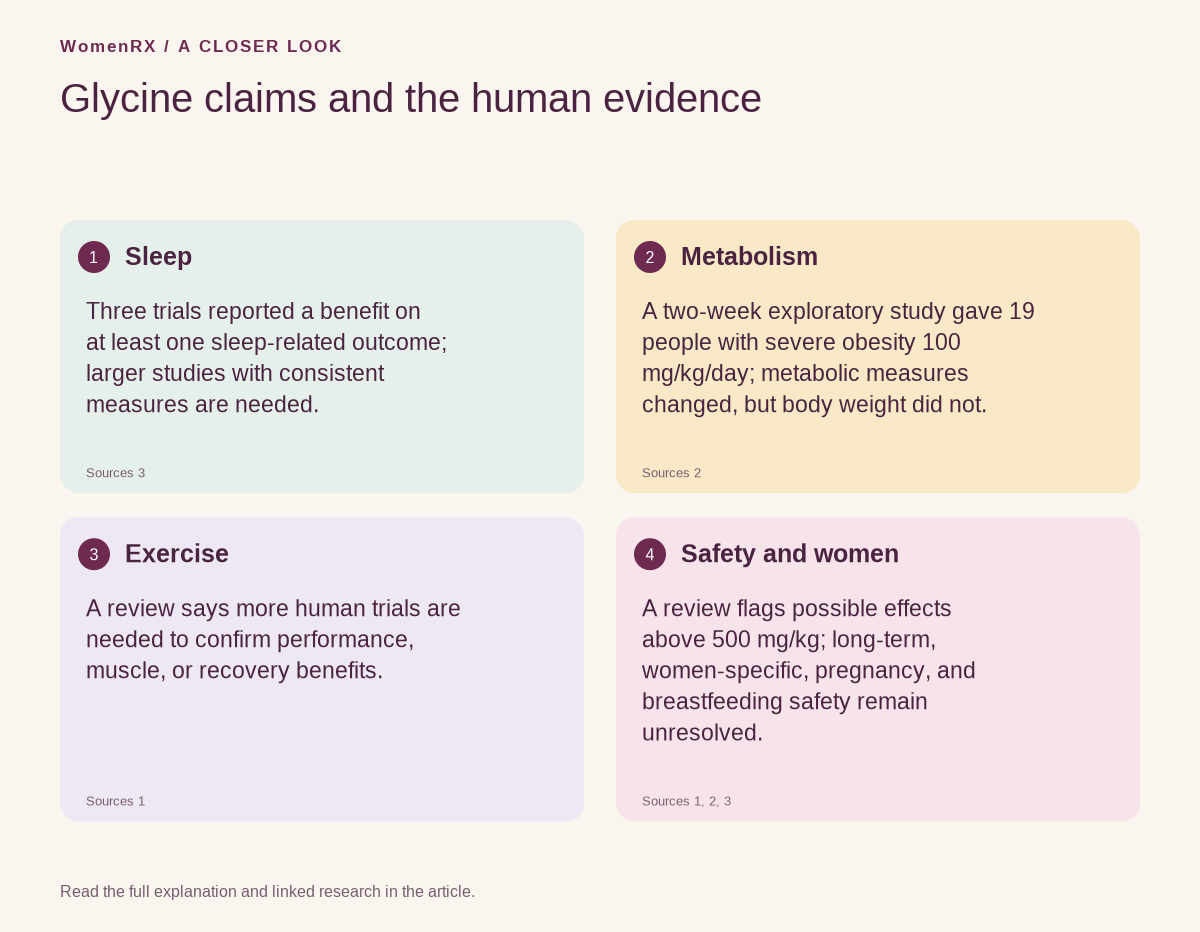
Glycine claims and the human evidence
Sleep: Three trials reported a benefit on at least one sleep-related outcome; larger studies with consistent measures are needed.3
Metabolism: A two-week exploratory study gave 19 people with severe obesity 100 mg/kg/day; metabolic measures changed, but body weight did not.2
Exercise: A review says more human trials are needed to confirm performance, muscle, or recovery benefits.1
Safety and women: A review flags possible effects above 500 mg/kg; long-term, women-specific, pregnancy, and breastfeeding safety remain unresolved.123
Read the figure as text
A quick map of what human research has examined and what remains unsettled.- Sleep: Three trials reported a benefit on at least one sleep-related outcome; larger studies with consistent measures are needed.3
- Metabolism: A two-week exploratory study gave 19 people with severe obesity 100 mg/kg/day; metabolic measures changed, but body weight did not.2
- Exercise: A review says more human trials are needed to confirm performance, muscle, or recovery benefits.1
- Safety and women: A review flags possible effects above 500 mg/kg; long-term, women-specific, pregnancy, and breastfeeding safety remain unresolved.123
More questions, answered
Do I need a glycine supplement because glycine is an amino acid?
No. Glycine is present in protein foods, and the body can make it. Its essential roles in the body don’t by themselves mean that extra glycine is necessary or beneficial. 1 2
Does the research establish an amount to take for sleep?
No. A review found three glycine sleep trials with a benefit on at least one sleep-related outcome, but these early findings don’t establish an effective amount or a standard approach. 3
Sources you can check
- An Update of the Promise of Glycine Supplementation for Enhancing Physical Performance and Recovery.Ramos-Jiménez A, Hernández-Torres RP, Hernández-Ontiveros DA, Ortiz-Ortiz M, López-Fregoso RJ, Martínez-Sanz JM, Rodríguez-Uribe G, Hernández-Lepe MA. · Sports (Basel, Switzerland) · 2024Return to first citation
- Metabolic impact of dietary glycine supplementation in individuals with severe obesity.Tan HC, Hsu JW, Tai ES, Chacko S, Wu V, Yen PM, Kovalik JP, Jahoor F. · Scientific reports · 2025Return to first citation
- Glycine Bioavailability and Sleep-Related Outcomes Following Oral Glycine and Collagen Supplementation-A Scoping Review.Fan Z, Nelson JM, Wallace TC. · Journal of dietary supplements · 2026Return to first citation