Does Glycine Help You Sleep? What Human Studies Show
A few human trials have found sleep-related benefits, but they don’t yet show how reliably glycine helps or who is most likely to benefit.
Possibly, but the evidence is early. A 2026 review identified three trials of glycine supplements for sleep, each reporting improvement in at least one outcome. That doesn’t mean glycine consistently improves sleep, and collagen or multi-ingredient studies can’t settle the question. The research also leaves open whether results differ for women or apply during pregnancy or menopause. 512

What changed in the glycine studies?
A 2026 scoping review identified three trials that tested supplemental glycine and measured sleep-related outcomes. All three reported a benefit on at least one measure. That’s a reason to keep studying glycine, not a finding that everyone slept better or that the same measure improved in every trial. 5
One human study is described in the background of a later collagen trial: people with sleep complaints took 3 grams of glycine one hour before bed. The reported findings included a shorter time to fall asleep measured by a sleep study, better self-rated sleep quality, and less daytime sleepiness. A 2012 review also describes improved self-rated sleep quality in people with insomnia-like tendencies. These accounts don’t provide enough detail about the original participants and study duration to judge how widely those results apply. The 3-gram amount tells you what researchers tested, not what you should take. 14
The measures matter if you’re deciding whether a supplement is worth considering. Falling asleep sooner, waking less often, and feeling better rested are different outcomes. A change in a sleep rating can be meaningful to the person reporting it, but it doesn’t automatically mean they slept longer. So far, the small glycine trial base doesn’t establish a reliable benefit across those different outcomes. 15
Why collagen and sleep blends don’t answer the same question
Collagen peptides contain glycine, but they contain other components too. In a crossover study, 13 physically active men with sleep complaints received collagen peptides or placebo for seven nights each. Researchers recorded fewer awakenings with collagen, both on a sleep study and in sleep diaries. They found no difference in sleep quantity, time to fall asleep, sleep efficiency, or self-rated sleep quality. The result is about collagen peptides in this small group of men; it can’t show that glycine alone prevented awakenings. 1
Another crossover study included nine men and seven women. It compared placebo with a blend containing glycine, tryptophan, magnesium, tart cherry powder, and L-theanine over three days. Sleep onset, duration, and efficiency improved with the blend, but there’s no way to assign those changes to glycine. The reported results also weren’t separated by sex. 2
That distinction is especially useful when you see a product claim built around glycine. Ask whether the study tested glycine alone, a glycine-rich food or supplement such as collagen, or several ingredients together. A promising result for one isn’t proof for the others. 125
What about body temperature?
There’s a plausible explanation for why glycine might affect sleep. In rat experiments, glycine increased blood flow at the skin, promoted heat loss, and affected sleep through a brain pathway involved in temperature regulation. That helps researchers form a hypothesis. It doesn’t establish that the same process explains the reported sleep benefits in people, or that taking glycine will improve your sleep. 35
What’s still unknown for women and for safety?
The description of the glycine-alone study doesn’t give a participant sex breakdown or results for women. The collagen study enrolled men only. Women were included in the blend study, but its reported results weren’t separated by sex and can’t isolate glycine’s effect. These findings therefore don’t answer whether glycine works differently across the menstrual cycle, during perimenopause, or after menopause. They also don’t establish safety in pregnancy or while breastfeeding. 125
If you’re thinking about trying glycine, the useful safety conversation is specific to you: What else am I taking, and is there anything about my health, pregnancy, or breastfeeding status that changes this decision? The sleep studies described here don’t establish long-term safety or identify particular medicine interactions. That isn’t a signal that an interaction exists, but it isn’t a reason to assume there can’t be one. 15
For now, glycine is a possible sleep aid with limited human evidence, not a proven fix for persistent sleep trouble. If poor sleep is regularly affecting your days, it’s worth figuring out what’s keeping you awake rather than relying on a supplement result that may not address your particular problem. 15
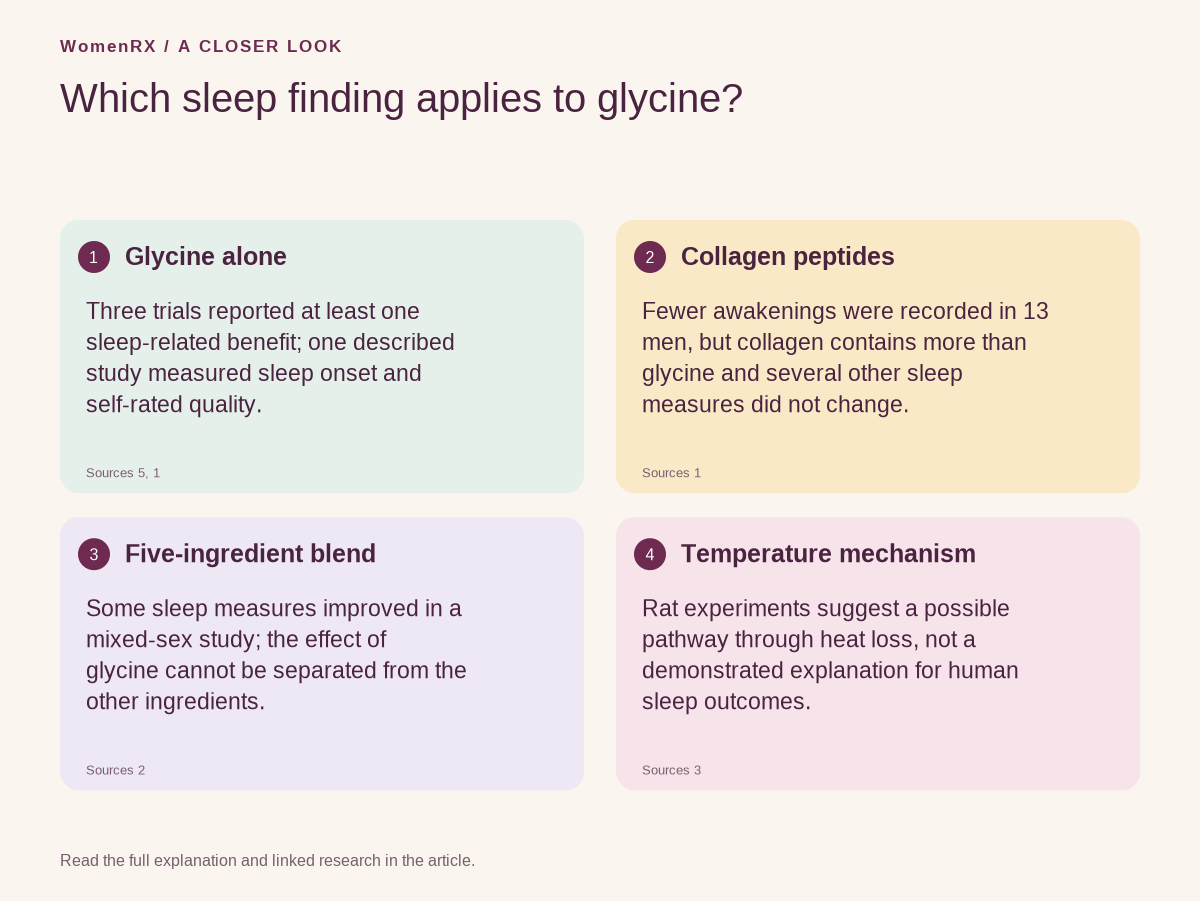
Which sleep finding applies to glycine?
Glycine alone: Three trials reported at least one sleep-related benefit; one described study measured sleep onset and self-rated quality.51
Collagen peptides: Fewer awakenings were recorded in 13 men, but collagen contains more than glycine and several other sleep measures did not change.1
Five-ingredient blend: Some sleep measures improved in a mixed-sex study; the effect of glycine cannot be separated from the other ingredients.2
Temperature mechanism: Rat experiments suggest a possible pathway through heat loss, not a demonstrated explanation for human sleep outcomes.3
Read the figure as text
The intervention and the outcome both matter when interpreting a promising result.- Glycine alone: Three trials reported at least one sleep-related benefit; one described study measured sleep onset and self-rated quality.51
- Collagen peptides: Fewer awakenings were recorded in 13 men, but collagen contains more than glycine and several other sleep measures did not change.1
- Five-ingredient blend: Some sleep measures improved in a mixed-sex study; the effect of glycine cannot be separated from the other ingredients.2
- Temperature mechanism: Rat experiments suggest a possible pathway through heat loss, not a demonstrated explanation for human sleep outcomes.3
Sources you can check
- Collagen peptide supplementation before bedtime reduces sleep fragmentation and improves cognitive function in physically active males with sleep complaints.Thomas C, Kingshott RN, Allott KM, Tang JCY, Dunn R, Fraser WD, Thorley J, Virgilio N, Prawitt J, Hogervorst E, Škarabot J, Clifford T. · European journal of nutrition · 2024Return to first citation
- Nutritional Modulation of Sleep Latency, Duration, and Efficiency: A Randomized, Repeated-Measures, Double-Blind Deception Study.Langan-Evans C, Hearris MA, Gallagher C, Long S, Thomas C, Moss AD, Cheung W, Howatson G, Morton JP. · Medicine and science in sports and exercise · 2023Return to first citation
- The sleep-promoting and hypothermic effects of glycine are mediated by NMDA receptors in the suprachiasmatic nucleus.Kawai N, Sakai N, Okuro M, Karakawa S, Tsuneyoshi Y, Kawasaki N, Takeda T, Bannai M, Nishino S. · Neuropsychopharmacology : official publication of the American College of Neuropsychopharmacology · 2015Return to first citation
- New therapeutic strategy for amino acid medicine: glycine improves the quality of sleep.Bannai M, Kawai N. · Journal of pharmacological sciences · 2012Return to first citation
- Glycine Bioavailability and Sleep-Related Outcomes Following Oral Glycine and Collagen Supplementation-A Scoping Review.Fan Z, Nelson JM, Wallace TC. · Journal of dietary supplements · 2026Return to first citation