Glycine for Sleep: Promising Signals, Limited Proof
A few human studies suggest glycine may affect some sleep measures, but they don’t establish it as a reliable treatment for insomnia.
Glycine has a plausible but preliminary case for occasional sleep trouble: human studies have reported changes in sleep onset, perceived sleep quality, or daytime sleepiness. But a review found only three trials of glycine for sleep, and the available evidence doesn’t establish a dependable benefit, sustained-use safety, or whether results apply during pregnancy, postpartum, or menopause. 23
What the human studies actually suggest
There’s a reason glycine gets discussed as a sleep supplement: it’s involved in processes that may influence sleep, and human research has reported some favorable signals. In one human study described in a later research paper, people with sleep complaints took glycine before bed; the paper reports shorter time to fall asleep measured by polysomnography, less daytime sleepiness, and improvements in perceived sleep quality and memory-task performance. 2
The later paper says the study tested 3 g of glycine taken 1 hour before bed. That’s the amount and timing used in a study, not a recommended dose. Neither the scoping review’s abstract nor the later paper’s account gives the sample size for this particular glycine trial, which makes it harder to judge how much weight to give its results. 23
That’s encouraging, but it doesn’t settle the question. A 2026 scoping review identified three trials examining supplemental glycine and sleep-related outcomes. All three reported a benefit on at least one measure, but that count doesn’t tell us how large or meaningful the benefits were, whether they lasted, or whether glycine reliably helps the same outcomes across different people. 3
The useful distinction is between a signal worth studying and a treatment that’s been shown to work consistently. Glycine fits the first description better than the second.
A better night can mean different things
Sleep studies measure several different outcomes, and they aren’t interchangeable. Taking less time to fall asleep is different from sleeping longer, waking less often, or feeling more rested the next day. The glycine findings described in the research include sleep-onset time, subjective sleep quality, daytime sleepiness, and a memory task. That’s a varied set of outcomes, not proof that glycine improves every part of sleep. 2
One small trial of a blend containing glycine, tryptophan, magnesium, tart cherry powder, and L-theanine found changes in sleep-onset time, total sleep time, and sleep efficiency. But because the ingredients were combined, that result can’t show whether glycine itself helped. The trial included 16 adults and lasted three days for each intervention period, so it also can’t answer whether effects continue with longer use. 1
Collagen is another source of confusion. It contains glycine, but a collagen supplement isn’t the same intervention as glycine by itself. In a seven-night crossover trial of 13 physically active men with sleep complaints, collagen peptides were associated with fewer recorded awakenings, but not differences in sleep quantity, time to fall asleep, sleep efficiency, or overall sleep quality. That finding in men doesn’t establish that glycine supplements produce the same effect, or that collagen improves sleep for women. 2
Does the evidence apply to women?
The available glycine sleep findings don’t establish whether effects differ between women and men. They also don’t answer whether glycine is helpful or safe during pregnancy, postpartum, or menopause. A mixed-sex study of a multi-ingredient blend included women and men, but it can’t isolate glycine’s effect or provide a clear women-specific result. 13
That means a result from a general adult study shouldn’t be treated as evidence for a menopause-specific sleep benefit, or as a reason to use glycine during pregnancy or while breastfeeding.
So, is it reasonable to try?
For occasional poor sleep, the research makes glycine a candidate people may want to learn about, not an established insomnia treatment. The studies are too limited to promise that it will help, and they don’t establish a dose that can be recommended here, long-term safety, or safety in pregnancy and lactation. 23
If you’re weighing a supplement, keep the question specific: are you hoping to fall asleep faster, wake less, or feel better the next morning? The human findings don’t answer all three equally, and evidence for a glycine-containing blend or collagen product shouldn’t be read as proof for glycine alone. Persistent sleep difficulty also deserves attention as a problem in its own right, rather than being reduced to choosing a supplement.
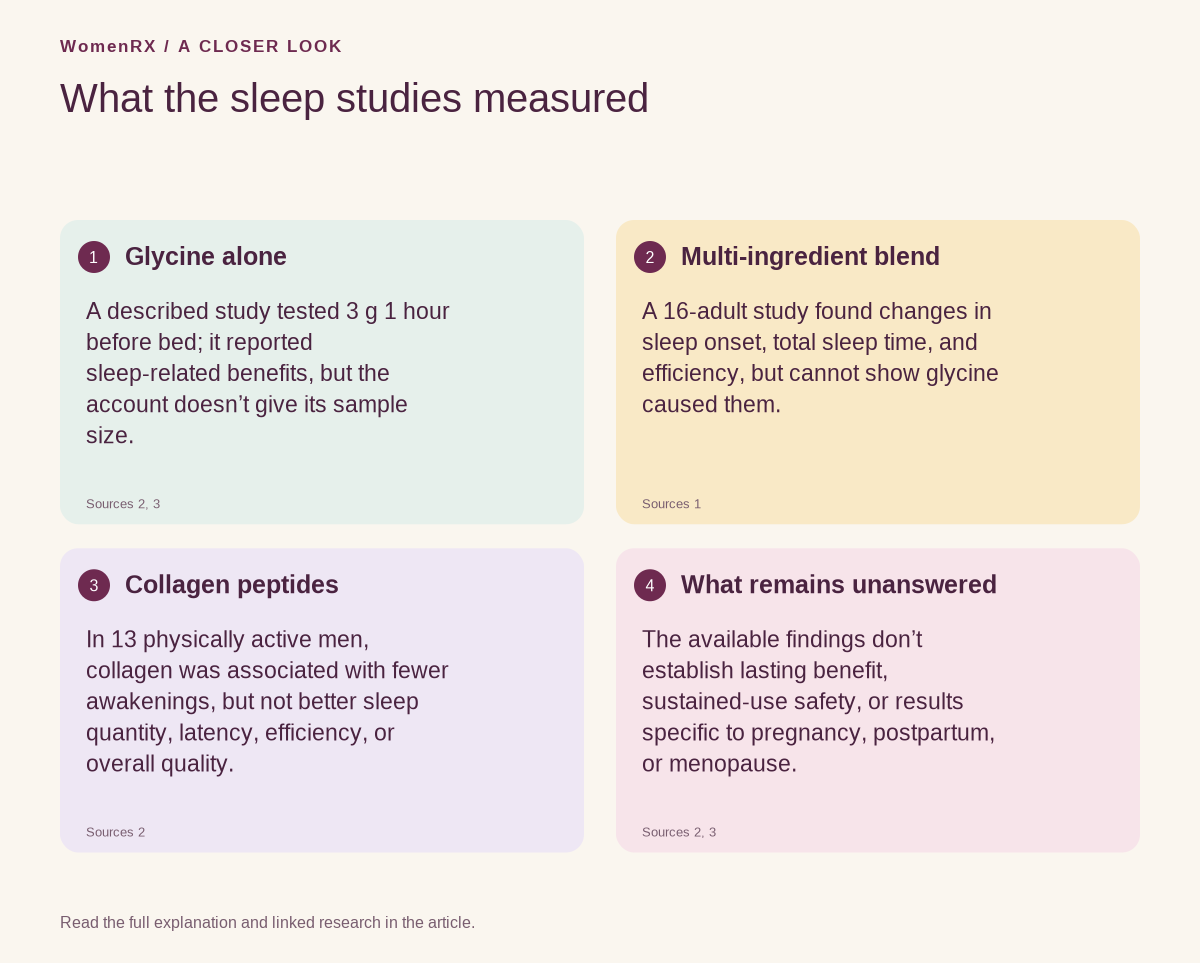
What the sleep studies measured
Glycine alone: A described study tested 3 g 1 hour before bed; it reported sleep-related benefits, but the account doesn’t give its sample size.23
Multi-ingredient blend: A 16-adult study found changes in sleep onset, total sleep time, and efficiency, but cannot show glycine caused them.1
Collagen peptides: In 13 physically active men, collagen was associated with fewer awakenings, but not better sleep quantity, latency, efficiency, or overall quality.2
What remains unanswered: The available findings don’t establish lasting benefit, sustained-use safety, or results specific to pregnancy, postpartum, or menopause.23
Read the figure as text
The findings vary by ingredient and outcome. This comparison separates glycine-alone signals from results that cannot be attributed to glycine.- Glycine alone: A described study tested 3 g 1 hour before bed; it reported sleep-related benefits, but the account doesn’t give its sample size.23
- Multi-ingredient blend: A 16-adult study found changes in sleep onset, total sleep time, and efficiency, but cannot show glycine caused them.1
- Collagen peptides: In 13 physically active men, collagen was associated with fewer awakenings, but not better sleep quantity, latency, efficiency, or overall quality.2
- What remains unanswered: The available findings don’t establish lasting benefit, sustained-use safety, or results specific to pregnancy, postpartum, or menopause.23
More questions, answered
Does collagen have the same evidence as glycine?
No. Collagen contains glycine, but it also contains other components, and a collagen-peptide trial can’t establish what glycine alone does. In one small trial of physically active men, collagen peptides were associated with fewer awakenings, but not better sleep quantity, sleep-onset time, efficiency, or overall sleep quality. 2
Do the studies establish that glycine is safe during pregnancy or breastfeeding?
No. The available sleep evidence doesn’t establish safety during pregnancy or breastfeeding, or provide a basis for a safety recommendation in those situations. 23
Sources you can check
- Nutritional Modulation of Sleep Latency, Duration, and Efficiency: A Randomized, Repeated-Measures, Double-Blind Deception Study.Langan-Evans C, Hearris MA, Gallagher C, Long S, Thomas C, Moss AD, Cheung W, Howatson G, Morton JP. · Medicine and science in sports and exercise · 2023Return to first citation
- Collagen peptide supplementation before bedtime reduces sleep fragmentation and improves cognitive function in physically active males with sleep complaints.Thomas C, Kingshott RN, Allott KM, Tang JCY, Dunn R, Fraser WD, Thorley J, Virgilio N, Prawitt J, Hogervorst E, Škarabot J, Clifford T. · European journal of nutrition · 2024Return to first citation
- Glycine Bioavailability and Sleep-Related Outcomes Following Oral Glycine and Collagen Supplementation-A Scoping Review.Fan Z, Nelson JM, Wallace TC. · Journal of dietary supplements · 2026Return to first citation