Glycine for Sleep: Morning or Before Bed?
A paper describes glycine being taken near bedtime for sleep, but research hasn’t established whether bedtime is better than morning.
A paper on collagen peptides describes an earlier study in which people with sleep complaints took glycine about an hour before bed. That’s a secondary description of the study schedule, not evidence that bedtime works better than morning. Reviews of glycine sleep research don’t establish which time is best, or a menopause-specific timing recommendation. 1 2 3
What the timing evidence actually shows
If you’re considering glycine for sleep, the schedule described in one paper is near bedtime, not a proven requirement. A paper on collagen peptides summarizes an earlier study in which people with sleep complaints took glycine one hour before bedtime. That paper’s description reports improvements in some sleep-related outcomes, but doesn’t tell us whether morning glycine would have worked differently. 2
A systematic review of glycine use in adults reports that longer-term administration improved sleep in healthy populations, while emphasizing that the studies were small and had a high risk of bias. A later scoping review identified three trials of supplemental glycine and sleep outcomes; its summary reports benefits on at least one sleep-related measure in each. Neither review summary establishes whether morning or bedtime use is better. 1 3
So “take it before bed” describes the timing in one secondary account of a glycine sleep study. Studies haven’t established bedtime as superior to morning.
Don’t confuse glycine with collagen peptides
Timing claims can get muddled because collagen contains glycine. In a small crossover trial, 13 physically active men with sleep complaints took collagen peptides one hour before bed or a placebo for seven nights. The researchers recorded fewer awakenings with collagen peptides on some measures, but found no differences in sleep quantity, sleep latency, or sleep efficiency. This was a collagen-peptide study in men, not a test of glycine alone, and it can’t show that glycine taken at bedtime improves sleep in women. 2
That distinction matters: a supplement containing glycine isn’t automatically equivalent to a glycine supplement. The scoping review treats collagen trials and glycine trials as separate parts of the clinical literature, and reports that whether glycine explains any sleep effects from collagen hasn’t been directly tested. 3
What this means if you’re choosing a time
If bedtime fits your routine, it matches the schedule described for one glycine sleep study. But current research doesn’t establish that you need to take glycine at a particular hour, or that moving it from morning to evening would change its effect. It also doesn’t establish one hour before bed as an ideal interval for everyone. 1 2 3
If you’re considering morning use for a different goal, these sleep findings don’t answer that question. They concern sleep outcomes rather than a comparison of morning and nighttime use across different goals. The useful takeaway is narrow: a bedtime schedule is described, but the best time hasn’t been established.
What’s known for women and menopause
Sleep research doesn’t give a clear timing recommendation for women by life stage. The systematic review considered participant age and sex, but its reported summary doesn’t provide a women-specific or menopause-specific result. The bedtime collagen-peptide trial included men only. That leaves no basis in these findings for claiming that women need a different schedule during cycling years, perimenopause, or after menopause. 1 2
Overall, bedtime is a schedule described in the sleep literature, not an established best time. The small, higher-risk-of-bias evidence base also means that reported sleep benefits should be read as preliminary rather than proof that a particular timing reliably helps. 1
Bedtime schedules: glycine and collagen
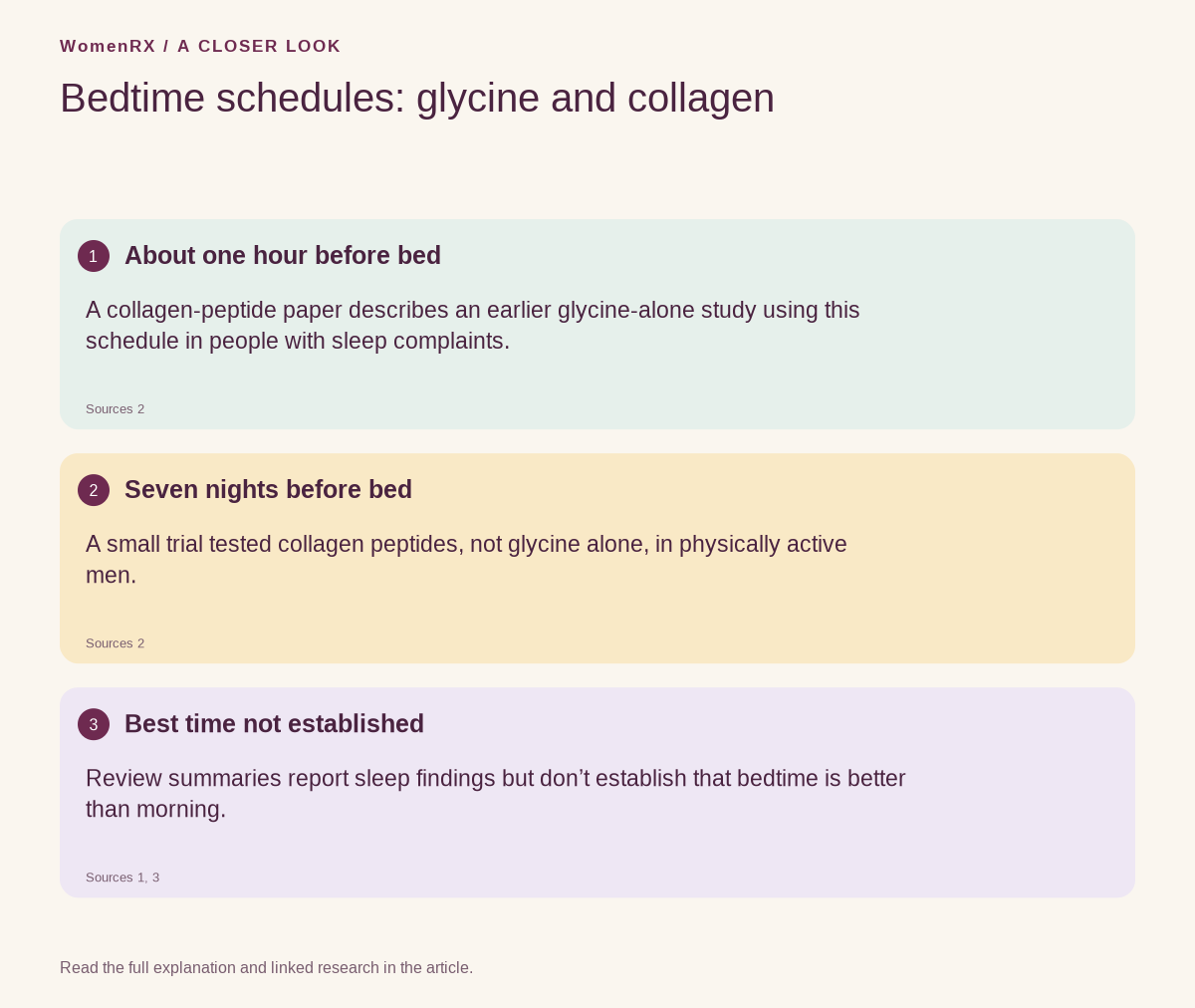
About one hour before bed: A collagen-peptide paper describes an earlier glycine-alone study using this schedule in people with sleep complaints.2
Seven nights before bed: A small trial tested collagen peptides, not glycine alone, in physically active men.2
Best time not established: Review summaries report sleep findings but don’t establish that bedtime is better than morning.13
Read the figure as text
These are schedules described in sleep research, not evidence that bedtime works better than morning.- About one hour before bed: A collagen-peptide paper describes an earlier glycine-alone study using this schedule in people with sleep complaints.2
- Seven nights before bed: A small trial tested collagen peptides, not glycine alone, in physically active men.2
- Best time not established: Review summaries report sleep findings but don’t establish that bedtime is better than morning.13
More questions, answered
Do the reviewed findings establish that bedtime glycine works better than morning glycine?
No. The review summaries report sleep findings but don’t establish a morning-versus-bedtime advantage. A paper describes an earlier glycine study using a bedtime schedule, but that schedule alone can’t show it is better. 1 2 3
Does collagen before bed show that glycine helps women’s sleep?
No. The cited collagen-peptide trial involved 13 physically active men, tested collagen peptides rather than glycine alone, and doesn’t establish an effect in women. 2
Sources you can check
- The effect of glycine administration on the characteristics of physiological systems in human adults: A systematic review.Soh J, Raventhiran S, Lee JH, Lim ZX, Goh J, Kennedy BK, Maier AB. · GeroScience · 2024Return to first citation
- Collagen peptide supplementation before bedtime reduces sleep fragmentation and improves cognitive function in physically active males with sleep complaints.Thomas C, Kingshott RN, Allott KM, Tang JCY, Dunn R, Fraser WD, Thorley J, Virgilio N, Prawitt J, Hogervorst E, Škarabot J, Clifford T. · European journal of nutrition · 2024Return to first citation
- Glycine Bioavailability and Sleep-Related Outcomes Following Oral Glycine and Collagen Supplementation-A Scoping Review.Fan Z, Nelson JM, Wallace TC. · Journal of dietary supplements · 2026Return to first citation