Does Glycine Help With Sleep? What the Evidence Shows
Glycine has shown a possible benefit for falling asleep and feeling rested, but the reported findings aren’t enough to call it an insomnia treatment.
Glycine may help some people fall asleep sooner or feel that they slept better. Human research summaries report those outcomes, along with less daytime sleepiness, but don’t give enough trial detail to judge how dependable the effects are. They also don’t establish a benefit for staying asleep or treating persistent insomnia. 1 2
What changed in the glycine research?
If you lie awake waiting for sleep, the most relevant finding is about sleep-onset latency, the time between trying to sleep and actually falling asleep. A 2024 research article describes an earlier study in people with sleep complaints: after taking oral glycine before bed, participants fell asleep sooner on a sleep recording and reported better sleep quality. The article also reports less daytime sleepiness and better performance on a memory task. These are findings from the earlier glycine study cited in the article’s background, not from the article’s own experiment. 1
A separate 2024 review describes human glycine research reporting better perceived sleep quality and less daytime sleepiness, including findings about fatigue after short-term sleep restriction. It refers to healthy men and people who had difficulty sleeping. 2
Those measures answer different questions. A sleep recording can estimate how long it took someone to fall asleep. A sleep-quality rating tells you how that person experienced the night. Feeling more alert the next day matters too, but it doesn’t tell you whether glycine prevented middle-of-the-night awakenings or increased total sleep time.
Why the findings aren’t a treatment recommendation
The reports of the glycine findings don’t give the underlying studies’ participant counts, lengths, or size of the sleep changes. That limits how confidently we can judge whether the results would hold up in a larger group, over repeated weeks, or in someone with ongoing insomnia. It doesn’t mean the original studies lacked those details; it means these reports alone can’t settle those questions. 1 2
There’s also a difference between having a sleep complaint and showing that a supplement treats an insomnia disorder. The reported glycine outcomes offer an early signal, particularly for falling asleep and perceived sleep quality. They don’t establish that glycine reliably helps people stay asleep or resolves persistent sleep difficulty with daytime effects. For ongoing insomnia, cognitive behavioral therapy for insomnia is described as a first-line treatment in the sleep research article. 1 2
What if your main problem is waking up?
Be careful not to substitute results from a different product. A small seven-night trial found fewer awakenings on some measures in 13 physically active men taking collagen peptides, compared with placebo. It found no difference in sleep quantity, sleep-onset latency, sleep efficiency, or subjective sleep quality. Collagen contains glycine alongside other components, so this trial cannot tell us whether glycine alone helps with awakenings. 1
If falling asleep is your chief concern, the glycine findings address that question, though the strength of the evidence remains uncertain. If you fall asleep easily but wake repeatedly, these findings give you much less reason to expect glycine to solve it. And if poor sleep is affecting your days week after week, it’s worth addressing the ongoing sleep problem rather than relying on a supplement with an unproven treatment effect. 1 2
Does the evidence say anything specific about women?
The glycine review mentions healthy men and people with difficulty sleeping, but doesn’t report results separately for women or by age or menopause status. We can’t tell from those findings whether women respond differently, or whether glycine helps with sleep changes around perimenopause or after menopause. The collagen trial included only men and cannot fill that gap. 1 2
Which Sleep Questions Can Glycine Research Answer?
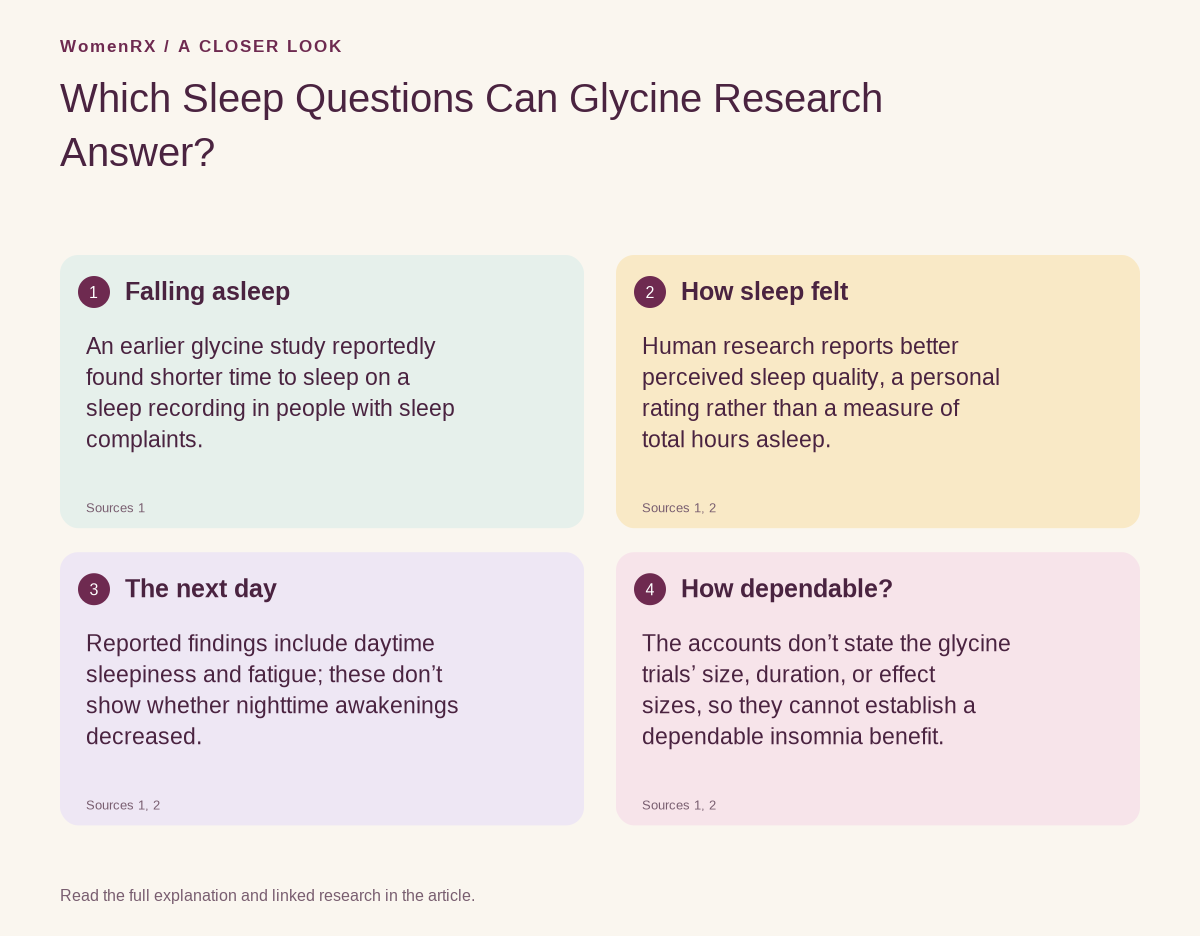
Falling asleep: An earlier glycine study reportedly found shorter time to sleep on a sleep recording in people with sleep complaints.1
How sleep felt: Human research reports better perceived sleep quality, a personal rating rather than a measure of total hours asleep.12
The next day: Reported findings include daytime sleepiness and fatigue; these don’t show whether nighttime awakenings decreased.12
How dependable?: The accounts don’t state the glycine trials’ size, duration, or effect sizes, so they cannot establish a dependable insomnia benefit.12
Read the figure as text
The reported outcomes offer different clues about sleep. None alone shows that glycine treats ongoing insomnia.- Falling asleep: An earlier glycine study reportedly found shorter time to sleep on a sleep recording in people with sleep complaints.1
- How sleep felt: Human research reports better perceived sleep quality, a personal rating rather than a measure of total hours asleep.12
- The next day: Reported findings include daytime sleepiness and fatigue; these don’t show whether nighttime awakenings decreased.12
- How dependable?: The accounts don’t state the glycine trials’ size, duration, or effect sizes, so they cannot establish a dependable insomnia benefit.12
Sources you can check
- Collagen peptide supplementation before bedtime reduces sleep fragmentation and improves cognitive function in physically active males with sleep complaints.Thomas C, Kingshott RN, Allott KM, Tang JCY, Dunn R, Fraser WD, Thorley J, Virgilio N, Prawitt J, Hogervorst E, Škarabot J, Clifford T. · European journal of nutrition · 2024Return to first citation
- An Update of the Promise of Glycine Supplementation for Enhancing Physical Performance and Recovery.Ramos-Jiménez A, Hernández-Torres RP, Hernández-Ontiveros DA, Ortiz-Ortiz M, López-Fregoso RJ, Martínez-Sanz JM, Rodríguez-Uribe G, Hernández-Lepe MA. · Sports (Basel, Switzerland) · 2024Return to first citation