Glycine for Sleep: What Human Studies Actually Show
A few human trials have reported sleep benefits, but the evidence is too small and limited to tell you how reliably glycine works or how quickly you might notice a change.
Human studies of glycine for sleep are few. A systematic review found possible improvements in healthy adults, but the studies were small and at high risk of bias; a later scoping review identified only three glycine sleep trials, each with a benefit on at least one sleep outcome. That doesn’t establish a dependable time-to-effect, long-term benefit, or a women-specific effect. 1 3
What the human studies measured
Glycine has been tested in people for sleep, but the research base is still narrow. A systematic review of glycine supplementation in adults found that longer-term studies in healthy populations reported improved sleep. The reviewers cautioned that those studies had small samples and a high risk of bias, which makes the results less dependable. 1
A later scoping review counted three trials of supplemental glycine with sleep-related outcomes. All three reported a benefit on at least one such outcome. That wording matters: it does not mean every measure improved, or that everyone who took glycine slept better. The review called for larger trials using standardized sleep measures. 3
An earlier review describes a human finding in people with insomniac tendencies: taking glycine before bed was reported to improve subjective sleep quality. But that review’s summary doesn’t provide enough detail to say how large or lasting the change was, or how soon a person would notice it. 2
Separate a measured result from a proposed explanation
Sleep quality reported by participants is not the same measure as sleep recorded by a device or in a sleep laboratory. When you read a study or product claim, check which outcome was measured, whether the comparison was against a placebo or another treatment, and how long participants were followed. An improvement in one sleep measure doesn’t automatically mean better daytime energy, recovery, or overall health.
There are biological explanations researchers have proposed for how glycine might relate to sleep, including effects involving body temperature and signaling in the nervous system. Those explanations make glycine a plausible research question; they don’t prove that a supplement improves sleep in a person. The temperature-related findings described in the review include animal research, so they shouldn’t be treated as demonstrated human effects. 2 3
A practical way to weigh the claims
Before treating a label or a study headline as an answer, ask:
- Was glycine tested by itself? Results from a mixture of amino acids or a glycine-containing product can’t show that glycine alone caused the change.
- Who took part? Findings in adults generally don’t automatically answer questions about pregnancy, postpartum sleep, or sleep disruption around menopause.
- What changed? Look for the actual sleep outcome, not a broad claim about “better sleep” or “recovery.”
- Was there a fair comparison? A change from before to after taking something is harder to interpret than a difference compared with a control group.
- How strong and lasting was the result? Small studies and short follow-up can suggest a possibility, but don’t establish a reliable effect or what happens with longer use.
The reviews describe adult research, but the findings don’t establish whether glycine works differently by sex or life stage. They also don’t establish a benefit during pregnancy or for menopause-related sleep disruption. Those questions need evidence specific to those situations. 1 3
If you’re considering a personal trial
Keep your existing sleep care steady rather than replacing it with a supplement. If you and your care team decide a trial makes sense, choose a simple way to track the question you actually have: for example, note sleep quality, time awake during the night, and how rested you feel the next morning. Record these consistently before and during the trial, and avoid changing several things at once. This can help you judge your own experience, but it won’t turn a personal result into proof that glycine caused the change.
There isn’t enough evidence here to give a reliable number of nights or days until glycine might help. The studies and reviews support continued research, not a promise of quick or lasting results. 1 2 3
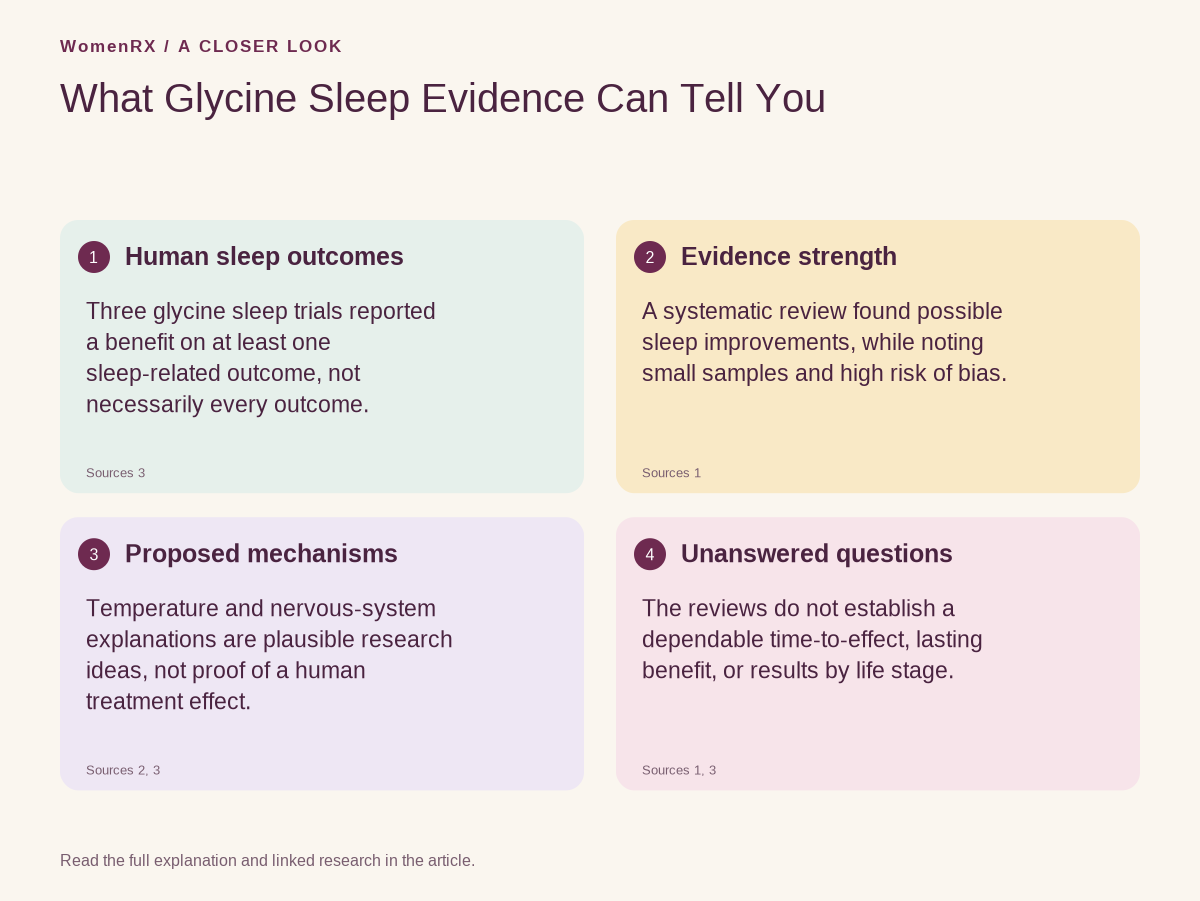
What Glycine Sleep Evidence Can Tell You
Human sleep outcomes: Three glycine sleep trials reported a benefit on at least one sleep-related outcome, not necessarily every outcome.3
Evidence strength: A systematic review found possible sleep improvements, while noting small samples and high risk of bias.1
Proposed mechanisms: Temperature and nervous-system explanations are plausible research ideas, not proof of a human treatment effect.23
Unanswered questions: The reviews do not establish a dependable time-to-effect, lasting benefit, or results by life stage.13
Read the figure as text
Separate sleep outcomes tested in people from plausible explanations and claims the trials do not establish.- Human sleep outcomes: Three glycine sleep trials reported a benefit on at least one sleep-related outcome, not necessarily every outcome.3
- Evidence strength: A systematic review found possible sleep improvements, while noting small samples and high risk of bias.1
- Proposed mechanisms: Temperature and nervous-system explanations are plausible research ideas, not proof of a human treatment effect.23
- Unanswered questions: The reviews do not establish a dependable time-to-effect, lasting benefit, or results by life stage.13
More questions, answered
Does glycine work the first night?
A review describes a human report of better subjective sleep quality after glycine was taken before bed, but it doesn’t establish a reliable first-night effect or how quickly any benefit begins. 2
Do these results apply to menopause-related sleep problems?
The reviews discuss adult populations but don’t establish a glycine benefit specifically for menopause-related sleep disruption or whether results differ by life stage. 1 3
Sources you can check
- The effect of glycine administration on the characteristics of physiological systems in human adults: A systematic review.Soh J, Raventhiran S, Lee JH, Lim ZX, Goh J, Kennedy BK, Maier AB. · GeroScience · 2024Return to first citation
- New therapeutic strategy for amino acid medicine: glycine improves the quality of sleep.Bannai M, Kawai N. · Journal of pharmacological sciences · 2012Return to first citation
- Glycine Bioavailability and Sleep-Related Outcomes Following Oral Glycine and Collagen Supplementation-A Scoping Review.Fan Z, Nelson JM, Wallace TC. · Journal of dietary supplements · 2026Return to first citation