Glycine Supplements: What the Safety Studies Actually Show
An acute study reported digestive symptoms but no serious events, while longer-term safety and pregnancy questions remain unanswered.
Glycine’s presence in the diet doesn’t establish the safety of a concentrated supplement. In an acute study of a 9 g bedtime amount, investigators reported digestive symptoms but no serious acute events or next-day sleepiness; the abstract doesn’t give the sample size or participants’ sexes.6 Small sleep studies offer some evidence of benefit, but they don’t settle safety for women or with regular use.54
Food and supplements answer different questions
Glycine is an amino acid your body can make, and it’s also part of the diet. Neither fact tells you how you’ll respond to taking an isolated amount at bedtime, or what happens if you keep taking it. That distinction matters when a supplement is marketed as an easy way to sleep better.34
What the sleep research tells you
A small randomized crossover study tested glycine against a flavored placebo while participants spent three nights with less time in bed than usual. The analysis included seven healthy men who did not have sleep disorders. Glycine was associated with less reported fatigue on the first day, though not the third, and faster responses on a vigilance test on both days. The study did not find a statistically significant difference in its visual-rating measure of sleepiness.5
Those findings are interesting if you’re wondering whether glycine might help after a few short nights. They’re not a test of treatment for ongoing insomnia, and an analysis of seven men cannot tell you whether the effects or tolerability are the same for women. A review also describes human sleep studies in people dissatisfied with their sleep, but concludes that more well-designed human trials are needed.45
The clearest side-effect finding is short-term
In an acute study of a 9 g bedtime amount, investigators observed digestive symptoms that they considered possible adverse effects, though not serious ones. They reported no serious acute adverse events and no carryover of daytime sleepiness. The abstract does not give a sample size, sex breakdown, or longer-term follow-up, so it cannot tell you how often digestive symptoms occur in adults taking glycine for sleep. The amount studied is an observation, not a recommended amount.6
Another trial monitored adverse reactions while 90 children received glycine for 28 days; it reported one nonserious reaction in that group. That adds a narrow piece of tolerability information, but children in a comparison trial are not a stand-in for adult women choosing a sleep supplement.3
The useful takeaway is neither “glycine has no side effects” nor “glycine is unsafe.” Digestive symptoms have been reported, while the studies described here are too limited to characterize side-effect rates or the safety of regular, longer-term use.634
When your situation changes the decision
If you’re pregnant or breastfeeding, the sleep and acute-safety findings above don’t establish whether supplemental glycine is safe for you or your baby. The seven people analyzed in the sleep-restriction study were men, and the acute study’s abstract doesn’t report participants’ sexes or pregnancy and breastfeeding outcomes.56 That is a reason to get advice specific to your situation before using a concentrated supplement, not a claim that glycine in food is a problem.
If you take medication or manage a health condition, these studies also cannot establish whether a particular product is suitable alongside your treatment. They do not verify a specific glycine-medicine interaction, so a list of supposed interactions would be guesswork. A pharmacist or your treating clinician can assess the actual product and medicines you use.
And if your main concern is sleep, consider what kind of problem you’re trying to solve. A few short nights are different from difficulty sleeping that persists for months or makes daily life hard to manage. Ongoing insomnia can be linked to medicines, another health condition, or a different sleep disorder; addressing the cause and using approaches such as cognitive behavioral therapy may be more useful than relying on a supplement.12
Glycine is also promoted for exercise recovery and performance. Much of the supporting work is in cells or animals, and a review concludes that human trials aren’t yet sufficient to establish it as a sports supplement. That claim should not be treated as an extra proven benefit when you weigh whether to take it for sleep.4
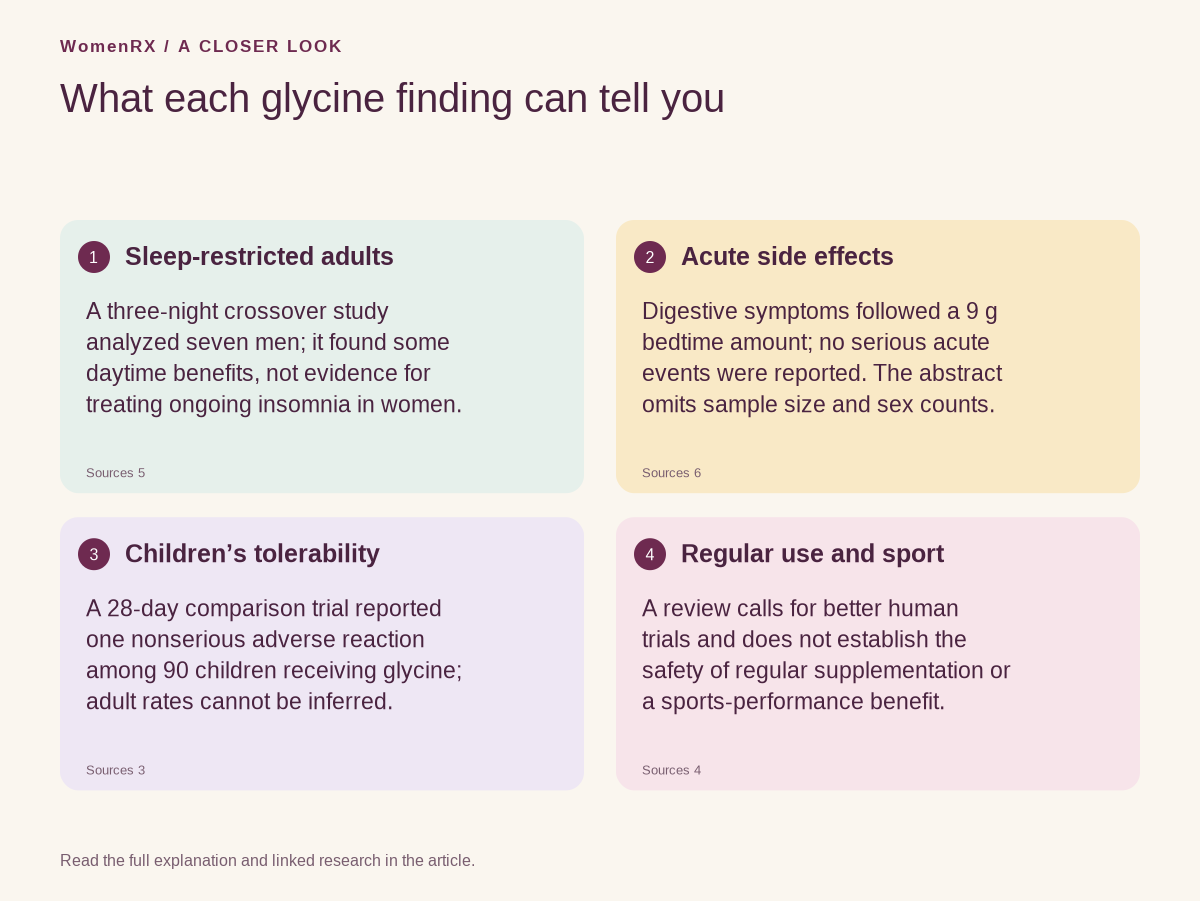
What each glycine finding can tell you
Sleep-restricted adults: A three-night crossover study analyzed seven men; it found some daytime benefits, not evidence for treating ongoing insomnia in women.5
Acute side effects: Digestive symptoms followed a 9 g bedtime amount; no serious acute events were reported. The abstract omits sample size and sex counts.6
Children’s tolerability: A 28-day comparison trial reported one nonserious adverse reaction among 90 children receiving glycine; adult rates cannot be inferred.3
Regular use and sport: A review calls for better human trials and does not establish the safety of regular supplementation or a sports-performance benefit.4
Read the figure as text
The studies answer different questions. Their populations and timeframes matter as much as their results.- Sleep-restricted adults: A three-night crossover study analyzed seven men; it found some daytime benefits, not evidence for treating ongoing insomnia in women.5
- Acute side effects: Digestive symptoms followed a 9 g bedtime amount; no serious acute events were reported. The abstract omits sample size and sex counts.6
- Children’s tolerability: A 28-day comparison trial reported one nonserious adverse reaction among 90 children receiving glycine; adult rates cannot be inferred.3
- Regular use and sport: A review calls for better human trials and does not establish the safety of regular supplementation or a sports-performance benefit.4
More questions, answered
Does the 9 g study mean that amount is safe to take?
No. It reports observations from an acute study, not a recommended amount or a test of regular use. Digestive symptoms were observed, and the abstract does not state the sample size or participants’ sexes.6
Sources you can check
- Insomnia | MedlinePlusAccessed 2026-09-25Return to first citation
- Insomnia - NHSAccessed 2026-09-25Return to first citation
- A Comparative Randomized Controlled Clinical Trial on the Effectiveness, Safety, and Tolerability of a Homeopathic Medicinal Product in Children with Sleep Disorders and Restlessness.Jong MC, Ilyenko L, Kholodova I, Verwer C, Burkart J, Weber S, Keller T, Klement P. · Evidence-based complementary and alternative medicine : eCAM · 2016Return to first citation
- An Update of the Promise of Glycine Supplementation for Enhancing Physical Performance and Recovery.Ramos-Jiménez A, Hernández-Torres RP, Hernández-Ontiveros DA, Ortiz-Ortiz M, López-Fregoso RJ, Martínez-Sanz JM, Rodríguez-Uribe G, Hernández-Lepe MA. · Sports (Basel, Switzerland) · 2024Return to first citation
- The Effects of Glycine on Subjective Daytime Performance in Partially Sleep-Restricted Healthy VolunteersAccessed 2026-09-26Return to first citation
- Assessment of Acute Adverse Events of Glycine Ingestion at a High Dose in Human Volunteers (2006)Accessed 2026-09-26Return to first citation