How to Compare Quercetin Supplements Without Chasing Hype
A useful comparison starts with what’s in the product, then asks whether the evidence matches the health goal on the label.
Compare the quercetin amount per serving, formulation, and added ingredients first. Then separate three different questions: Does the product contain what it says? Has its formulation been tested for absorption in people? Does it help with your intended use? A laboratory comparison found differences among formulations, but it did not establish better health outcomes in people. 2
Start with what you can compare on the label
Check how much quercetin a product states per serving, then check how many capsules, tablets, or scoops make up that serving. If it’s part of a blend, look for a separate quercetin amount. Two products can display similar-looking numbers while defining a serving differently, or disclose different amounts of the ingredient you’re trying to compare.
Write down the stated form of quercetin and the other ingredients, too. A plain quercetin product and a multi-ingredient blend aren’t direct comparisons. If an amount or form isn’t disclosed clearly, that’s a useful finding: you may not have enough information to decide whether the products are comparable.
What does “better absorption” actually mean?
A formulation claim might refer to how well a substance dissolves in a laboratory fluid, how it behaves in a cell model, or how much reaches the bloodstream when people take it. Those aren’t interchangeable tests.
In a 2025 study, researchers compared four commercial quercetin formulations using particle-size and solubility measurements, along with intestinal-cell and liver-cell models. Results differed among formulations. One showed higher apparent permeability in the cell model alongside signs of reduced cell integrity, which complicates a simple “more gets through, so it’s better” interpretation. The study did not measure absorption or health outcomes in people. 2
If a product promises enhanced absorption, ask what was measured, what it was compared with, and whether the test involved that finished product. Even a human absorption result would answer a different question from whether the supplement relieves symptoms.
Match the evidence to your reason for buying it
Suppose you’re considering quercetin for seasonal allergy symptoms. You’d want evidence about symptoms in people with allergies. A study of a supplement combining quercetin with postbiotics and other plant-derived ingredients instead measured barrier and immune responses in an experimental human gut-cell model. It cannot tell you whether quercetin alone, or the combination, improves anyone’s allergy symptoms. 5
For another example, a systematic review found changes in some biochemical measures in animal models of high uric acid. The authors also noted limited clinical trial research in people with hyperuricemia. That animal result isn’t evidence that a retail supplement treats the condition in people. 1
A “for women” label needs the same scrutiny. A review covering conditions including endometriosis, fibroids, and PCOS found that robust human clinical evidence for quercetin’s efficacy is generally lacking. It doesn’t establish a benefit for any one of those conditions or for a particular stage of life. 3
Read quality disclosures for what they actually verify
If a company mentions testing, look for what was tested, whether the disclosure applies to the finished product or a particular batch, and whether it reports the quercetin amount. An analytical-method study measured quercetin in one dietary supplement and found results consistent with another laboratory method. That shows a way quercetin content can be assessed; it isn’t a quality endorsement of retail brands. 4
A content test, an absorption study, and a trial measuring symptom relief each answer a different question. None can stand in for the others. Without current, comparable product-level evidence, a confident “best quercetin brands” ranking would overstate what’s known.
Account for your medicines and life stage
If you take medicines, bring the exact product label, including the full ingredient list, to a pharmacist or prescriber for review. The added ingredients matter when the product is a blend. The research described above doesn’t establish an interaction profile for a particular product, so a general claim that quercetin is compatible with your medicines would be misplaced.
If you’re pregnant or breastfeeding, don’t treat a “natural,” “for women,” or enhanced-absorption claim as a safety finding. The formulation comparison and review of uterine-related conditions don’t establish supplement safety during pregnancy or breastfeeding. 2 3 Ask about the specific product and all its ingredients before deciding whether to use it.
A short comparison note is often enough: amount per serving, form, added ingredients, what any testing actually measured, and whether human research addresses your reason for considering it. That puts a polished label in perspective without requiring you to guess which product is “best.”
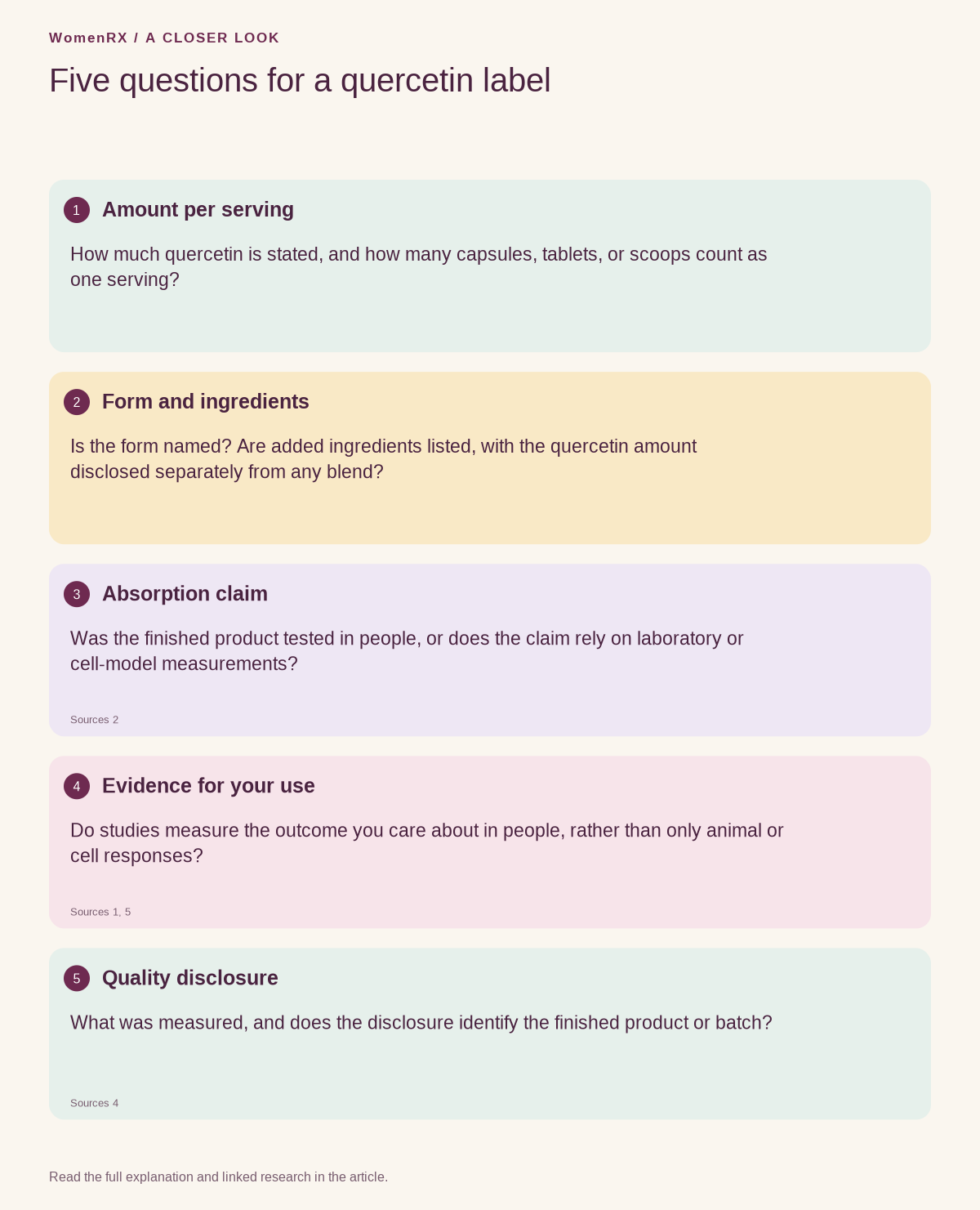
Five questions for a quercetin label
Amount per serving: How much quercetin is stated, and how many capsules, tablets, or scoops count as one serving?
Form and ingredients: Is the form named? Are added ingredients listed, with the quercetin amount disclosed separately from any blend?
Absorption claim: Was the finished product tested in people, or does the claim rely on laboratory or cell-model measurements?2
Evidence for your use: Do studies measure the outcome you care about in people, rather than only animal or cell responses?15
Quality disclosure: What was measured, and does the disclosure identify the finished product or batch?4
Read the figure as text
Use this checklist to tell product details apart from evidence about absorption, quality, and health effects.- Amount per serving: How much quercetin is stated, and how many capsules, tablets, or scoops count as one serving?
- Form and ingredients: Is the form named? Are added ingredients listed, with the quercetin amount disclosed separately from any blend?
- Absorption claim: Was the finished product tested in people, or does the claim rely on laboratory or cell-model measurements?2
- Evidence for your use: Do studies measure the outcome you care about in people, rather than only animal or cell responses?15
- Quality disclosure: What was measured, and does the disclosure identify the finished product or batch?4
More questions, answered
Does a more soluble formulation work better?
Not necessarily. In a laboratory comparison, formulations differed in solubility and cell-model results, but researchers did not test whether people absorbed them differently or experienced better health outcomes. 2
Sources you can check
- The effect of Quercetin supplementation on hyperuricemia-related biochemical and renal outcomes in animal models: a systematic review and meta-analysis.Jingjing Z, Zixin C, Hang Q. · Journal of health, population, and nutrition · 2026Return to first citation
- An in vitro investigation on the physicochemical properties of different quercetin formulations.Ibi A, Chang C, Zhang Y, Kuo YC, Du M, Roh K, Gahler R, Solnier J. · Journal of complementary & integrative medicine · 2025Return to first citation
- A Review of the Potential Therapeutic Benefits of Quercetin for Uterine-Related Conditions.Leone MA, Kurman G, Bright M, Gregersen PK, Metz CN. · Biomedicines · 2026Return to first citation
- Fluorescence polarization enzyme assay: a novel approach for the quantification of quercetin based on its interaction with α-amylase.Filimonova SM, Melnikov ES, Mukhametova LI, Raysyan A, Eremin SA. · Analytical and bioanalytical chemistry · 2026Return to first citation
- Novel Food Supplement Containing a Combination of Postbiotics and Plant-Derived Compounds Regulates Epithelial Barrier Integrity and Immune Response in Human Enterocytes.Oglio F, Coppola S, Cadavere A, Di Santillo R, Mauriello V, Michelini M, Iorio RF, Caldaria E, Carucci L. · Foods (Basel, Switzerland) · 2026Return to first citation