Spermidine Supplements: Is There a Proven Human Dose?
A small pilot tested two daily amounts, but neither establishes a dose that slows aging or improves health in women.
A small healthy-adult pilot and a separate radiotherapy trial do not establish a spermidine dose that promotes healthy aging. In the 12-person pilot, researchers tested 1.5 mg and 3.3 mg daily for 56 days; selected biomarkers changed at the higher amount, but that isn’t proof of longer life or better everyday health. 2 1
What human dose evidence actually shows
The clearest dose information comes from a 56-day pilot involving 12 healthy men and women, with an average age of about 55. Participants were assigned to 1.5 mg or 3.3 mg of spermidine daily from a specific rice germ extract. In the 3.3 mg group, the researchers reported changes from baseline in several measures, including Beclin-1 and ULK1, biomarkers related to autophagy. The study was small and brief, and those biomarker changes do not show that people lived longer, aged more slowly, or felt healthier. They also don’t establish that the same amount in a different product would have the same effects. 2
A separate randomized trial tested spermidine in 58 people receiving head and neck cancer radiotherapy. At three months after treatment, dry mouth was reported in 48.28% of the spermidine group and 79.31% of the placebo group. That is a potentially useful finding for a specific treatment-related problem, but the trial addressed radiation-related dry mouth, not healthy aging. 1
So 3.3 mg is a dose studied in a small pilot, not a proven daily recommendation. A study amount is evidence that researchers tested it, not a general-purpose dose.
Why the longevity story gets ahead of the results
Spermidine is studied partly because researchers are interested in its relationship to autophagy, a process cells use to break down and recycle components. A plausible mechanism can help researchers decide what to test. It cannot, by itself, show that taking a supplement prevents disease or extends life in people. 2
That distinction matters when a product promises “anti-aging” effects. A change in a blood biomarker is not the same as a meaningful outcome such as improved function, fewer illnesses, or longer life. The small healthy-adult pilot measured biomarkers and other health indicators over eight weeks; it was not a trial demonstrating a longevity benefit. 2
Does the evidence answer women’s questions?
The pilot included both men and women, but its reported results do not show whether women responded differently. It also doesn’t report results by menstrual status or menopause stage. The radiotherapy trial was about treatment-related dry mouth, not aging outcomes in women. Neither study establishes a dose specifically for women. 1 2
These studies also don’t establish safety during pregnancy or breastfeeding. That’s a separate evidence question from whether a supplement changes a biomarker in nonpregnant adults; a healthy-aging pilot cannot answer it.
A practical way to assess a product
Before treating a label’s number as a recommendation, look for evidence that answers these questions:
- What ingredient and amount were studied? The pilot tested spermidine from a named rice germ extract. Its results don’t automatically transfer to other sources or formulations. 2
- Was the outcome meaningful to you? Biomarker changes are early signals, not demonstrated anti-aging benefits. Look for human trials measuring health outcomes that matter, not only a proposed mechanism. 2
- Were the participants like you? The pilot was very small and did not report women’s results separately. It cannot settle questions about sex or menopause-stage differences. 2
- What product-specific safety information exists? The pilot described a good short-term safety profile for 3.3 mg/day of Miricell rice germ extract. That finding comes from only 12 participants followed for 56 days; it doesn’t establish long-term safety or safety during pregnancy or breastfeeding. 2
For now, if your reason for considering spermidine is a general promise of longer life or slower aging, these studies do not identify a dose shown to support that promise. The most useful next evidence would be larger, longer human trials that test clearly described products, measure outcomes people experience, report results for women, and follow safety over time.
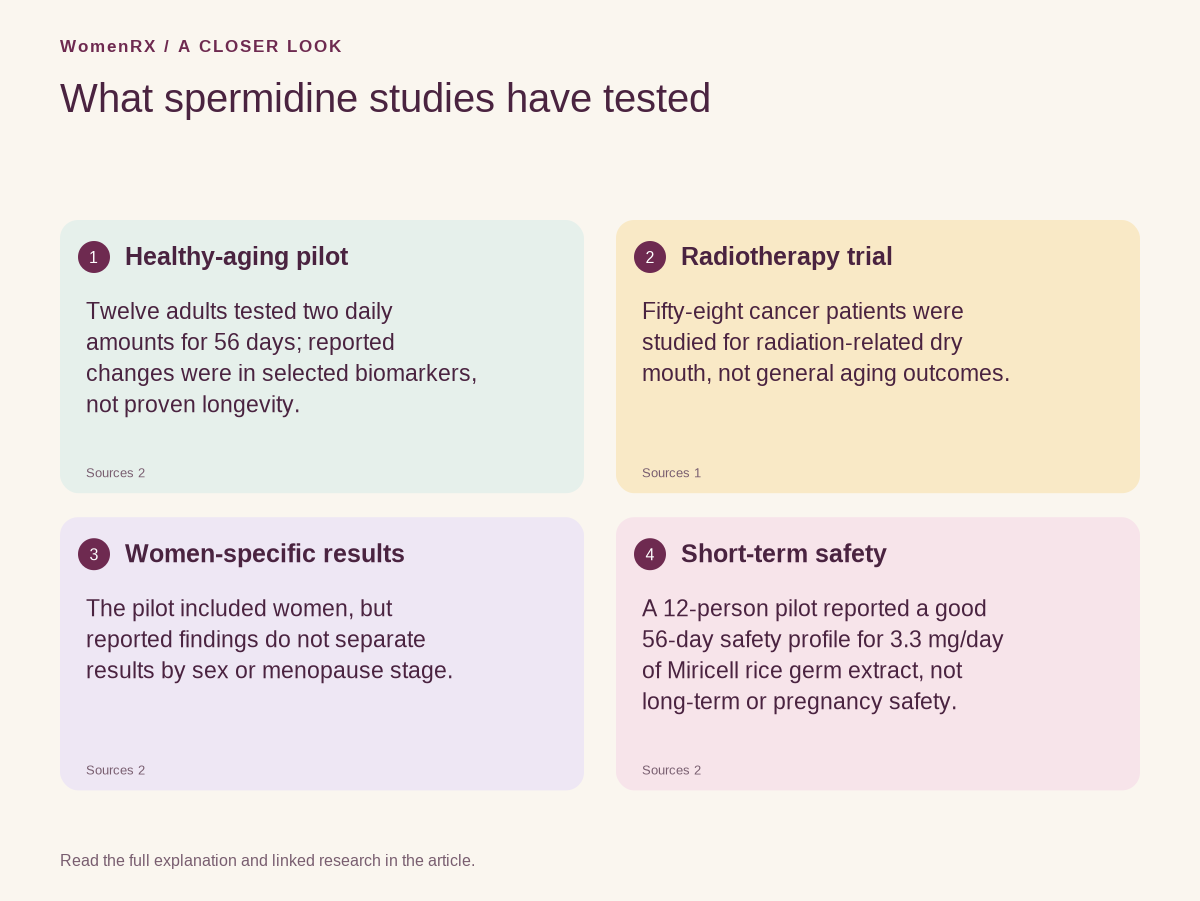
What spermidine studies have tested
Healthy-aging pilot: Twelve adults tested two daily amounts for 56 days; reported changes were in selected biomarkers, not proven longevity.2
Radiotherapy trial: Fifty-eight cancer patients were studied for radiation-related dry mouth, not general aging outcomes.1
Women-specific results: The pilot included women, but reported findings do not separate results by sex or menopause stage.2
Short-term safety: A 12-person pilot reported a good 56-day safety profile for 3.3 mg/day of Miricell rice germ extract, not long-term or pregnancy safety.2
Read the figure as text
The same supplement appears in studies with different purposes. The outcome, product, and population determine what each result can tell you.- Healthy-aging pilot: Twelve adults tested two daily amounts for 56 days; reported changes were in selected biomarkers, not proven longevity.2
- Radiotherapy trial: Fifty-eight cancer patients were studied for radiation-related dry mouth, not general aging outcomes.1
- Women-specific results: The pilot included women, but reported findings do not separate results by sex or menopause stage.2
- Short-term safety: A 12-person pilot reported a good 56-day safety profile for 3.3 mg/day of Miricell rice germ extract, not long-term or pregnancy safety.2
More questions, answered
Does 3.3 mg daily count as the recommended dose?
No. It was one amount tested for 56 days in a 12-person pilot, with biomarker changes reported at that amount. That does not establish a recommended dose or a healthy-aging benefit. 2
Do these studies establish safety during pregnancy or breastfeeding?
No. The human studies described here don’t answer that question. They also don’t report outcomes by menopause stage. 1 2
Sources you can check
- Oral Spermidine Supplementation Preserves Submandibular Gland Function After Radiotherapy: Mechanistic Insights and Use in a Phase II Randomized Clinical Trial.Min Y, Gao K, Liu Y, Dai L, Peng X. · MedComm · 2026Return to first citation
- Effects of Spermidine-Rich Rice Germ Extract Supplement on Biomarkers of Healthy Aging and Autophagy-Proof-of-Concept Pilot Study.Bruno G, La Monica M, Ziegenfuss TN. · Alternative therapies in health and medicine · 2025Return to first citation