Keratin for Hair: Is There a Proven Daily Dose?
A small trial tested one keratin-containing blend, but it didn’t establish a daily dose of keratin that works on its own.
There’s no established daily keratin dose proven to treat hair loss. One small trial in women tested 500 mg of keratin per day as part of a formula that also contained vitamins and minerals, so its results can’t show whether keratin alone helped. If your hair is persistently changing, the cause matters more than matching a supplement to a dose from one study. 2
What the human evidence actually tested
The clearest keratin-specific human evidence in this research concerns one product, not keratin in general. In a 90-day randomized, placebo-controlled trial, 50 women ages 40 to 71 with signs of damaged hair and nails received either a daily formula containing 500 mg of keratin or a placebo. The active formula also contained zinc, copper, and several B vitamins, including biotin. The researchers reported improvements in several hair and nail measures compared with placebo. 2
That result is worth knowing, but it doesn’t tell us which ingredient mattered. The study didn’t compare keratin alone with the same formula without keratin. It was also small, conducted at one center, and focused on women with damaged hair and nails, not on establishing a general treatment for hair loss. Pregnant and breastfeeding women were excluded. 2
A 2026 systematic review and meta-analysis included 14 studies of different oral hair supplements, involving 967 people. The review reported improvements in several hair-cycle measures across some products, but the formulas and study populations varied. Total hair count did not differ significantly between supplement and placebo groups in the pooled analysis. Because the review couldn’t analyze results by individual supplement or by sex, its findings can’t establish a daily keratin dose for women. 1
A product label isn’t the same as a tested dose
If you’re considering a product, look beyond the word “keratin.” Compare its full ingredient list and amounts with the studied formula. A product that lists keratin may not match the type or combination tested in the trial, and the trial can’t tell you whether a keratin-only product would have the same results. The tested product was a blend, not a test of keratin by itself. 2
Oral supplements and products applied to the hair are different interventions. A shampoo or other topical product isn’t evidence for an oral dose, and the oral trial doesn’t show that a topical keratin product prevents hair loss. Check what the product actually claims and what was measured in the study you’re relying on.
Also notice whether a “keratin” supplement adds biotin or other vitamins and minerals. Those ingredients were part of the trial formula, so any observed difference could not be assigned to keratin alone. The study is not a reason to assume that taking more of any one ingredient will improve hair. 2
When the hair change deserves a closer look
Hair changes can have more than one cause. A review of hair supplements describes hair loss as potentially related to factors including genetics, hormonal influences, nutritional status, illness, and medications. A supplement aimed at hair quality may not address the reason your hair is shedding or thinning. 1
If shedding is persistent, clearly worsening, or began after a major change in your health or medicines, consider discussing the timing and pattern with a clinician rather than relying on a supplement label. The keratin trial doesn’t answer questions about pregnancy, postpartum shedding, or menopause-related hair changes: it excluded pregnant and breastfeeding participants, and the broader review couldn’t report results by women’s subgroup. 1 2
The useful takeaway is modest: one small trial offers a signal for one specific multi-ingredient product, not a proven daily keratin dose. If you’re comparing products, ask whether the exact formula and the hair outcome you care about were tested. If the change in your hair is ongoing, identifying its likely cause may be a more useful next step than trying to reproduce a dose from a blend.
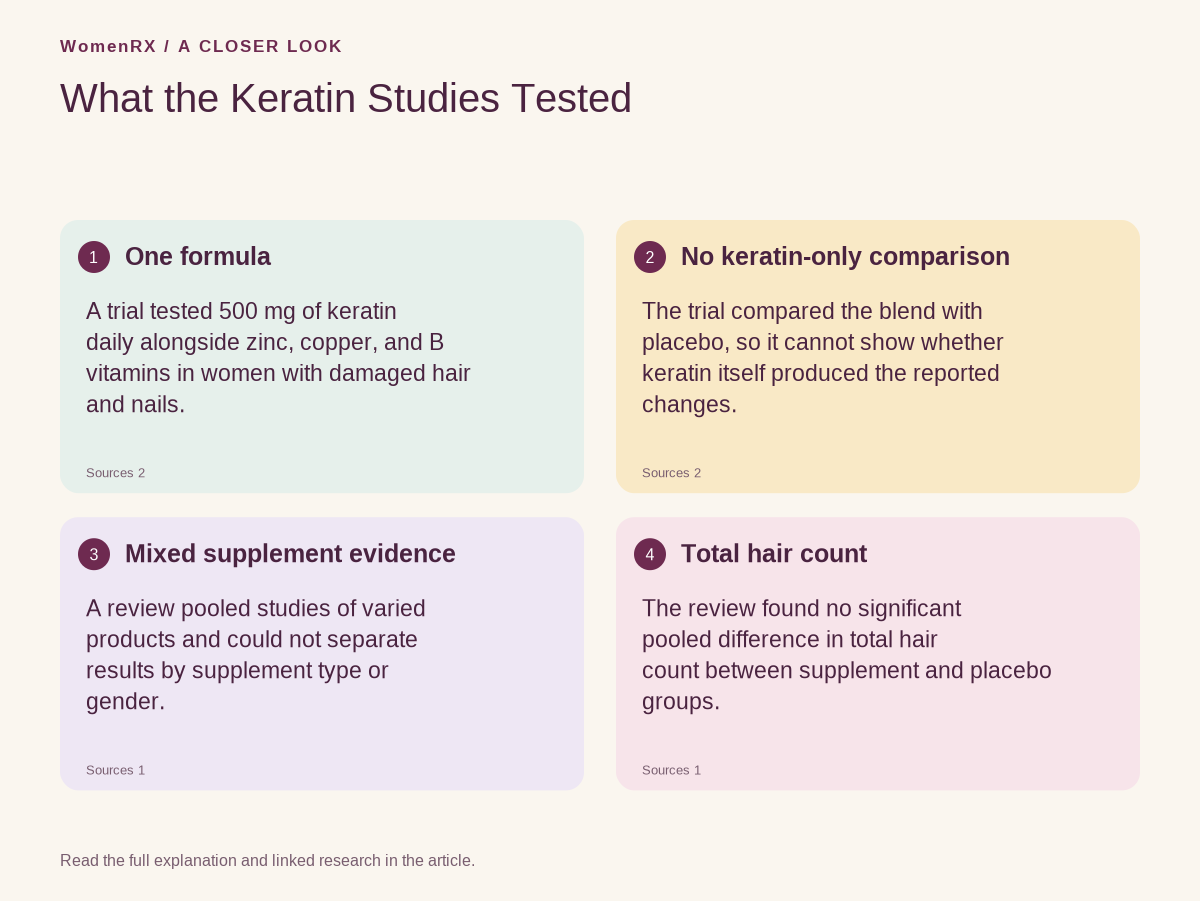
What the Keratin Studies Tested
One formula: A trial tested 500 mg of keratin daily alongside zinc, copper, and B vitamins in women with damaged hair and nails.2
No keratin-only comparison: The trial compared the blend with placebo, so it cannot show whether keratin itself produced the reported changes.2
Mixed supplement evidence: A review pooled studies of varied products and could not separate results by supplement type or gender.1
Total hair count: The review found no significant pooled difference in total hair count between supplement and placebo groups.1
Read the figure as text
These findings distinguish one tested multi-ingredient formula from broader supplement evidence that cannot isolate keratin.- One formula: A trial tested 500 mg of keratin daily alongside zinc, copper, and B vitamins in women with damaged hair and nails.2
- No keratin-only comparison: The trial compared the blend with placebo, so it cannot show whether keratin itself produced the reported changes.2
- Mixed supplement evidence: A review pooled studies of varied products and could not separate results by supplement type or gender.1
- Total hair count: The review found no significant pooled difference in total hair count between supplement and placebo groups.1
More questions, answered
Did the keratin trial test 500 mg of keratin by itself?
No. Participants took 500 mg of keratin as part of a formula that also contained zinc, copper, and B vitamins. The study didn’t test a keratin-only product. 2
Does the research prove keratin supplements stop hair loss?
No. One small trial reported improvements with a specific blend in women with damaged hair and nails. A broader review included many different supplements and couldn’t isolate keratin’s effects or report a women-specific result. 1 2
Sources you can check
- Evaluating the Effectiveness of Commercial Oral Supplements for Hair Growth: A Systematic Review and Meta-Analysis.Alanazi R, Alshammari S, Aldossari K, Alwatban R, Aljeribah D, Alanazi S, Alsalhi A, Alhumam A, Alajlan A. · Journal of cosmetic dermatology · 2026Return to first citation
- A clinical trial to investigate the effect of Cynatine HNS on hair and nail parameters.Beer C, Wood S, Veghte RH. · TheScientificWorldJournal · 2014Return to first citation