Keratin Supplements: What the Label Can and Can't Tell You
A keratin treatment for hair, keratin in a supplement, and the protein in hair itself aren’t interchangeable.
Keratin is a structural protein in hair and nails, but a product using the word “keratin” could mean a salon hair treatment or an ingested keratin-derived ingredient. Oral studies have tested specific formulations, not every product with keratin on its label. One small trial reported improvements in hair and nail measures with a supplement that also contained vitamins and minerals; another studied a particular poultry-feather hydrolysate. Neither establishes that all keratin supplements promote hair growth. 1 3 4
First, separate the three meanings
Keratin is a structural protein associated with hair and nails. But seeing the word on a product doesn’t tell you whether it’s a salon treatment, an ingredient you swallow, or simply a claim about the kind of result the product aims to create. Those are different things, and evidence for one doesn’t automatically apply to the others. 4
A salon service marketed as a Brazilian keratin treatment is applied to hair, often to make it straighter or more manageable. A review described claims about reduced frizz and improved shine, and raised concern that many such products contained formaldehyde or its derivatives. That’s a different use from an oral supplement, and the name of the service doesn’t tell you what an oral product contains. 1
Topical hair-care research also doesn’t necessarily test a product made of keratin alone. For example, one laboratory study tested a hair-applied copolymer made from motifs related to silk, elastin, and keratin. Its results on hair samples are evidence about that particular material and use, not about swallowing a keratin supplement. 2
What the oral studies actually tested
Two human trials in women help show why the exact formulation matters.
In a randomized, placebo-controlled trial, 50 women were assigned to take either a sheep-wool-derived keratin ingredient or a placebo for 90 days. The active capsules also contained vitamins and minerals. The study assessed hair loss, growth, strength, and appearance, as well as nail measures, and reported statistically significant improvements in hair and nails compared with placebo. Because the supplement combined ingredients, the study can’t show that keratin alone caused the reported results. And 50 participants is a small basis for predicting what a different product will do. 4
A separate randomized, placebo-controlled study enrolled 99 women aged 35 to 65 who had signs of physiological aging, including brittle hair and nails. It tested a specific hydrolysate made from poultry feathers over 90 days. The researchers reported improvements in measured skin, hair, and nail outcomes compared with placebo. The hair and nail measures included gloss and nail hardness; this isn’t the same as demonstrating that the ingredient regrows hair or treats hair loss. 3
These trials offer some evidence for the particular products and measures studied. They don’t establish that every keratin source, processing method, dose, or combination product will have the same effect. A study of hair gloss, for instance, can’t by itself support a claim about new hair growth.
A practical way to read the label
When you’re comparing products, look for more than the front-label word “keratin.” Ask:
- What is the ingredient, specifically? Is it a hydrolysate or peptide ingredient, and does the label identify its source? The trials above tested ingredients derived from sheep wool and poultry feathers, respectively. 3 4
- Does the study match the full formula? The sheep-wool-derived product also contained vitamins and minerals. Results from that combination don’t identify which ingredient mattered. 4
- What outcome is being promised? Shine, nail hardness, less breakage, and hair growth are distinct outcomes. Check whether the study measured the one you care about. 3 4
- Who was studied? One trial involved women aged 35 to 65 with signs of physiological aging and brittle hair or nails. Pregnancy and lactation were exclusion criteria, and the study doesn’t establish results for those stages or show that benefits differ by menopause or menstrual status. 3
A claim is a closer match to the evidence when the product’s ingredient and formulation, the people studied, and the measured result are similar. If those details are missing, the word “keratin” alone doesn’t tell you much about whether the study applies.
What the evidence can and can’t answer
The trials give an early reason to study certain keratin-derived supplements further, including for hair and nail appearance. One included hair growth among its measures and reported overall improvements in hair and nails, but the reported results don’t establish which individual hair endpoints improved. The other tested one specific hydrolysate and focused its hair and nail measures on appearance and nail hardness. Taken together, they don’t establish a general hair-growth effect for keratin supplements as a category. 3 4
If your concern is hair thinning or shedding rather than shine or breakage, don’t assume a supplement study about appearance answers that question. The distinction between what a product was tested for and what its label promises is the most useful place to start.
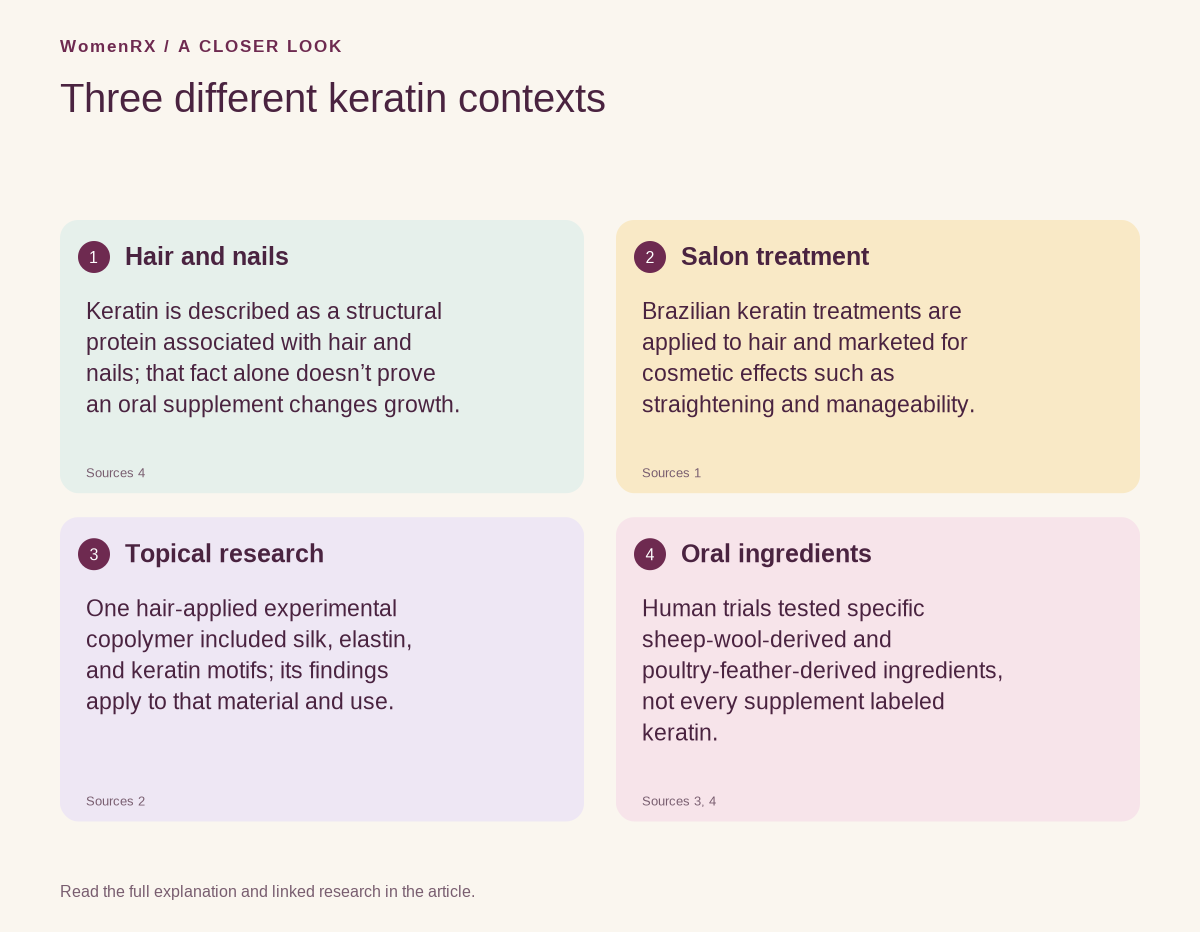
Three different keratin contexts
Hair and nails: Keratin is described as a structural protein associated with hair and nails; that fact alone doesn’t prove an oral supplement changes growth.4
Salon treatment: Brazilian keratin treatments are applied to hair and marketed for cosmetic effects such as straightening and manageability.1
Topical research: One hair-applied experimental copolymer included silk, elastin, and keratin motifs; its findings apply to that material and use.2
Oral ingredients: Human trials tested specific sheep-wool-derived and poultry-feather-derived ingredients, not every supplement labeled keratin.34
Read the figure as text
The word “keratin” can refer to the protein associated with hair and nails, a salon treatment category, or a specific ingredient tested in an oral supplement. Match each claim to the kind of product studied.- Hair and nails: Keratin is described as a structural protein associated with hair and nails; that fact alone doesn’t prove an oral supplement changes growth.4
- Salon treatment: Brazilian keratin treatments are applied to hair and marketed for cosmetic effects such as straightening and manageability.1
- Topical research: One hair-applied experimental copolymer included silk, elastin, and keratin motifs; its findings apply to that material and use.2
- Oral ingredients: Human trials tested specific sheep-wool-derived and poultry-feather-derived ingredients, not every supplement labeled keratin.34
More questions, answered
Does keratin in a supplement prove it will grow hair?
No. One small trial of a combination supplement included hair growth among its measures and reported overall improvements in hair and nails, but the formula also contained vitamins and minerals. The reported results don’t establish which individual hair endpoints improved. A separate trial of a specific poultry-feather hydrolysate reported changes in hair measures such as gloss, which doesn’t establish hair regrowth. 3 4
Are salon keratin treatments the same as oral keratin supplements?
No. Salon treatments are applied to hair and are marketed for cosmetic effects such as straightening or manageability. Oral supplements are ingested, and the clinical trials tested specific ingredients and formulations. Evidence about one use doesn’t establish benefits for the other. 1 3 4
Sources you can check
- Brazilian keratin hair treatment: a review.Weathersby C, McMichael A. · Journal of cosmetic dermatology · 2013Return to first citation
- Cosmetic Potential of a Structural Protein Copolymer Based on Silk, Elastin, and Keratin.Mota A, Caçador M, Carvalho JP, Tinoco A, da Costa A, Ribeiro A, Gonçalves F, Cavaco-Paulo A. · ACS biomaterials science & engineering · 2025Return to first citation
- The Effects of an Oral Supplementation of a Natural Keratin Hydrolysate on Skin Aging: A Randomized, Double-Blind, Placebo-Controlled Clinical Study in Healthy Women.Tursi F, Nobile V, Cestone E, De Ponti I, Lepoudere A, Sergheraert R, Soulard JP. · Journal of cosmetic dermatology · 2025Return to first citation
- A clinical trial to investigate the effect of Cynatine HNS on hair and nail parameters.Beer C, Wood S, Veghte RH. · TheScientificWorldJournal · 2014Return to first citation