Chromium Supplements: What the Label Can and Can’t Tell You
A chromium label tells you the amount and form, but study doses only make sense alongside the people and outcomes studied.
Read the Supplement Facts amount as elemental chromium, then check the form and what outcome a similar amount was studied for. A trial dose isn’t a recommended dose. Chromium may interact with diabetes medicines or levothyroxine, and high intakes raise additional questions if you have kidney or liver disease. Pregnancy and breastfeeding need a separate assessment. 1
Start with the number on the label
If a bottle says “chromium 200 mcg (as chromium picolinate),” the 200 micrograms (mcg) is the amount of elemental chromium, not the weight of the whole picolinate compound. That’s the number to compare across Supplement Facts panels. Check any multivitamin you take, too: most multivitamin/mineral supplements contain chromium, typically 35-120 mcg. Single-ingredient chromium products commonly contain 200-500 mcg, and some contain up to 1,000 mcg. These are product amounts, not suggestions for how much to take. 1
The form matters for identifying what was studied, but it isn’t a shortcut to finding a proven winner. Products may contain chromium picolinate, chloride, nicotinate, polynicotinate, or histidinate. The NIH Office of Dietary Supplements describes absorption of the various forms as similar; a form name alone doesn’t show that a product will work better for your goal. 1
Keep intake references separate from study doses
For women ages 19-50, the Adequate Intake (AI) for chromium is 25 mcg a day; for women 51 and older, it’s 20 mcg. The AI is 30 mcg during pregnancy and 45 mcg while breastfeeding for adults ages 19-50. An AI is an intake reference used when evidence is insufficient to set a more precise requirement. It isn’t a target for supplement use, and it isn’t a safety ceiling. 1
Clinical trials have often tested amounts in the hundreds of micrograms to answer a particular question, such as whether chromium changes blood-glucose measures in people with type 2 diabetes. Reviews have found small overall improvements in some glucose measures in people with diabetes, but results across studies are inconsistent and the clinical importance is unclear. A 24-week trial in 137 adults with type 2 diabetes, for example, found no significant improvement in insulin sensitivity, fasting glucose, or HbA1c with 1,000 mcg a day of chromium picolinate compared with placebo. Neither a positive trial nor a large number on a label establishes the right amount for you. 1
A 2026 narrative review of chromium and biotin reports modest metabolic findings but also notes differences in participants, formulations, and study designs that limit how broadly its conclusions apply. It doesn’t resolve which chromium product or amount would benefit an individual. 2
If you’re looking at chromium for polycystic ovary syndrome (PCOS), use the PCOS research rather than assuming diabetes results apply. Reviews of trials in women with PCOS include chromium picolinate amounts of 200-1,000 mcg a day, generally studied for 8-24 weeks in one seven-trial analysis. Findings were mixed across outcomes, including glucose and hormone measures, and the practical value of reported changes remains uncertain. Those numbers describe research, not a PCOS dosing plan. 1
What could change your decision?
Diabetes medicines: Chromium might add to the blood-sugar-lowering effect of insulin, metformin, or other diabetes medicines, increasing the risk of low blood sugar. If you take one, ask your prescriber or pharmacist about the specific chromium product before adding it. 1
Levothyroxine: In a small study, taking chromium picolinate at the same time as levothyroxine reduced levothyroxine absorption over six hours. That finding makes timing worth discussing with a pharmacist, but it doesn’t establish a particular number of hours to separate them. 1
Kidney or liver disease: No tolerable upper intake level was set for chromium. That doesn’t mean high amounts have been proved safe: the Food and Nutrition Board noted limited safety data and said people with kidney or liver disease might be more susceptible to adverse effects from high intakes. 1
Pregnancy or breastfeeding: The higher AIs during these periods are intake references, not evidence that a high-dose supplement is needed or safe. Diabetes and PCOS trial doses shouldn’t be carried over to pregnancy or breastfeeding without a separate discussion about the product and your reason for considering it. 1
The most useful label comparison is therefore specific: How much elemental chromium does this product provide, in what form, and for what outcome was a similar amount studied? Then check whether a medicine, health condition, pregnancy, or breastfeeding changes the decision. A product can match a trial amount and still be a poor match for your situation. 1
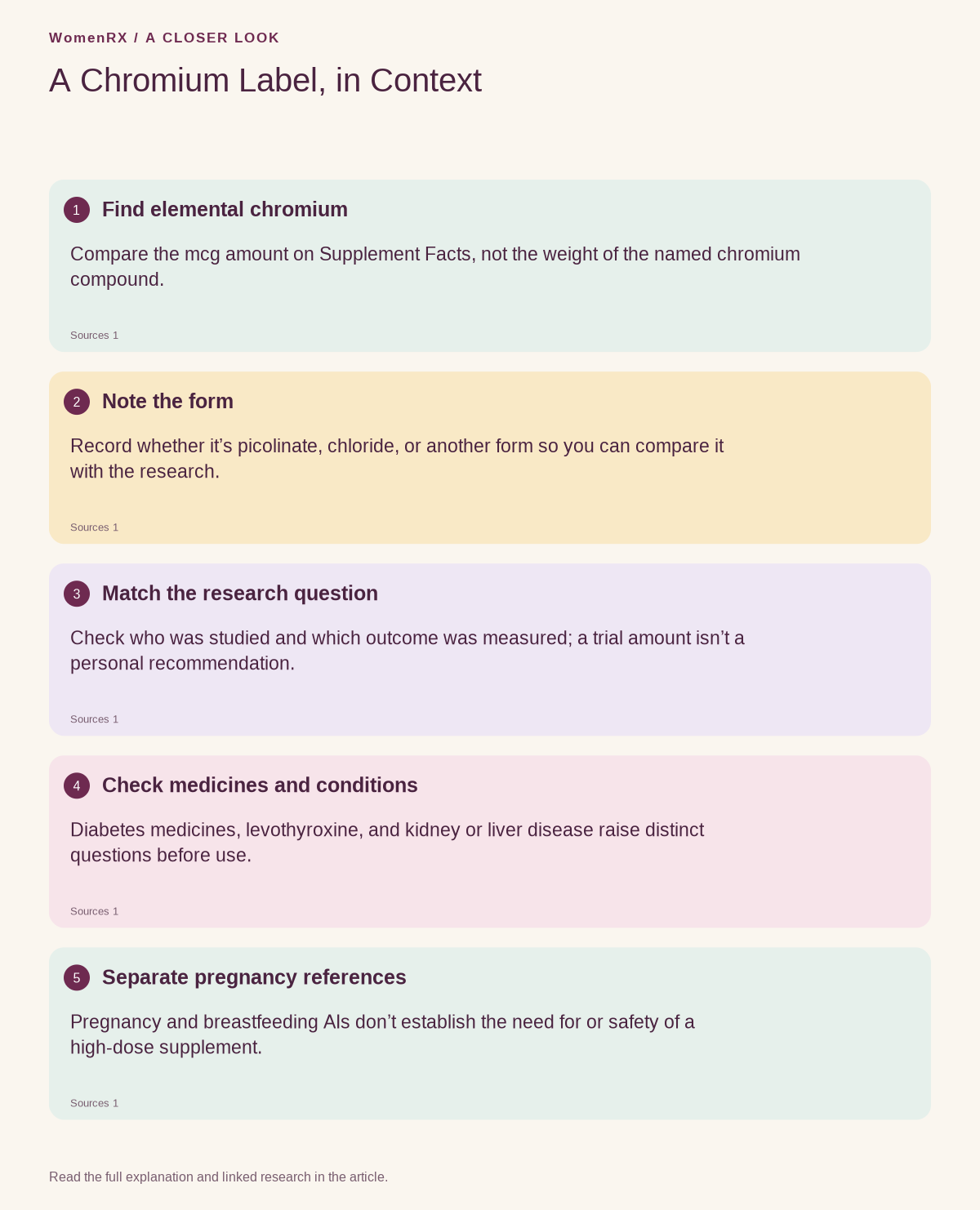
A Chromium Label, in Context
Find elemental chromium: Compare the mcg amount on Supplement Facts, not the weight of the named chromium compound.1
Note the form: Record whether it’s picolinate, chloride, or another form so you can compare it with the research.1
Match the research question: Check who was studied and which outcome was measured; a trial amount isn’t a personal recommendation.1
Check medicines and conditions: Diabetes medicines, levothyroxine, and kidney or liver disease raise distinct questions before use.1
Separate pregnancy references: Pregnancy and breastfeeding AIs don’t establish the need for or safety of a high-dose supplement.1
Read the figure as text
These checks distinguish what the product contains from what a study tested and what might affect your decision.- Find elemental chromium: Compare the mcg amount on Supplement Facts, not the weight of the named chromium compound.1
- Note the form: Record whether it’s picolinate, chloride, or another form so you can compare it with the research.1
- Match the research question: Check who was studied and which outcome was measured; a trial amount isn’t a personal recommendation.1
- Check medicines and conditions: Diabetes medicines, levothyroxine, and kidney or liver disease raise distinct questions before use.1
- Separate pregnancy references: Pregnancy and breastfeeding AIs don’t establish the need for or safety of a high-dose supplement.1
More questions, answered
Does a missing upper limit mean more chromium is safe?
No. A tolerable upper intake level wasn’t established, and the Food and Nutrition Board cautioned that safety data were limited. It specifically noted possible susceptibility to adverse effects from high intakes in people with kidney or liver disease. 1
Sources you can check
- Chromium - Health Professional Fact SheetAccessed 2026-09-25Return to first citation
- Nutritional Adjuvants in Diabetes: Biotin and Chromium Picolinate as Emerging Therapeutic Agents.Mehta M, Saini A, Mehta DK, Das R. · Current pharmaceutical design · 2026Return to first citation