Chromium Supplements: Check the Label, Then the Claim
A clear label can tell you which chromium form and amount a product contains, but it can’t show whether research supports its advertised benefit.
Before comparing chromium products, note the form and amount per serving, then match the product’s claim to the people and outcomes actually studied. Reviews of trials in people with diabetes report possible improvements in glucose measures, but findings have been inconsistent across reviews, long-term safety remains uncertain, and these results don’t establish benefits for women generally, PCOS, or weight loss. 1 2 4
Start with the promised benefit
A product may advertise support for blood sugar, weight, or “metabolism.” Those claims aren’t interchangeable. Ask what outcome the research measured and whether the participants resemble you.
Two reviews of trials in people with diabetes reported improvements in glucose measures with chromium. One included 25 randomized trials and found improvements in average HbA1c and fasting glucose; another included 13 trials and also reported lower fasting glucose. But the first review noted that earlier reviews had been inconsistent. These findings suggest a possible effect in people with diabetes, not a dependable result for every person or product. 1 2
The population matters. Results in people with diabetes don’t establish that chromium prevents diabetes or benefits women who don’t have diabetes. The summaries of those reviews don’t report sex-specific outcomes, so they don’t demonstrate a benefit specifically for women. And glucose results aren’t proof of weight loss: a review discussing chromium’s metabolic effects reported no body-composition effect in healthy individuals. 1 2 4
Read the form and amount without treating them as proof
Write down the exact chromium form named on the label, such as chromium picolinate, and the amount per serving. Chromium picolinate has been used in clinical trials, but it’s one of several chromium compounds. A review describes differences in the chemical properties of chromium compounds and ongoing uncertainty about how chromium works in the body. A familiar form or a larger amount on the label doesn’t, by itself, show that a product is more effective. 1 4
Amounts and formulations have varied across studies. One meta-analysis included trials using chromium or brewer’s yeast, with reported amounts ranging from 42 to 1,000 micrograms per day. That range describes what was studied, not a recommended amount or a proven effective range for a particular product or purpose. 2
Check whether the product combines chromium with other ingredients, too. If it does, a result from a combination product may not show what chromium alone contributed. The diabetes review described evidence on combined chromium supplements as limited and inconclusive. 1
Match a glucose claim to the person studied
For a blood-sugar claim, check whether the research involved people with diabetes, people with prediabetes, or people without either condition. A trial protocol describes a planned study of chromium combined with zinc, vitamin C, and copper for adults with prediabetes. A protocol is a plan to test an intervention, not a finding that it worked. 3
For a PCOS claim, don’t use glucose findings in people with diabetes as a substitute for research on PCOS. The diabetes reviews discussed above don’t report PCOS outcomes, so they can’t establish that chromium improves PCOS symptoms or related outcomes. 1 2
Put safety and medication questions in context
In the diabetes trials included in one review, adverse events did not differ between chromium and placebo. That is reassuring for the studies reviewed, but it doesn’t settle long-term safety; the authors said longer-term benefit and safety need further study. 1
If you take medicine for blood sugar, a pharmacist or prescriber can check the actual product ingredients against your treatment plan. The trial reviews report glucose outcomes, but they don’t establish whether a particular chromium product is appropriate alongside a specific medicine. Don’t use a supplement as a replacement for diabetes treatment.
A quick comparison that keeps the claim in view
Before comparing products, jot down four details: the form, amount per serving, intended outcome, and population in the supporting research. If a product claims to help with weight or PCOS, glucose findings from diabetes trials aren’t a close match. If it combines ingredients, look for evidence on that combination rather than assuming chromium explains any reported effect.
This won’t identify a universally best brand. It helps separate a transparent label, which is useful for comparison, from evidence that a product will deliver the benefit you want.
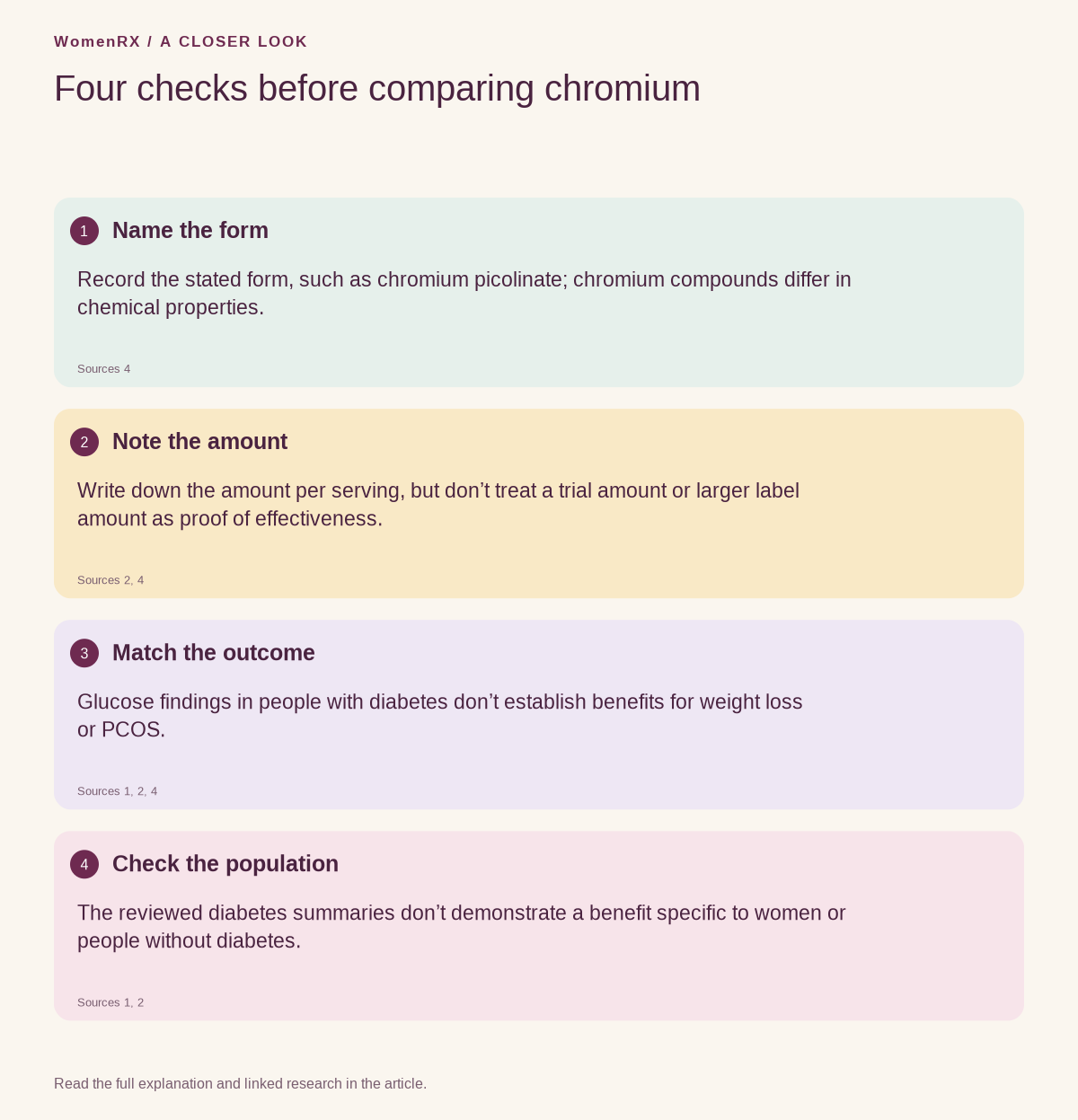
Four checks before comparing chromium
Name the form: Record the stated form, such as chromium picolinate; chromium compounds differ in chemical properties.4
Note the amount: Write down the amount per serving, but don’t treat a trial amount or larger label amount as proof of effectiveness.24
Match the outcome: Glucose findings in people with diabetes don’t establish benefits for weight loss or PCOS.124
Check the population: The reviewed diabetes summaries don’t demonstrate a benefit specific to women or people without diabetes.12
Read the figure as text
Use these checks to compare a product’s label with the outcome and population its research actually addresses.- Name the form: Record the stated form, such as chromium picolinate; chromium compounds differ in chemical properties.4
- Note the amount: Write down the amount per serving, but don’t treat a trial amount or larger label amount as proof of effectiveness.24
- Match the outcome: Glucose findings in people with diabetes don’t establish benefits for weight loss or PCOS.124
- Check the population: The reviewed diabetes summaries don’t demonstrate a benefit specific to women or people without diabetes.12
More questions, answered
Does chromium picolinate have stronger evidence than other forms?
Chromium picolinate has been studied, but the available reviews don’t establish it as the best form for every person or outcome. Different chromium compounds have different chemical properties, and the way chromium acts in the body remains unsettled. 1 4
Do diabetes studies show that chromium helps with PCOS?
No. Glucose findings in people with diabetes don’t establish a PCOS benefit. The reviewed findings don’t report PCOS outcomes or a benefit specific to women. 1 2
Sources you can check
- Systematic review and meta-analysis of the efficacy and safety of chromium supplementation in diabetes.Suksomboon N, Poolsup N, Yuwanakorn A. · Journal of clinical pharmacy and therapeutics · 2014Return to first citation
- [Chromium supplementation in patients with type 2 diabetes and high risk of type 2 diabetes: a meta-analysis of randomized controlled trials].San Mauro-Martin I, Ruiz-León AM, Camina-Martín MA, Garicano-Vilar E, Collado-Yurrita L, Mateo-Silleras Bd, Redondo Del Río Mde P. · Nutricion hospitalaria · 2016Return to first citation
- Protocol for a randomized controlled trial to evaluate the impact of daily supplementation with zinc, chromium, vitamin C, and copper on progression of prediabetes in Jakarta, Indonesia.Agustina R, Prafiantini E, Putri AR, Mufida R, Hanifa H, Afifah S, Tahapary DL, Shankar AH, Soewondo P. · Contemporary clinical trials · 2025Return to first citation
- Chromium Supplementation in Human Health, Metabolic Syndrome, and Diabetes.Maret W. · Metal ions in life sciences · 2019Return to first citation