Biotin: When Supplements Help and Tests Can Be Affected
Biotin may help when you’re deficient, but beauty benefits aren’t established for most people, and some supplements can distort blood-test results.
Biotin deficiency is rare, and evidence hasn’t shown that supplements reliably improve hair, skin, or nails in people without a deficiency. If you take biotin, tell the clinician ordering your blood work and the laboratory what product you use, how much it contains, and when you last took it. Some tests can read falsely high or low, depending on the assay. 1 2
Biotin isn’t a proven beauty fix
Biotin, also called vitamin B7, helps the body process fats, carbohydrates, and proteins. It’s available in foods such as eggs, meat, fish, nuts, and seeds, as well as in supplements. Deficiency is rare, and severe deficiency has not been reported in healthy people eating a normal mixed diet. 1
Hair thinning and brittle nails can occur with biotin deficiency, but those changes alone don’t show that you’re deficient. The evidence for supplements as a beauty treatment is limited. The small studies on brittle nails had no placebo group, and they didn’t establish whether participants were biotin-deficient. Hair benefits are supported by case reports in children with uncombable hair syndrome, a rare hair-shaft condition. Skin benefits are supported by case reports in infants with rash or dermatitis. Neither set of reports establishes a benefit for healthy adults. 1
If your hair or nails have changed, taking more biotin isn’t automatically the answer. Hair changes during pregnancy or midlife aren’t, by themselves, proof of deficiency.
Pregnancy findings don’t prove a hair benefit
Biotin status may change during pregnancy and breastfeeding. Studies summarized by the NIH Office of Dietary Supplements found that at least a third of pregnant women developed marginal biotin deficiency despite normal intake. The clinical significance of this finding isn’t clear, and it does not show that extra biotin improves pregnancy-related hair changes. 1
Biotin is available in foods and supplements. The adult adequate intake is 30 micrograms daily, including during pregnancy, and the adequate intake during breastfeeding is 35 micrograms. These are nutrition reference values, not instructions to take a supplement. 1
For midlife hair changes, don’t assume biotin deficiency. The evidence doesn’t establish a menopause-specific benefit from biotin supplements, and the rarity of deficiency makes symptoms alone an unreliable reason to start one. 1
Why biotin can change a test result
Some laboratory tests use assay methods that rely on biotin. When enough biotin is present in the blood, it can disrupt the measurement, making a result look falsely high or falsely low depending on the test. Some thyroid and vitamin D tests can be affected. This is a testing artifact, not necessarily a change in your health. 1 2
The amount of interference can depend on the assay method. In a study of children treated with biotin for biotinidase deficiency, thyroid results were affected with one testing system but were generally normal with another. That study doesn’t predict what will happen with every adult, supplement, or lab test, but it shows why the laboratory method matters. 3
Some false results could lead to a serious misunderstanding. For example, biotin has been linked to a falsely low result on a troponin test used to help assess a heart attack. Tell the care team about biotin before testing, especially if blood work is being done for an urgent concern. 1
What to tell the clinician and lab
Before a blood draw, tell the person ordering the test and the laboratory that you take biotin. Check standalone supplements, multivitamins, and hair, skin, or nail products. Share the product name, the amount on its label, and when you last took it. 1 2
Then ask whether the specific test can be affected and whether the lab can use a method that avoids the problem. Don’t rely on a fixed number of hours or days for everyone: assay methods and the amount of biotin in your blood can matter. If you take biotin for a diagnosed condition, check with the clinician managing that treatment before changing it. 1 3
Assessing mild deficiency can be difficult, too. The NIH Office of Dietary Supplements notes that serum biotin levels don’t reliably identify marginal deficiency with existing tests. That’s another reason not to diagnose yourself from hair or nail changes alone. 1
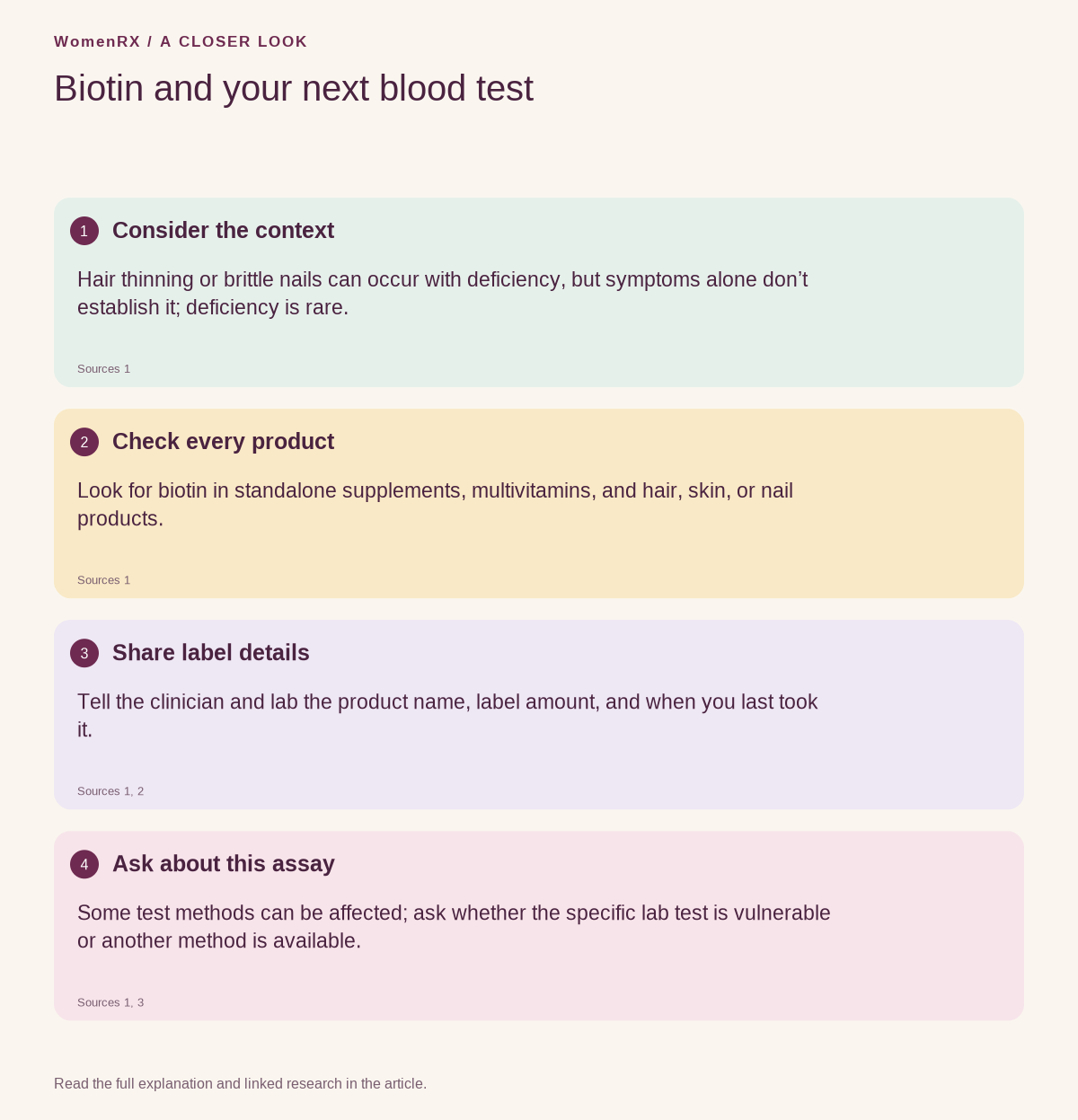
Biotin and your next blood test
Consider the context: Hair thinning or brittle nails can occur with deficiency, but symptoms alone don’t establish it; deficiency is rare.1
Check every product: Look for biotin in standalone supplements, multivitamins, and hair, skin, or nail products.1
Share label details: Tell the clinician and lab the product name, label amount, and when you last took it.12
Ask about this assay: Some test methods can be affected; ask whether the specific lab test is vulnerable or another method is available.13
Read the figure as text
Use these steps to share useful details and help the lab assess whether biotin could affect a particular test.- Consider the context: Hair thinning or brittle nails can occur with deficiency, but symptoms alone don’t establish it; deficiency is rare.1
- Check every product: Look for biotin in standalone supplements, multivitamins, and hair, skin, or nail products.1
- Share label details: Tell the clinician and lab the product name, label amount, and when you last took it.12
- Ask about this assay: Some test methods can be affected; ask whether the specific lab test is vulnerable or another method is available.13
More questions, answered
Does biotin affect every blood test?
No. The concern is with certain assay methods, not every blood test. Tell the clinician and laboratory what you take so they can check whether the particular test could be affected. 1 3
Can a blood test confirm mild biotin deficiency?
It can be difficult to identify marginal deficiency. The NIH Office of Dietary Supplements says serum biotin levels aren’t a reliable indicator because they may not change enough for current tests to detect marginal deficiency. 1
Sources you can check
- Biotin - Health Professional Fact SheetAccessed 2026-09-25Return to first citation
- Biotin Supplementation-The Cause of Hypersensitivity and Significant Interference in Allergy Diagnostics.Lis K. · Nutrients · 2025Return to first citation
- Serum Level of Biotin Rather than the Daily Dosage Is the Main Determinant of Interference on Thyroid Function Assays.Paketçi A, Köse E, Gürsoy Çalan Ö, Acar S, Teke P, Demirci F, Abacı A, Demir K, Arslan N, Böber E. · Hormone research in paediatrics · 2019Return to first citation