Biotin for Hair: Who Benefits, and What Claims Miss
Biotin can help when there’s a real deficiency, but that doesn’t establish a benefit for common hair shedding or routine cosmetic use.
Biotin is an essential vitamin, but deficiency is rare. Replacing it makes sense when deficiency or a rare condition affecting biotin use is identified; evidence that supplements improve hair in people without deficiency is very limited. Pregnancy can change biotin markers, but whether this matters clinically is unclear. Biotin can also distort some blood-test results, so disclose it before testing. 1
Start with the reason you’re considering it
Biotin, or vitamin B7, helps enzymes process fats, carbohydrates, and amino acids. A deficiency can cause hair thinning, brittle nails, and a scaly rash, sometimes along with neurological symptoms. But deficiency is rare, and hair changes by themselves don’t show that biotin is the cause. 1
That distinction matters because the clearest reason to use biotin is to correct a deficiency or manage a rare inherited condition that interferes with biotin use. For people without a deficiency, the claims about fuller hair or stronger nails go further than the research can support. 12
Some circumstances make low biotin status more plausible. These include biotinidase deficiency, chronic alcohol exposure, and certain long-term anticonvulsant treatments. These factors don’t mean that hair loss is due to biotin, or that taking a supplement will fix it. 1
What has actually been studied for hair and nails?
The NIH’s review describes only case reports supporting biotin for hair, involving children with uncombable hair syndrome, a rare hair-shaft disorder. Those reports don’t establish that biotin helps common hair thinning in adults with adequate biotin. The evidence for routine cosmetic use is limited. 1
A study of women after sleeve gastrectomy offers a narrow, useful example, not a general test of biotin for hair loss. Hair shedding was reported by 112 of 156 women during the year after surgery. Among 22 women with biotin deficiency who were given biotin, 5 reported a notable decline in shedding; among 29 women who took it despite optimal biotin levels, 11 reported a notable decline. The study found no significant difference between these groups. The outcome was self-reported, and the study cannot establish that biotin caused the changes. 3
Nail claims have a little more research, but it’s still weak: the small studies described in the NIH review had no placebo group and didn’t establish participants’ biotin status. They don’t show that routine supplements improve nails for people who aren’t deficient. 1
Pregnancy and postpartum: changed markers aren’t proof of a hair treatment
The NIH review reports that at least a third of pregnant women develop markers of marginal biotin deficiency despite normal intake. Biotin concentrations in plasma and breast milk can also decrease during lactation. The clinical significance of these findings needs more research. 1
These observations don’t establish that biotin supplements prevent or treat postpartum hair shedding. They also don’t show that common pregnancy or postpartum hair changes are caused by biotin deficiency. A change in a nutrient marker and a proven benefit from taking a supplement are different findings. 1
For context, the adequate intake is 30 micrograms a day for adults, including during pregnancy, and 35 micrograms during lactation. These are reference values for intake, not doses shown to treat hair loss. The National Academies set an adequate intake rather than a recommended dietary allowance because the evidence wasn’t sufficient to establish an RDA for biotin. 1
The lab-test risk can matter more than the beauty claim
Some blood tests use biotin-streptavidin technology. High biotin intake can interfere with these tests, making results falsely high or falsely low depending on the assay. Tests that may be affected include some thyroid hormone, vitamin D, and cardiac troponin tests. A misleading result can complicate diagnosis or care. 1
In a study of six healthy adults, taking 10 milligrams daily for a week interfered with several tests. A separate finding reported interference with some thyroid tests after a single 10-milligram dose when testing occurred within 24 hours. These findings don’t set a universal waiting period: the effect depends on the test. If you take biotin, mention it to the person ordering your blood work and the lab so they can interpret results appropriately. 1
A practical decision
If you’re considering biotin for hair or nails, ask first whether there’s a specific reason to suspect deficiency, rather than treating shedding as proof. A known deficiency or inherited condition is a different situation from taking a beauty supplement without evidence of low status. If you already use a biotin-containing product, include it when you share your medicines and supplements before blood tests. 1
Biotin is found in foods including eggs, nuts, seeds, fish, and meat. For most people, the available evidence doesn’t show that adding a supplement improves hair when biotin status is already adequate. 12
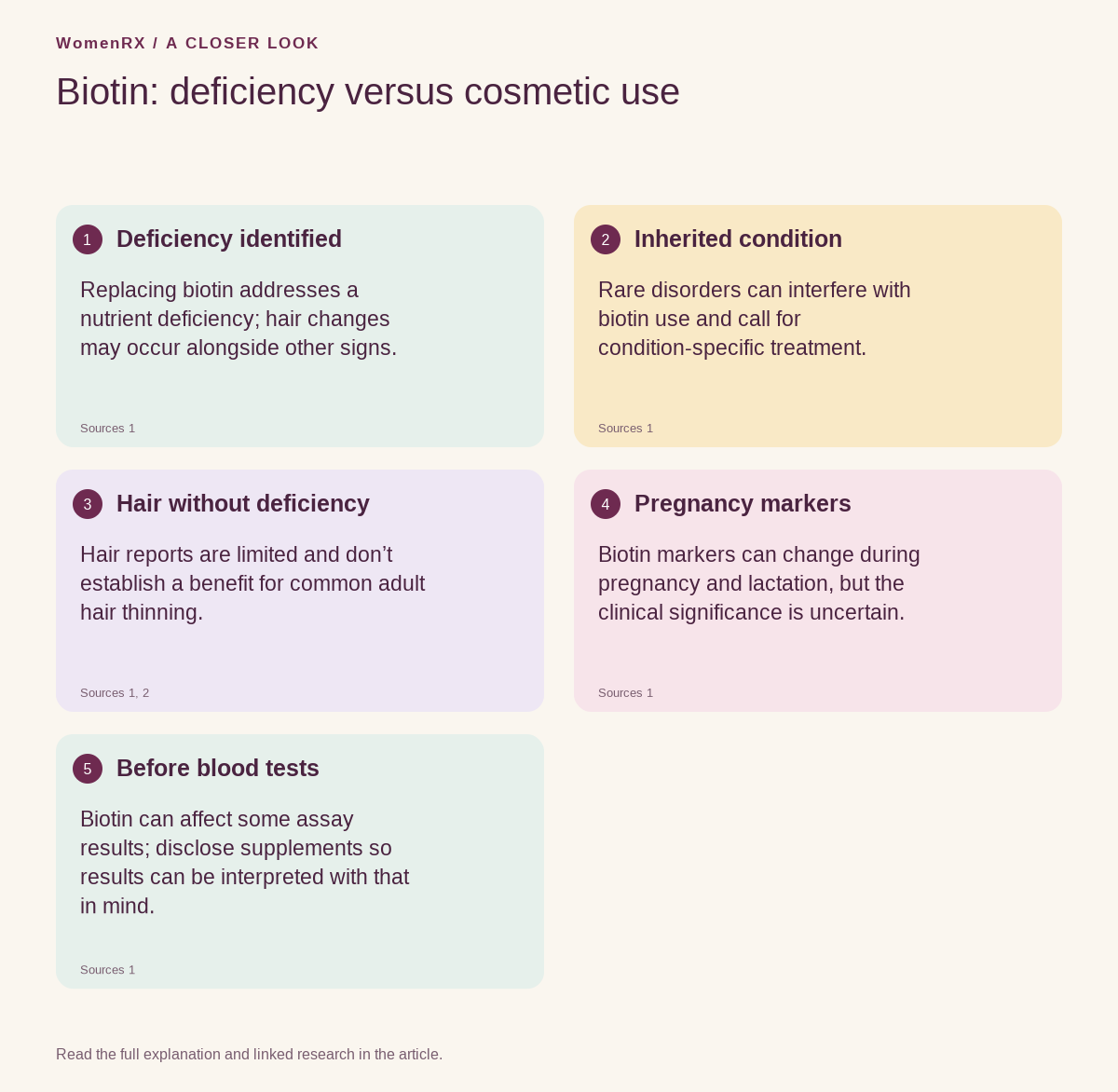
Biotin: deficiency versus cosmetic use
Deficiency identified: Replacing biotin addresses a nutrient deficiency; hair changes may occur alongside other signs.1
Inherited condition: Rare disorders can interfere with biotin use and call for condition-specific treatment.1
Hair without deficiency: Hair reports are limited and don’t establish a benefit for common adult hair thinning.12
Pregnancy markers: Biotin markers can change during pregnancy and lactation, but the clinical significance is uncertain.1
Before blood tests: Biotin can affect some assay results; disclose supplements so results can be interpreted with that in mind.1
Read the figure as text
Compare the better-supported role of correcting deficiency with the limits of cosmetic claims and the separate risk of misleading lab results.- Deficiency identified: Replacing biotin addresses a nutrient deficiency; hair changes may occur alongside other signs.1
- Inherited condition: Rare disorders can interfere with biotin use and call for condition-specific treatment.1
- Hair without deficiency: Hair reports are limited and don’t establish a benefit for common adult hair thinning.12
- Pregnancy markers: Biotin markers can change during pregnancy and lactation, but the clinical significance is uncertain.1
- Before blood tests: Biotin can affect some assay results; disclose supplements so results can be interpreted with that in mind.1
More questions, answered
Does an adequate intake mean I need a biotin supplement?
No. An adequate intake is a reference for usual intake, not proof that you’re deficient or that a supplement will improve hair or nails. Biotin occurs in foods such as eggs, nuts, seeds, fish, and meat. 1
Can biotin affect thyroid blood tests?
Yes. Some thyroid assays can show falsely high or low results when biotin interferes with the test. Tell the person ordering the test and the lab about supplements containing biotin; the effect and any relevant timing depend on the specific assay. 1
Sources you can check
- Biotin - Health Professional Fact SheetAccessed 2026-09-25Return to first citation
- Biotin DeficiencyCervantes A, Daley SF. · 2025Return to first citation
- Hair Loss After Sleeve Gastrectomy and Effect of Biotin Supplements.Şen O, Türkçapar AG. · Journal of laparoendoscopic & advanced surgical techniques. Part A · 2021Return to first citation