Biotin Products: What the Label Can and Cannot Tell You
A biotin label can show you how much is in a serving, but it can’t tell you whether biotin will help your hair.
Compare a biotin product with a documented need or a clinician’s recommendation, not a promise of thicker hair. Biotin deficiency can cause hair loss, but evidence that supplements improve hair in people without deficiency is limited. Check the amount per serving and any biotin in your other supplements. Before bloodwork, disclose biotin use because it can distort some test results. 2
First, ask what the biotin is for
Biotin is vitamin B7. A deficiency can cause thinning hair and brittle nails, so the connection on a hair-and-nails label has a basis. What the label leaves out is the distinction between correcting a deficiency and taking extra biotin in the hope of improving hair. Evidence for the second use is limited. The hair-benefit reports described by the NIH Office of Dietary Supplements involved children with a rare hair-shaft disorder; they don’t establish a benefit for common hair thinning in adults without deficiency. 2
If biotin has been recommended for a specific reason, use that reason when comparing products. If you’re shopping because you’ve noticed more hair in your brush or a widening part, the label can’t tell you what’s causing the change. Hair loss has different possible causes, and an assessment can help identify which kind you’re dealing with. 1
The timing of hair changes matters too. If they began during pregnancy, after birth, or around menopause, mention that timing when discussing them with a clinician. It’s useful context, not a diagnosis of biotin deficiency or an automatic reason to buy a supplement.
Read the serving amount, then look beyond it
Find the biotin amount per serving, and check how many tablets, capsules, or gummies make up that serving. Then look at products you already use. Biotin appears not only in standalone supplements but also in B-complex products and some multivitamins. 2
US labels use a Daily Value of 30 micrograms of biotin for adults and children age 4 and older. The Daily Value helps you compare nutrient amounts across products. It isn’t a hair-growth target, and a larger percentage on the label isn’t evidence of a better result. 2
Nor can a label confirm that you’re deficient. Even testing biotin status has limits: NIH notes that serum biotin concentration isn’t a good indicator of marginal deficiency. Hair loss alone doesn’t settle the question. 2
Put “tested” claims in their place
When a company says a product is tested, look for what was tested, who did it, and whether the information applies to the product you’re holding. A statement about product testing and a claim that biotin improves hair answer different questions. Neither the word “tested” nor an impressive-looking biotin amount demonstrates that a product treats hair loss.
That’s why there’s no useful brand winner based on hair promises alone. A clearer comparison is whether the serving amount matches the reason you’re considering biotin, whether you’ve accounted for other supplements, and whether you can readily identify the product and amount if you need to report them before a lab test.
Before bloodwork, make the biotin visible
Biotin can interfere with certain laboratory assays, making a result appear falsely high or falsely low. Thyroid testing is one example: NIH reports interference after a single 10 mg dose when the test was performed within 24 hours. That is a documented example, not a universal threshold or waiting period. Laboratory research shows that susceptibility differs among assays and testing systems; not every test that uses biotin is affected in the same way. 234
Tell the clinician ordering bloodwork and the lab if you take biotin, including biotin in a multivitamin or combination product. Share the product and serving amount if you have them, and ask whether that particular test needs any special preparation. Don’t guess a stop-and-restart schedule from a supplement label: the answer depends on the test being used. 23
A label is good for comparing what’s in products. Your reason for taking biotin, and any upcoming lab tests, determine what to do with that information.
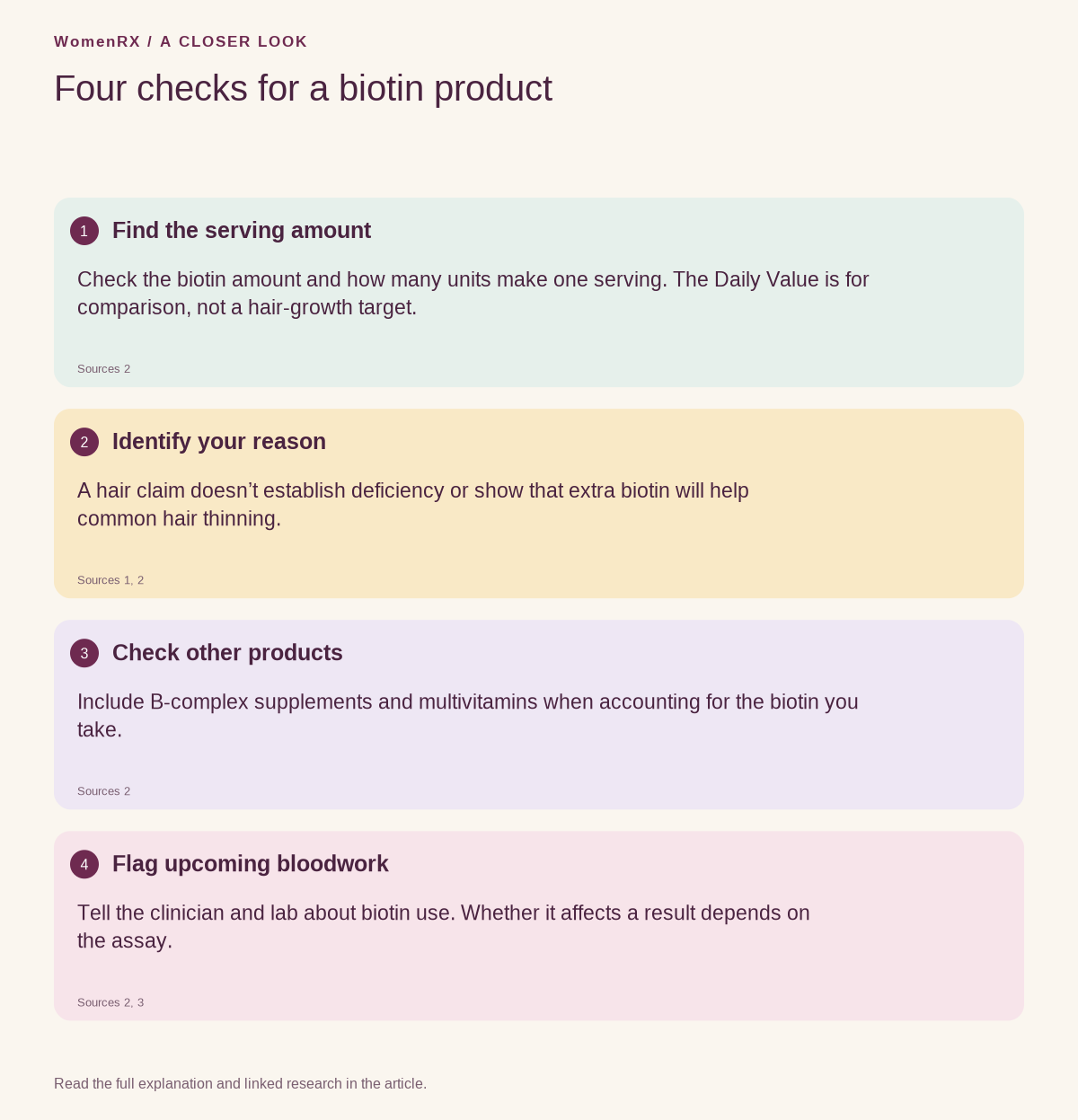
Four checks for a biotin product
Find the serving amount: Check the biotin amount and how many units make one serving. The Daily Value is for comparison, not a hair-growth target.2
Identify your reason: A hair claim doesn’t establish deficiency or show that extra biotin will help common hair thinning.12
Check other products: Include B-complex supplements and multivitamins when accounting for the biotin you take.2
Flag upcoming bloodwork: Tell the clinician and lab about biotin use. Whether it affects a result depends on the assay.23
Read the figure as text
Use these checks to separate what the label shows from what it cannot establish.- Find the serving amount: Check the biotin amount and how many units make one serving. The Daily Value is for comparison, not a hair-growth target.2
- Identify your reason: A hair claim doesn’t establish deficiency or show that extra biotin will help common hair thinning.12
- Check other products: Include B-complex supplements and multivitamins when accounting for the biotin you take.2
- Flag upcoming bloodwork: Tell the clinician and lab about biotin use. Whether it affects a result depends on the assay.23
Sources you can check
- Hair loss - NHSAccessed 2026-09-25Return to first citation
- Biotin - Health Professional Fact SheetAccessed 2026-09-25Return to first citation
- In-vitro verification of tolerance limits for biotin interference of routine biochemistry and immunology assays.Swallow K, Wild G, Sargur R. · Annals of clinical biochemistry · 2026Return to first citation
- Biotin interference in routine clinical immunoassays.Chiu KC, Jhan JR, Yan HN, Liao YC, Lu WH, Lee KY, Cheng LY, Yeh CK, Lee YF, Kuo CH, Chung KP, Chien TI. · Practical laboratory medicine · 2025Return to first citation