Does Biotin Affect Your Weight?
Biotin helps your body process nutrients, but that doesn’t tell you whether taking more will change your weight.
Biotin helps enzymes carry out steps in fat, glucose, and amino-acid metabolism. That explains why it’s marketed for “metabolism,” but it doesn’t show that a supplement causes weight loss or gain. The effect of biotin supplements on weight in people without a diagnosed deficiency, including women specifically, remains unclear from the human weight evidence discussed here. 13
If a biotin bottle promises “metabolism support,” the wording sounds closely related to weight. There’s a missing step, though: showing what happens to people’s weight when they take the supplement.
A metabolic role isn’t a weight result
Biotin, also called vitamin B7, helps five enzymes carry out steps involved in processing fats, glucose, and amino acids. Your body needs it for that work. But the fact that a nutrient participates in metabolism doesn’t tell you whether taking extra biotin changes what the scale shows. 1
For a weight claim, the useful question is: Was body weight measured in people taking biotin, and how did it compare with people who didn’t take it? A change in a metabolic marker isn’t interchangeable with a change in weight. NIH’s review of weight-loss supplements makes this distinction between proposed mechanisms and measured outcomes. It also notes that when a product contains several ingredients, an observed effect can be difficult to attribute to just one. 3
What about a study in females?
A 2024 biotin study did measure weight in female rats. The mothers had undergone calorie restriction during pregnancy, and the female offspring were given fructose after weaning. Offspring of both the biotin-supplemented and unsupplemented calorie-restricted mothers weighed less than offspring in a comparison group whose mothers weren’t calorie-restricted. The researchers also reported that the groups had similar final weights after catch-up growth. Those comparisons can’t show that taking biotin changes weight in women without a deficiency. 4
That’s the distinction to keep in mind with a supplement marketed for women: a result in female animals isn’t a women-specific human weight result. Nor does biotin’s established job in the body establish a weight effect for women. 14
A weight change isn’t a biotin test
Biotin deficiency is rare. The signs described by NIH include hair loss, a distinctive rash around body openings, and neurological symptoms. Ordinary weight change isn’t listed as a typical sign. 1
A scale reading has limits, too. Body weight includes water, muscle, bone, and fat, so a change doesn’t identify what changed or why. If you’re gaining or losing weight unexpectedly, particularly if the change is sudden, MedlinePlus advises getting it checked rather than assuming a supplement or nutrient is the explanation. 2
There’s one practical reason to mention biotin if you do take it: supplemental biotin can interfere with certain blood tests, including some thyroid tests, and produce misleading results. Tell the person ordering your tests about it. 1
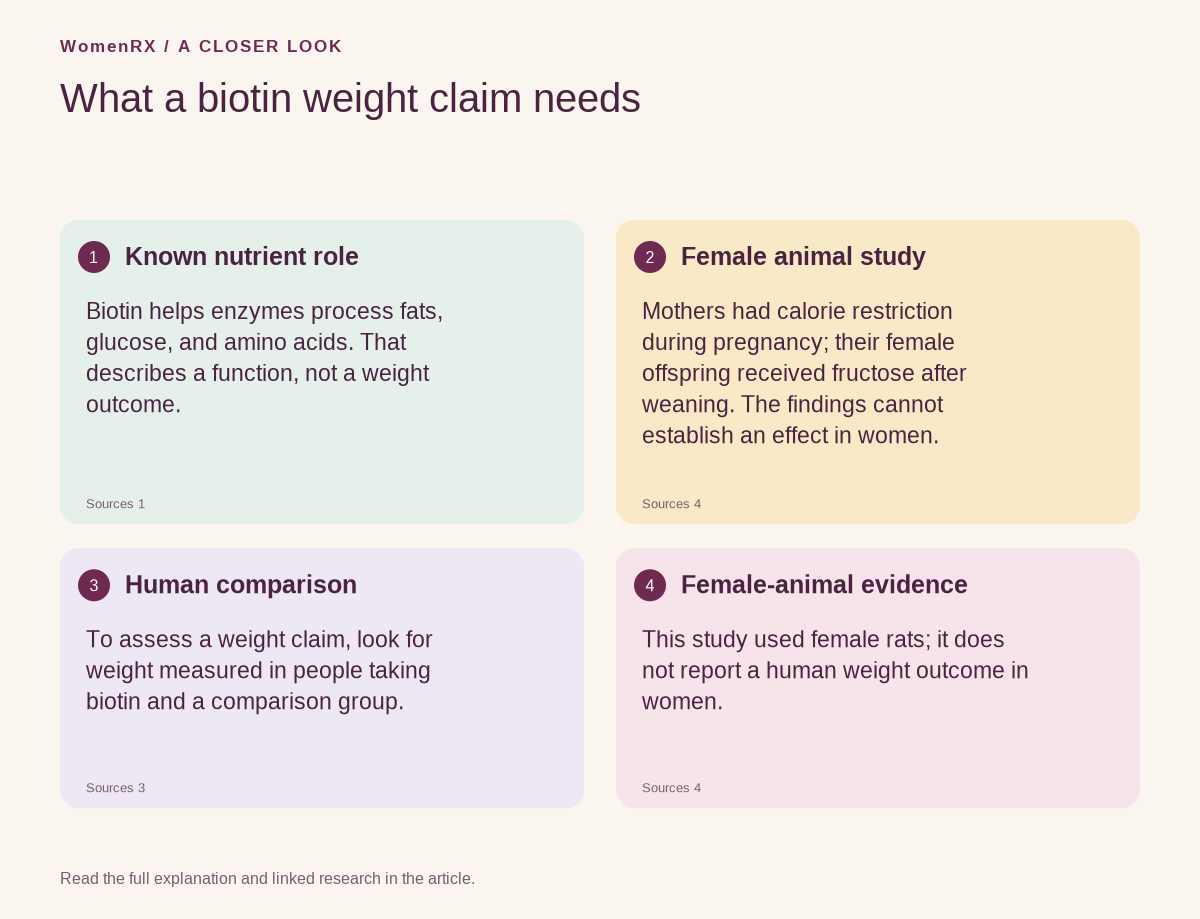
What a biotin weight claim needs
Known nutrient role: Biotin helps enzymes process fats, glucose, and amino acids. That describes a function, not a weight outcome.1
Female animal study: Mothers had calorie restriction during pregnancy; their female offspring received fructose after weaning. The findings cannot establish an effect in women.4
Human comparison: To assess a weight claim, look for weight measured in people taking biotin and a comparison group.3
Female-animal evidence: This study used female rats; it does not report a human weight outcome in women.4
Read the figure as text
This evidence map separates biotin’s known function from findings that could answer a weight question.- Known nutrient role: Biotin helps enzymes process fats, glucose, and amino acids. That describes a function, not a weight outcome.1
- Female animal study: Mothers had calorie restriction during pregnancy; their female offspring received fructose after weaning. The findings cannot establish an effect in women.4
- Human comparison: To assess a weight claim, look for weight measured in people taking biotin and a comparison group.3
- Female-animal evidence: This study used female rats; it does not report a human weight outcome in women.4
Sources you can check
- Biotin - Health Professional Fact SheetAccessed 2026-09-25Return to first citation
- Body Weight: MedlinePlusAccessed 2026-09-25Return to first citation
- Dietary Supplements for Weight Loss - Health Professional Fact SheetAccessed 2026-09-25Return to first citation
- The Beneficial Effects of Prenatal Biotin Supplementation in a Rat Model of Intrauterine Caloric Restriction to Prevent Cardiometabolic Risk in Adult Female Offspring.Aguilera-Méndez A, Figueroa-Fierros I, Ruiz-Pérez X, Godínez-Hernández D, Saavedra-Molina A, Rios-Chavez P, Villafaña S, Boone-Villa D, Ortega-Cuellar D, Gauthereau-Torres MY, Niet... · International journal of molecular sciences · 2024Return to first citation