Biotin for Hair and Nails: What the Evidence Says
Biotin can treat a real deficiency, but that doesn’t mean it will improve hair or nails when your levels are adequate.
Biotin deficiency can cause hair loss and brittle nails, but deficiency is rare. For people without a confirmed deficiency, strong evidence that biotin improves hair growth is lacking; the best-quality study in a recent review found no difference from placebo. Biotin can also distort some blood test results, so tell your clinician and lab about every supplement containing it before testing. 3 4
Deficiency and beauty supplementation aren’t the same thing
Biotin, also called vitamin B7, helps the body process fats, carbohydrates, and amino acids. A genuine deficiency can include thinning hair, brittle nails, and a red, scaly rash. But deficiency is rare, and those signs alone don’t confirm it. 3
That distinction matters because biotin is often marketed for thicker hair or stronger nails even when a person has no known deficiency. A 2024 review found only three studies of oral biotin for hair growth or quality. The highest-quality study was double-blind and placebo-controlled, and it found no difference between biotin and placebo. The two other studies involved specific groups, people taking isotretinoin and women after sleeve gastrectomy, and had potential biases. The review concluded that high-quality evidence does not support biotin as a general hair supplement. 4
Nail claims have a similar evidence problem. The NIH Office of Dietary Supplements describes a few small studies, but none had a placebo group, and they didn’t establish whether participants were biotin-deficient to begin with. Those results can’t show that routine biotin strengthens nails in people with adequate biotin. 3
Hair changes need a cause, not an automatic supplement
Hair shedding can have more than one explanation, and some types are related to medical conditions. A supplement won’t address every cause. 2 Hair changes after pregnancy or during menopause aren’t, by themselves, evidence of biotin deficiency, and the reviewed studies don’t establish that biotin treats hair changes in either situation. If shedding is concerning or persists, getting the cause assessed is more useful than assuming a beauty supplement will fix it.
Biotin status can also change during pregnancy and breastfeeding. The NIH fact sheet reports biochemical findings consistent with marginal deficiency in some pregnant women, but says the clinical significance is not yet clear. Those findings don’t establish that taking biotin prevents or treats hair shedding after pregnancy. 3
Put blood tests on your biotin checklist
Biotin supplements can interfere with some laboratory tests that use biotin-streptavidin technology. Depending on the test, results may appear falsely high or falsely low. Tests that may be affected include some thyroid hormone tests and tests for vitamin D; a falsely low troponin result could also be dangerous because troponin helps assess possible heart injury. 3
The effect can happen even after a single high-dose supplement: the NIH fact sheet describes thyroid test interference within 24 hours of one 10 mg dose. That example isn’t a universal waiting period. Effects depend on the test and supplement exposure, so don’t guess at a stop-and-restart schedule. Ask the clinician or laboratory handling your test for instructions specific to your situation. 3
Before a blood draw:
- Check every label. Biotin may be in a standalone supplement, a multivitamin, a B-complex, or a hair, skin, and nails product. 3
- Tell the clinician and lab. Share the product name, the amount listed on the label, and when you last took it.
- Ask what to do before this test. The right instructions depend on the test. Don’t stop a supplement prescribed for a diagnosed condition without discussing it with the prescriber.
- Mention it if results seem surprising. Biotin interference is one possible reason a result may not fit how you feel or what your clinician observes. 3
A simple disclosure can help the care team interpret a result correctly. MedlinePlus notes that following pre-test instructions is one factor that can affect laboratory results. 1
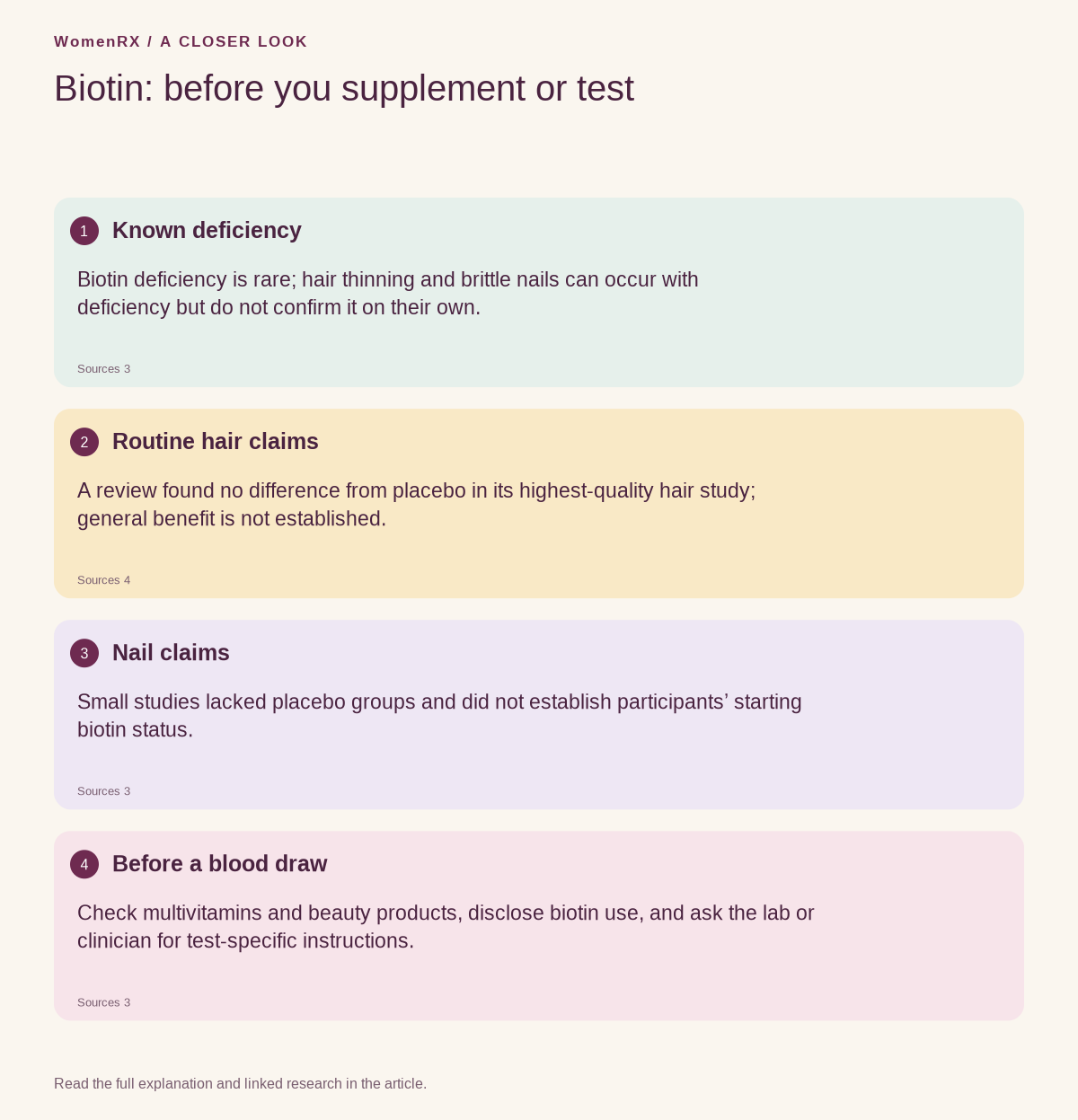
Biotin: before you supplement or test
Known deficiency: Biotin deficiency is rare; hair thinning and brittle nails can occur with deficiency but do not confirm it on their own.3
Routine hair claims: A review found no difference from placebo in its highest-quality hair study; general benefit is not established.4
Nail claims: Small studies lacked placebo groups and did not establish participants’ starting biotin status.3
Before a blood draw: Check multivitamins and beauty products, disclose biotin use, and ask the lab or clinician for test-specific instructions.3
Read the figure as text
Use these distinctions to separate deficiency-related care from cosmetic claims and to flag possible test interference.- Known deficiency: Biotin deficiency is rare; hair thinning and brittle nails can occur with deficiency but do not confirm it on their own.3
- Routine hair claims: A review found no difference from placebo in its highest-quality hair study; general benefit is not established.4
- Nail claims: Small studies lacked placebo groups and did not establish participants’ starting biotin status.3
- Before a blood draw: Check multivitamins and beauty products, disclose biotin use, and ask the lab or clinician for test-specific instructions.3
More questions, answered
Can biotin deficiency be checked with a blood test?
Biotin status can be difficult to assess. The NIH Office of Dietary Supplements says reliable indicators are limited, and serum biotin levels aren’t a good way to detect marginal deficiency. A clinician can consider your history and symptoms rather than relying on a beauty supplement label or one result alone. 3
Should I stop biotin before every blood test?
There isn’t one stop time that applies to every test. Biotin can affect some assays, and the relevant timing depends on the test and your supplement use. Tell the ordering clinician and lab what you take and follow their test-specific instructions. 3
Sources you can check
- Laboratory Tests: MedlinePlusAccessed 2026-09-25Return to first citation
- Hair loss - NHSAccessed 2026-09-25Return to first citation
- Biotin - Health Professional Fact SheetAccessed 2026-09-25Return to first citation
- Biotin for Hair Loss: Teasing Out the Evidence.Yelich A, Jenkins H, Holt S, Miller R. · The Journal of clinical and aesthetic dermatology · 2024Return to first citation