Biotin for Hair or Nails: How Long Might It Take?
A 90-day study reported changes in hair measures, but it doesn’t establish when standard biotin supplements will help, or whether they help if you aren’t deficient.
Biotin deficiency can cause hair loss and brittle nails, but it’s rare, and evidence that supplements help people without deficiency is limited. One 2025 trial reported changes in hair measures over 90 days using specific biotin-containing botanical products. Small nail studies used biotin for months, but their treatment durations aren’t the same as when samples were taken. Biotin can also interfere with some lab tests. 1 2
The answer depends on whether you’re deficient
Biotin, also called vitamin B7, is needed for normal metabolism. A true deficiency can include thinning hair and brittle nails, but it’s rare. Hair changes or nail problems on their own don’t establish that you’re deficient. 1
That distinction matters because a supplement that corrects a deficiency is a different question from taking biotin for appearance when your status is adequate. The evidence doesn’t show that routine biotin reliably improves hair in people without a deficiency. 1
What the study timelines really show
A 2025 randomized, double-blind, placebo-controlled study enrolled 105 adults with hair, skin, or nail concerns; 97 completed the 90-day study. It compared a biotin-containing botanical product, the same biotin amount combined with silica, and a placebo. Hair measures were assessed at days 30, 60, and 90. 2
By day 90, the study reported lower hair fall and higher measured hair-growth rates in both active-treatment groups. Those reported changes don’t, by themselves, establish an advantage over placebo. And the trial tested specific botanical formulations, one with silica, so its findings don’t establish that an ordinary biotin supplement will produce the same results or when you might notice a difference. The reported overall findings don’t tell you how women or people with menopausal hair changes responded. 2
The nail research has a different timing caveat: how long participants took biotin and when nail samples were collected weren’t always the same thing. In one small study, participants took biotin for 6-15 months. For eight people with brittle nails, samples were collected immediately before and after supplementation; for another 14, samples were collected 2-4 months after starting and 1-4 months after stopping. That second set showed a 7% increase in nail thickness, which wasn’t statistically significant. 1
Another small study reported an average treatment duration of 5.5 months, and a retrospective study reported treatment periods of 6-15 months. These studies had no placebo groups, and participants’ starting biotin status wasn’t reported, so they don’t establish that biotin caused the changes. 1
So, “90 days” is an assessment period in one hair study, not a proven waiting period or a promise of results. The available evidence doesn’t set a reliable timeline for biotin to improve hair or nails in someone without a confirmed deficiency.
Pregnancy and life-stage changes
At least a third of pregnant women may develop marginal biotin deficiency despite normal biotin intake. During lactation, plasma and breastmilk biotin concentrations can decrease even when intake exceeds the adequate intake level. The clinical significance of these findings is unclear; neither finding establishes that hair changes during or after pregnancy are caused by biotin deficiency or will improve with supplements. 1
For menopause, the trial’s overall findings don’t tell you whether women experiencing hair changes at that time would respond in the same way. If your hair changes around menopause, the timing alone doesn’t show that biotin is the answer. 2
Don’t overlook lab-test interference
Biotin supplements can make some lab results falsely high or falsely low, depending on the test. Affected tests can include thyroid hormone tests and tests for other substances; the problem could lead to a misleading result. In a small study, six healthy adults taking biotin had interference in several lab assays. Even a single 10 mg dose interfered with thyroid tests taken within 24 hours. 1
Tell the person ordering or collecting your blood test that you take biotin, including the amount listed on your supplement label. Don’t assume a hair-and-nail product is too small to matter. Whether to pause it before a particular test depends on the test and the circumstances, so ask the testing team for instructions rather than guessing at a waiting period. 1
A practical takeaway
If you’re considering biotin because your hair is thinning or your nails are brittle, don’t use a supplement’s study timeline to diagnose the cause. Deficiency is uncommon, and evidence for benefit without deficiency remains limited. If you take biotin, make it part of the information you share before lab testing, because an inaccurate result can affect what happens next. 1
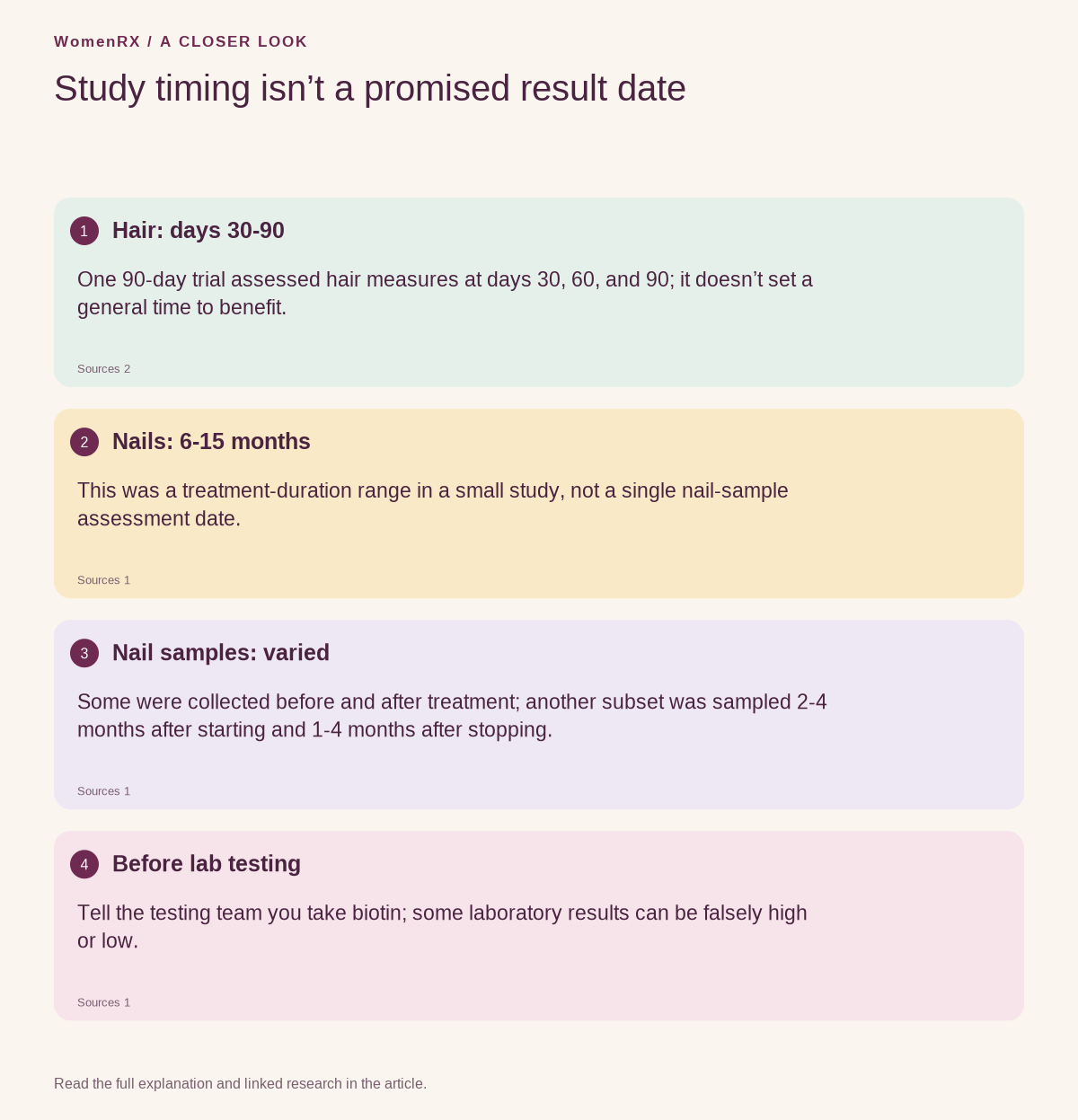
Study timing isn’t a promised result date
Hair: days 30-90: One 90-day trial assessed hair measures at days 30, 60, and 90; it doesn’t set a general time to benefit.2
Nails: 6-15 months: This was a treatment-duration range in a small study, not a single nail-sample assessment date.1
Nail samples: varied: Some were collected before and after treatment; another subset was sampled 2-4 months after starting and 1-4 months after stopping.1
Before lab testing: Tell the testing team you take biotin; some laboratory results can be falsely high or low.1
Read the figure as text
Hair assessment visits, nail treatment durations, and nail sample collection are different kinds of timing. None establishes a guaranteed time to benefit.- Hair: days 30-90: One 90-day trial assessed hair measures at days 30, 60, and 90; it doesn’t set a general time to benefit.2
- Nails: 6-15 months: This was a treatment-duration range in a small study, not a single nail-sample assessment date.1
- Nail samples: varied: Some were collected before and after treatment; another subset was sampled 2-4 months after starting and 1-4 months after stopping.1
- Before lab testing: Tell the testing team you take biotin; some laboratory results can be falsely high or low.1
Sources you can check
- Biotin - Health Professional Fact SheetAccessed 2026-09-25Return to first citation
- The Role of Sesbania grandiflora-Derived Biotin and Bambusa arundinacea-Derived Silica Extracts in Promoting Hair, Skin, and Nail Health: A Randomized, Double-Blind, Placebo-Controlled Clinical Study.Patel MN, Maheshvari J, Patel N. · Cureus · 2025Return to first citation