Silica vs. Silicon Supplements: What the Evidence Shows
The form of silicon can affect absorption, but being absorbed doesn’t prove a supplement improves hair, skin, nails, or bones.
Silicon is an element; silica and silicates are compounds containing it, and orthosilicic acid is a soluble form. Supplements use different forms, which can vary in absorption. Human evidence for benefits is limited: a review describes a hair-fiber finding, while bone studies are largely animal research or human dietary associations. A few small, short safety findings apply only to particular forms and conditions. 2 3
First, separate the names
Silicon is an element found in foods and water. Silica and silicates are silicon-containing compounds. Orthosilicic acid is a soluble form of silicon, and some supplements use forms such as monomethylsilanetriol (MMST) or choline-stabilized orthosilicic acid (ch-OSA). These names refer to different chemical forms, not interchangeable ingredients. 2
That distinction matters because forms can differ in bioavailability, or how much is absorbed. A review describes orthosilicic acid as more readily available than polymerized forms, which are less readily absorbed. But evidence that a form is absorbed tells you only one step in the chain. It doesn’t establish that taking it changes a health outcome. 2
What the human evidence says about hair and skin
A review of silicon research describes a study in which ch-OSA partially prevented a loss of hair tensile strength. Tensile strength describes a hair fiber’s resistance to breaking. That finding is not the same as proof that a supplement prevents hair loss, promotes growth, or improves appearance. The review excerpt doesn’t provide enough detail about the study’s population or design to tell how broadly the result applies, including to women generally. 2
For skin, the review discusses proposed roles for silicon in collagen-related processes and findings from laboratory research. Those mechanisms give researchers reasons to investigate silicon, but they don’t demonstrate that a supplement visibly improves skin. This evidence also doesn’t establish a reliable supplement benefit for nails. 2
Bone claims: animal results aren’t human results
Silicon has shown bone-related effects in animal studies. For example, one study tested a novel silicon form in broiler chickens and reported increased silicon in blood and tibia, alongside a difference in tibia breaking strength in one trial. That result can help explain why the ingredient is being studied, but it doesn’t show that a supplement improves bone health or prevents fractures in people. 1
A 2024 review of controlled studies on silicon and bone excluded studies involving people. It discusses human research reporting associations between dietary silicon intake and bone measures, but an association does not show that supplements caused the difference. The review also describes substantial difficulty translating animal results into a human intake level. 3
So far, the evidence in these sources doesn’t establish that silicon supplements improve bone outcomes in women. It also doesn’t show that findings apply across reproductive stages, such as pregnancy, postpartum, perimenopause, or after menopause. 2 3
What the safety findings do, and don’t, tell you
Safety evidence is specific to the form and the conditions studied. A review describes a four-week study of MMST in 22 healthy women who were not menopausal. The study concluded that the supplement was absorbed and safe under the study conditions. A group of that size followed for four weeks cannot establish long-term safety, or safety for other forms, products, or groups of women. 2
The same review reports a separate assessment of ch-OSA, drawing on human and animal evidence. It concluded that the silicon in ch-OSA was bioavailable and that use at the proposed levels did not present a safety concern provided choline intake stayed below the stated maximum. That assessment is specific to ch-OSA and its conditions; it does not establish the safety of every silicon supplement or every product that uses a similar ingredient name. 2
A useful way to assess a product claim
Start with the outcome the product promises. For hair, look for human evidence measuring hair loss or growth if that’s the claim, rather than relying on a hair-fiber strength result. For skin or nails, ask whether the research measured the visible outcome being promised. For bone, distinguish human supplementation studies from animal experiments and from associations with dietary intake. 1 2 3
Then identify the specific silicon form. The research indicates that absorption varies across forms, but greater absorption alone does not make a product more effective. Finally, check whether safety evidence concerns that same form and whether the study duration and participants resemble the situation you’re considering. The available findings are too limited to establish a general need for silicon supplements for women’s hair, skin, nails, or bones. 2 3
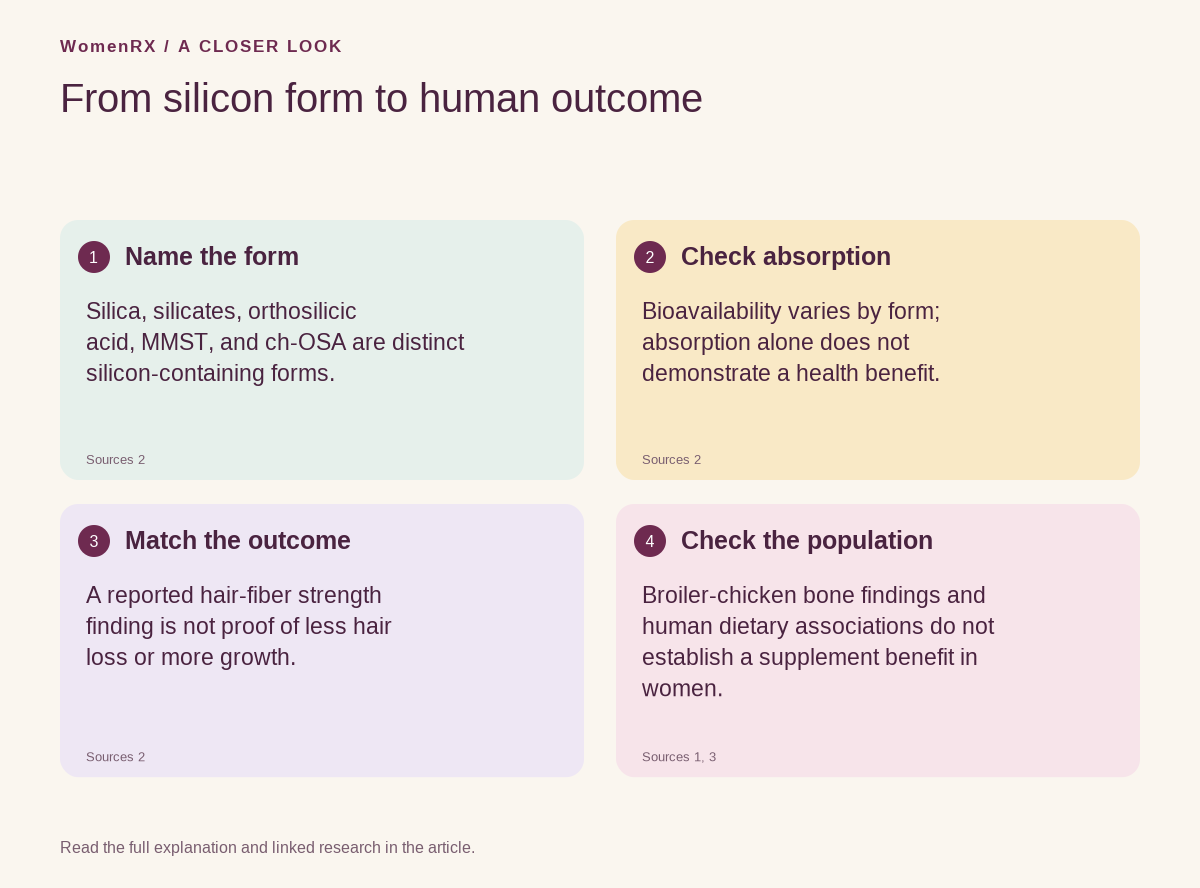
From silicon form to human outcome
Name the form: Silica, silicates, orthosilicic acid, MMST, and ch-OSA are distinct silicon-containing forms.2
Check absorption: Bioavailability varies by form; absorption alone does not demonstrate a health benefit.2
Match the outcome: A reported hair-fiber strength finding is not proof of less hair loss or more growth.2
Check the population: Broiler-chicken bone findings and human dietary associations do not establish a supplement benefit in women.13
Read the figure as text
Each step asks a different question: what form is used, whether it is absorbed, and whether a meaningful outcome has been demonstrated in people.- Name the form: Silica, silicates, orthosilicic acid, MMST, and ch-OSA are distinct silicon-containing forms.2
- Check absorption: Bioavailability varies by form; absorption alone does not demonstrate a health benefit.2
- Match the outcome: A reported hair-fiber strength finding is not proof of less hair loss or more growth.2
- Check the population: Broiler-chicken bone findings and human dietary associations do not establish a supplement benefit in women.13
More questions, answered
Does a more absorbable form mean a better supplement?
Not by itself. Absorption means the body takes up more of a form; it doesn’t prove a meaningful improvement in hair, skin, nails, or bones. That benefit needs to be measured in people. 2
Do these findings apply to women at every life stage?
That hasn’t been established. The review describes a four-week MMST study in 22 healthy women who were not menopausal, but this doesn’t show how findings apply during pregnancy, postpartum, perimenopause, or after menopause. 2
Sources you can check
- Bioavailability of a novel form of silicon supplement.Scholey DV, Belton DJ, Burton EJ, Perry CC. · Scientific reports · 2018Return to first citation
- Use of silicon for skin and hair care: an approach of chemical forms available and efficacy.Araújo LA, Addor F, Campos PM. · Anais brasileiros de dermatologia · 2016Return to first citation
- Silicon Supplementation for Bone Health: An Umbrella Review Attempting to Translate from Animals to Humans.Pritchard A, Nielsen BD. · Nutrients · 2024Return to first citation