Does Silica Really Help Hair, Skin, or Nails?
Small studies of one silicon formulation found changes in hair measurements and skin texture, but they don’t establish that a silica product will deliver a visible beauty benefit.
There’s some human evidence for choline-stabilized orthosilicic acid, a specific silicon formulation, but not for silica supplements as a category. In small trials involving women, researchers measured differences in hair-fiber properties and forearm skin texture; the nail finding relied on participants’ ratings of brittleness. Those results don’t demonstrate hair growth, visibly fuller hair, or stronger nails from the product you’re considering. 23
A promise of “stronger hair, skin, and nails” sounds straightforward. The studies behind it are less so. They tested choline-stabilized orthosilicic acid, usually shortened to ch-OSA, rather than every supplement sold under the word silica. And they measured three different things: how hair fibers behaved in a strength test, changes detected by skin instruments, and how brittle participants felt their hair and nails were. 23
Hair: a fiber test, not a hair-growth study
In a nine-month randomized trial, 48 women with fine hair received either ch-OSA beadlets providing 10 mg of silicon a day or a placebo. Researchers examined individual hairs before and after treatment. One measure, called the elastic gradient, worsened in both groups, but significantly less in the ch-OSA group. The force needed to break a hair fell in the placebo group and changed less in the ch-OSA group. Hair cross-sectional area increased significantly from baseline in the ch-OSA group, though the abstract doesn’t establish a significant between-group difference for that measure. 2
That’s a reason to study this formulation further, not proof it makes hair visibly thicker. The trial tested fiber properties in women who already had fine hair. Its reported endpoints don’t show that participants grew more hairs, had less shedding, or saw fuller-looking coverage on their scalps. The distinction matters if your concern is hair loss rather than hair breakage. 2
Skin: measured texture, not a before-and-after promise
A separate 20-week randomized trial involved 50 women with photodamaged facial skin. The researchers tested ch-OSA pellets against placebo, again providing 10 mg of silicon a day. They measured skin roughness and hydration on the forearm, and a mechanical property on the forehead. Two reported roughness measures changed more favorably with ch-OSA than with placebo. 3
Those are human skin measurements, not just a theory about collagen. But the roughness result came from the forearm, even though participants were recruited for facial photodamage. The abstract doesn’t report whether someone looking in the mirror would notice a difference, or whether the product improved the appearance of facial wrinkles. A claim about smoother-looking facial skin goes further than these reported endpoints. 3
Nails: the finding is more subjective
In that same 20-week trial, participants rated how brittle their hair and nails felt. Ratings were significantly lower after treatment in the ch-OSA group than they had been at the start. The abstract doesn’t report a placebo-group comparison for those brittleness ratings or describe an objective test of nail strength. So the result shouldn’t be presented as proof that ch-OSA strengthens nails more than a placebo. 3
A 2025 review of nail supplements describes ch-OSA among ingredients associated with improvements in nail appearance, strength, and brittleness. That broader assessment is worth knowing about, but its abstract doesn’t supply the underlying comparisons or effect sizes needed to turn the claim into a prediction for your nails. 4
How to judge the claim on a bottle
Start with the formulation. The two trials above used ch-OSA in beadlets or pellets. A label that says only “silica,” or names a different silicon-containing ingredient, doesn’t establish that its product was tested in those trials. Then look for a match between the promise and the measurement: a hair-strength test isn’t a hair-growth result, an instrument reading on forearm skin isn’t necessarily a visible facial change, and a brittleness rating isn’t a measured increase in nail strength. 23
That doesn’t make the trial findings meaningless. It makes them narrower than a three-in-one beauty promise. If a product cites a study, the useful question is: Was this formulation compared with a placebo in people, and did researchers measure the change I’m hoping to see?
If you’re considering silica because your hair is shedding or thinning, don’t assume a supplement addresses the cause. Hair loss can be temporary, related to an illness, or a form of pattern hair loss; identifying the type changes which treatments might help. 1
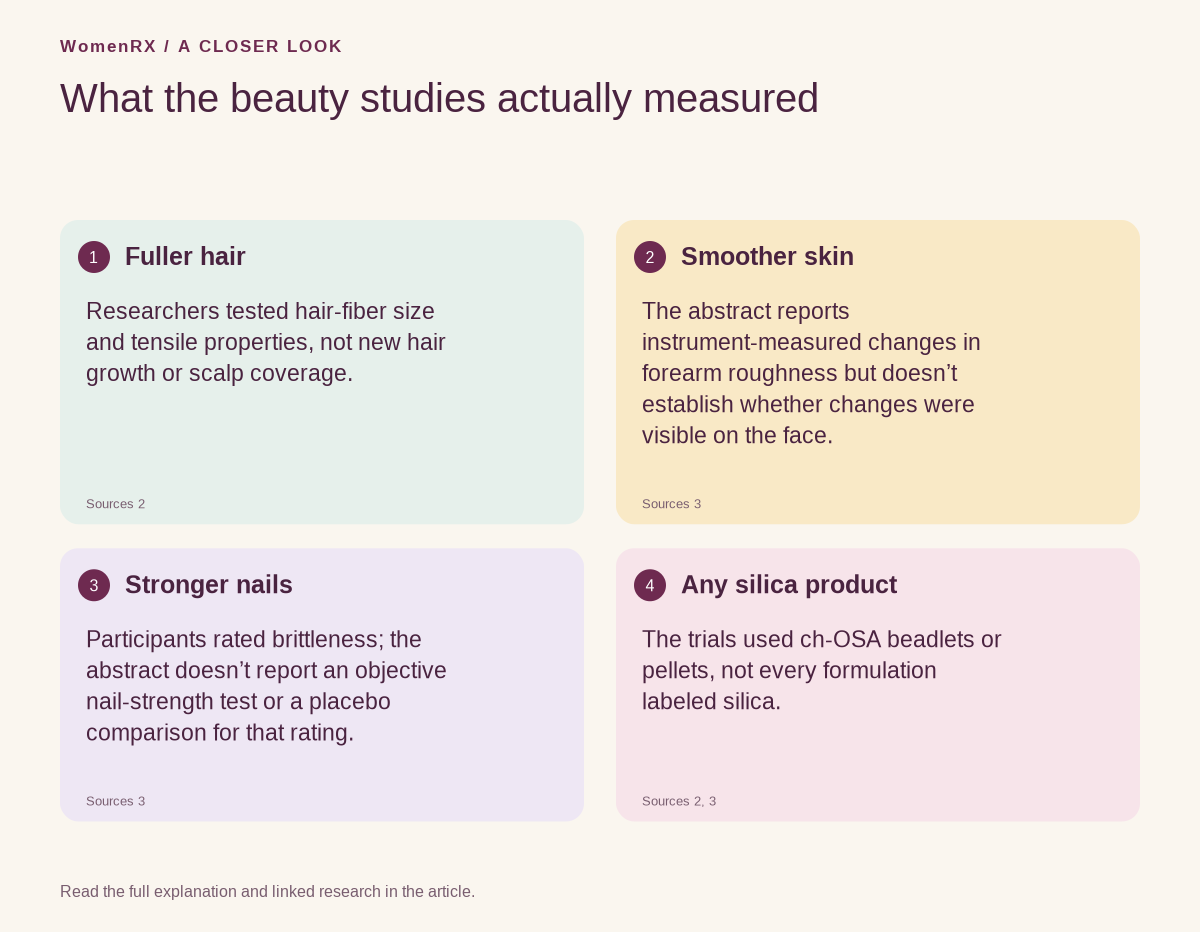
What the beauty studies actually measured
Fuller hair: Researchers tested hair-fiber size and tensile properties, not new hair growth or scalp coverage.2
Smoother skin: The abstract reports instrument-measured changes in forearm roughness but doesn’t establish whether changes were visible on the face.3
Stronger nails: Participants rated brittleness; the abstract doesn’t report an objective nail-strength test or a placebo comparison for that rating.3
Any silica product: The trials used ch-OSA beadlets or pellets, not every formulation labeled silica.23
Read the figure as text
Match each common promise to the outcome reported in trials of ch-OSA.- Fuller hair: Researchers tested hair-fiber size and tensile properties, not new hair growth or scalp coverage.2
- Smoother skin: The abstract reports instrument-measured changes in forearm roughness but doesn’t establish whether changes were visible on the face.3
- Stronger nails: Participants rated brittleness; the abstract doesn’t report an objective nail-strength test or a placebo comparison for that rating.3
- Any silica product: The trials used ch-OSA beadlets or pellets, not every formulation labeled silica.23
More questions, answered
Is a study reporting “thicker hair” evidence of new hair growth?
Not necessarily. In the fine-hair trial, researchers measured the cross-sectional area and tensile properties of hair fibers. Those measurements don’t tell us whether participants grew more hairs or had less shedding. 2
Sources you can check
- Hair loss - NHSAccessed 2026-09-25Return to first citation
- Effect of oral intake of choline-stabilized orthosilicic acid on hair tensile strength and morphology in women with fine hair.Wickett RR, Kossmann E, Barel A, Demeester N, Clarys P, Vanden Berghe D, Calomme M. · Archives of dermatological research · 2007Return to first citation
- Effect of oral intake of choline-stabilized orthosilicic acid on skin, nails and hair in women with photodamaged skin.Barel A, Calomme M, Timchenko A, De Paepe K, Demeester N, Rogiers V, Clarys P, Vanden Berghe D. · Archives of dermatological research · 2005Return to first citation
- Nail Supplements: When, How, and Why?Zaraa I, Richert B. · Skin appendage disorders · 2025Return to first citation