Does Silica Help Hair, Skin, or Nails?
A few small trials in women found signals for one specific form of silicon, but they don’t show that silica supplements broadly improve beauty concerns.
There’s limited human trial evidence for choline-stabilized orthosilicic acid, a particular form of silicon, in women with photodamaged skin or fine hair. The studies reported some improvements in skin measurements, hair properties, and self-rated hair and nail brittleness, but they were small and don’t establish that other silica products help, that results apply to hair loss, or that benefits are noticeable in everyday life. 2 3
The evidence is specific, not a yes for every silica product
“Silica” is often used as a general supplement term, but the human trials here tested choline-stabilized orthosilicic acid (ch-OSA), a particular, bioavailable form of silicon. A review describes silicon forms as differing in their bioavailability; results from ch-OSA trials shouldn’t be treated as proof for every product marketed as silica. 5
The distinction matters because silicon’s presence in hair, nails, and skin, or a proposed role in connective tissue, is biological context, not proof that taking a supplement improves those tissues. A review notes that silicon’s precise biological roles remain uncertain. 4 5
What the trials found, by concern
Skin changes: In a randomized, placebo-controlled study, 50 women with photodamaged facial skin took ch-OSA or placebo for 20 weeks. Some skin-surface roughness measurements changed more favorably with ch-OSA than placebo. This is a measured signal in women with sun-damaged skin, not evidence that the supplement reverses other kinds of skin changes or produces a visible result for everyone. 2
Fine hair: A separate randomized, placebo-controlled study enrolled 48 women with fine hair and compared ch-OSA with placebo over nine months. The researchers measured hair tensile properties and morphology. Some measures changed less in the supplement group, and hair cross-sectional area increased from baseline in that group. These findings concern hair structure in women with fine hair, not whether the supplement treats thinning, stops shedding, or regrows hair. 3
Brittle nails: In the 20-week study of women with photodamaged skin, participants taking ch-OSA reported lower hair and nail brittleness scores after treatment than at baseline. The cited nail finding is a change from baseline, not a demonstrated advantage over placebo. That makes it a weaker basis for expecting help with brittle nails than a clear between-group nail result would be. 2
What this means if you’re deciding whether to try it
The results are worth distinguishing from a blanket claim that silica improves hair, skin, and nails. The trials offer early evidence for one preparation and particular outcomes, but they don’t tell you whether other forms work, how well the findings hold up in broader groups, or whether any measured changes would be meaningful to you. The studies were in women, but the cited findings don’t show whether effects differ by menstrual or menopausal stage. 2 3
If you’re considering a product, check whether it actually contains ch-OSA rather than assuming all “silica” products match the tested form. Even a matching ingredient doesn’t guarantee the same result: these studies tested defined preparations, not every formulation sold. These studies also don’t establish how safe long-term use is, so they alone can’t settle that question. 2 3 5
For hair concerns, keep the question specific. These trials studied fine-hair properties, not the causes or treatment of hair loss. Hair loss can sometimes be related to a medical condition, so evidence about hair structure shouldn’t be used as a substitute for understanding why shedding or thinning is happening. 1 3
Bottom line: An oral ch-OSA supplement has a small amount of trial evidence in women for certain skin and hair measurements, plus a limited self-reported signal for brittle nails. That may be a reason to look more closely at the exact form and claim, but it isn’t strong evidence that silica in general will solve a hair, skin, or nail concern.
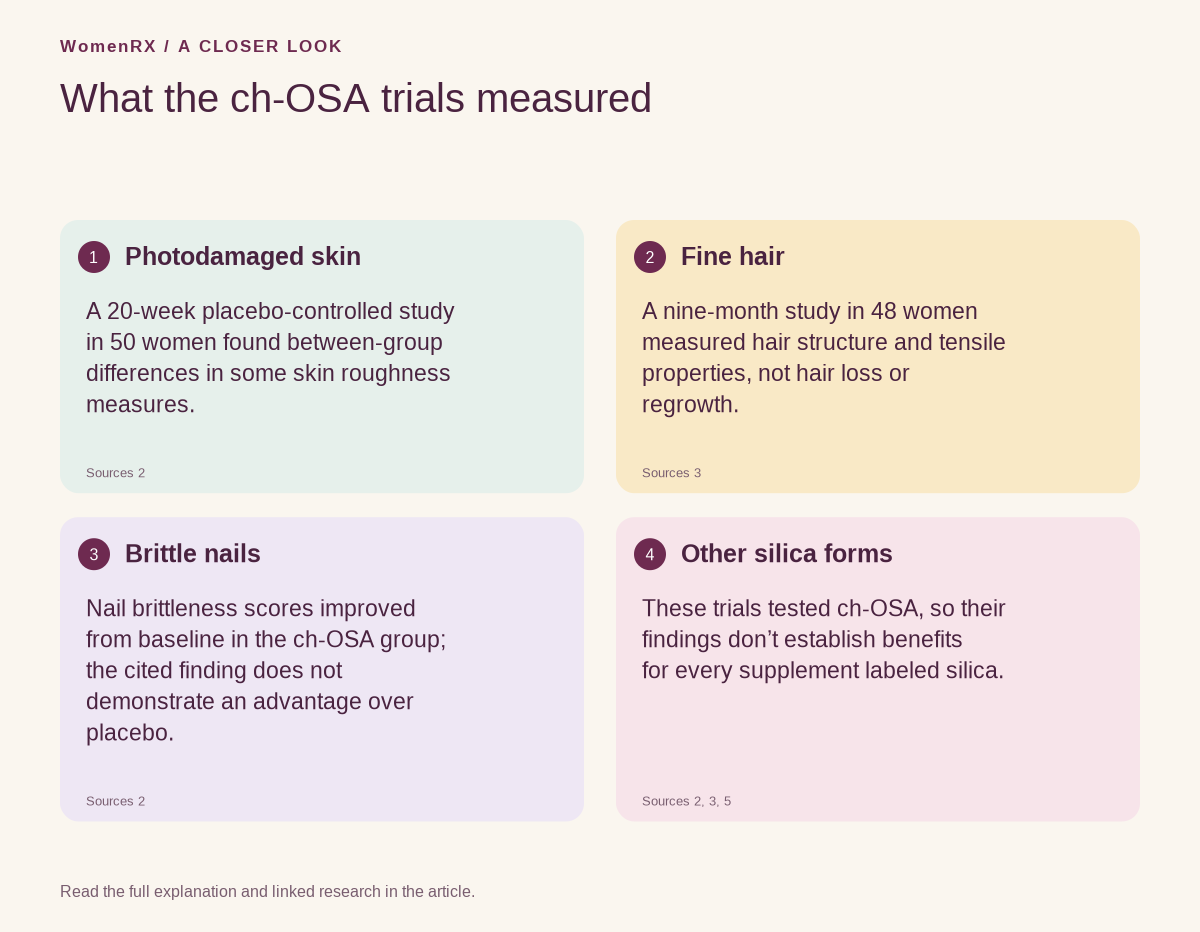
What the ch-OSA trials measured
Photodamaged skin: A 20-week placebo-controlled study in 50 women found between-group differences in some skin roughness measures.2
Fine hair: A nine-month study in 48 women measured hair structure and tensile properties, not hair loss or regrowth.3
Brittle nails: Nail brittleness scores improved from baseline in the ch-OSA group; the cited finding does not demonstrate an advantage over placebo.2
Other silica forms: These trials tested ch-OSA, so their findings don’t establish benefits for every supplement labeled silica.235
Read the figure as text
These studies offer limited evidence for one silicon preparation. The outcome and comparison matter.- Photodamaged skin: A 20-week placebo-controlled study in 50 women found between-group differences in some skin roughness measures.2
- Fine hair: A nine-month study in 48 women measured hair structure and tensile properties, not hair loss or regrowth.3
- Brittle nails: Nail brittleness scores improved from baseline in the ch-OSA group; the cited finding does not demonstrate an advantage over placebo.2
- Other silica forms: These trials tested ch-OSA, so their findings don’t establish benefits for every supplement labeled silica.235
More questions, answered
Does the hair research show that silica can regrow hair?
No. The nine-month trial studied hair strength and morphology in women with fine hair. It did not test treatment for hair loss or regrowth. 3
Are silica and silicon the same thing in supplements?
The terms refer to related but different forms: silicon is the element, while silica is a silicon-and-oxygen compound. Supplements can also use specific silicon forms such as choline-stabilized orthosilicic acid. Forms differ, so evidence for one shouldn’t automatically be applied to another. 5
Sources you can check
- Hair loss - NHSAccessed 2026-09-25Return to first citation
- Effect of oral intake of choline-stabilized orthosilicic acid on skin, nails and hair in women with photodamaged skin.Barel A, Calomme M, Timchenko A, De Paepe K, Demeester N, Rogiers V, Clarys P, Vanden Berghe D. · Archives of dermatological research · 2005Return to first citation
- Effect of oral intake of choline-stabilized orthosilicic acid on hair tensile strength and morphology in women with fine hair.Wickett RR, Kossmann E, Barel A, Demeester N, Clarys P, Vanden Berghe D, Calomme M. · Archives of dermatological research · 2007Return to first citation
- Silicon: the health benefits of a metalloid.Martin KR. · Metal ions in life sciences · 2013Return to first citation
- Biological and therapeutic effects of ortho-silicic acid and some ortho-silicic acid-releasing compounds: New perspectives for therapy.Jurkić LM, Cepanec I, Pavelić SK, Pavelić K. · Nutrition & metabolism · 2013Return to first citation