Silica Supplements for Hair, Nails, and Bones
Small studies have examined particular forms of silicon, but their findings don’t apply to every bottle labeled “silica.”
For hair and nails, limited human trials have reported positive findings with choline-stabilized orthosilicic acid. For bones, a reported finding in postmenopausal women tested orthosilicic acid added to calcium and vitamin D, not silica taken alone. Before deciding whether a study applies to a supplement, compare its silicon form, other ingredients, and measured outcome with your reason for considering it. 2 4 5
“Silica” on a label doesn’t identify one interchangeable ingredient. Silicon comes in different chemical forms, and reviews report that their absorption varies. Orthosilicic acid is considered a bioavailable form, but absorption is only the first question. The next is whether taking a particular form improved the outcome you care about. 1 4
Hair: a finding for one formulation, not a hair-loss treatment
A review of silicon for skin and hair care describes randomized studies of choline-stabilized orthosilicic acid, often shortened to ch-OSA. It reports positive hair findings in a placebo-controlled trial and in another randomized study involving 48 volunteers. The review also concludes that clinical research on efficacy and safety remains limited. These studies offer a reason to investigate ch-OSA further, not a reliable prediction of what you’ll see in the mirror. 4
Match the claim to the outcome. If you’re worried about shedding, a positive finding on a measured hair characteristic shouldn’t be read as proof that a supplement treats the cause of hair loss. The reported findings don’t establish how consistently people notice a cosmetic difference, and they don’t validate other products simply labeled “silica.” 4
Nails: a reported result, with little to generalize from
The same review describes a placebo-controlled ch-OSA trial that reported positive nail as well as hair findings. That’s more directly relevant to brittle nails than a claim based only on how silicon might contribute to tissue structure. Still, a reported result with this formulation doesn’t establish that every silicon supplement strengthens nails or that an individual will notice a change. 4
For both hair and nails, the useful distinction is between the form studied and the category sold. A bottle containing another silicon compound isn’t the product tested in the ch-OSA trials. 4
Bones: the postmenopausal study tested an addition
A review reports a potentially beneficial finding for femoral bone mineral density when orthosilicic acid was added to calcium and vitamin D, compared with calcium and vitamin D alone. Another review identifies the studied population as postmenopausal women. Because the comparison included calcium and vitamin D in both groups, it can examine the possible incremental effect of adding orthosilicic acid. It does not tell us whether taking silica alone improves bone density, and a bone-density finding is not proof that a supplement prevents fractures. 2 5
Life stage matters when reading other bone research. A reported dietary association between higher silicon intake and higher bone mineral density was seen in men and premenopausal women, but not postmenopausal women in the cross-sectional study discussed by reviews. That observation concerns diet, not the effect of starting a supplement; it shouldn’t be used to promise a bone benefit after menopause. 3 5
There’s a plausible biological question behind the bone research. In a laboratory study, orthosilicic acid reduced the development and bone-resorbing activity of osteoclasts grown from human cells. Cells in a dish, though, can’t show whether an oral supplement improves bone density or prevents fractures in a person. 3
How close is the bottle to the study?
A product claim becomes more useful when you can make three comparisons:
- Form: Does the label identify choline-stabilized orthosilicic acid, orthosilicic acid, or a different silicon compound? Absorption and the available clinical findings differ by form. 1 4
- Other ingredients: Is silicon the only ingredient you’re evaluating, or is it combined with calcium and vitamin D? The reported postmenopausal bone comparison tested the addition of orthosilicic acid to those two nutrients. It didn’t test standalone silica. 2 5
- Outcome: Is the evidence about hair or nail characteristics, bone mineral density, or something else? A result on one measure doesn’t establish less hair shedding or fewer fractures. 2 4
For example, if you’re considering a generic silica capsule for bone health after menopause, the reported combination study is an imperfect match: its silicon form and other ingredients both matter. If a product doesn’t clearly name its silicon form, it’s harder to connect that bottle to any of these findings. The evidence leaves room for further study, but not for calling one silica supplement the best choice for hair, nails, or bones. 2 4 5
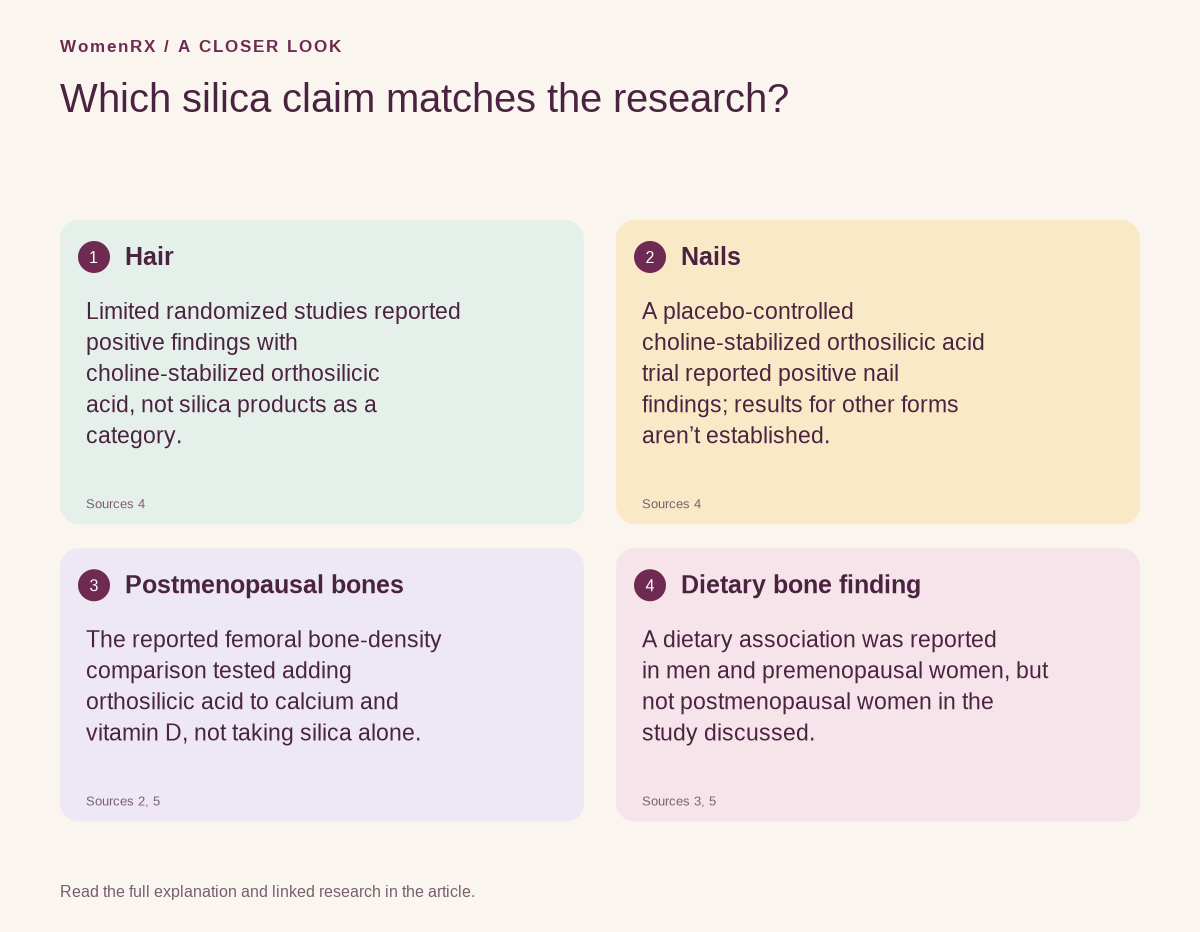
Which silica claim matches the research?
Hair: Limited randomized studies reported positive findings with choline-stabilized orthosilicic acid, not silica products as a category.4
Nails: A placebo-controlled choline-stabilized orthosilicic acid trial reported positive nail findings; results for other forms aren’t established.4
Postmenopausal bones: The reported femoral bone-density comparison tested adding orthosilicic acid to calcium and vitamin D, not taking silica alone.25
Dietary bone finding: A dietary association was reported in men and premenopausal women, but not postmenopausal women in the study discussed.35
Read the figure as text
The human findings differ by outcome, silicon form, and what else participants received.- Hair: Limited randomized studies reported positive findings with choline-stabilized orthosilicic acid, not silica products as a category.4
- Nails: A placebo-controlled choline-stabilized orthosilicic acid trial reported positive nail findings; results for other forms aren’t established.4
- Postmenopausal bones: The reported femoral bone-density comparison tested adding orthosilicic acid to calcium and vitamin D, not taking silica alone.25
- Dietary bone finding: A dietary association was reported in men and premenopausal women, but not postmenopausal women in the study discussed.35
More questions, answered
Is a more absorbable form automatically more effective?
No. Reviews describe orthosilicic acid as a bioavailable form and report differences in absorption among silicon compounds. Absorption doesn’t by itself establish a visible hair or nail improvement, or a bone benefit. 1 4
Sources you can check
- Silicon: the health benefits of a metalloid.Martin KR. · Metal ions in life sciences · 2013Return to first citation
- Silicon: A neglected micronutrient essential for bone health.Rondanelli M, Faliva MA, Peroni G, Gasparri C, Perna S, Riva A, Petrangolini G, Tartara A. · Experimental biology and medicine (Maywood, N.J.) · 2021Return to first citation
- Orthosilicic acid inhibits human osteoclast differentiation and bone resorption.Magnusson C, Ransjö M. · PloS one · 2024Return to first citation
- Use of silicon for skin and hair care: an approach of chemical forms available and efficacy.Araújo LA, Addor F, Campos PM. · Anais brasileiros de dermatologia · 2016Return to first citation
- Silicon Supplementation for Bone Health: An Umbrella Review Attempting to Translate from Animals to Humans.Pritchard A, Nielsen BD. · Nutrients · 2024Return to first citation