Silica After 40: What the Bone Evidence Really Shows
Silicon has been studied in women with low bone mass, but the results don’t yet show that a supplement prevents fractures or treats osteoporosis.
If you’re considering silica for bone health after 40, the human evidence is promising in places but not strong enough to establish a reliable benefit. A trial in women with low bone mass found a change in one bone-formation marker, but not a significant overall change in spine bone density. A small study in postmenopausal women found no change in bone-turnover markers. 1 2
Start with the goal, not your age
Turning 40 doesn’t, by itself, tell you that you need more silicon or silica. The useful question is what you want a supplement to do. The human studies here focus on bone-related measures, not whether silica prevents fractures, treats osteoporosis, or improves hair or skin. The bone findings also don’t establish a benefit for every woman after 40.
Silicon appears in different forms in these studies. One trial tested choline-stabilized orthosilicic acid, or ch-OSA, alongside calcium and vitamin D. Another tested silicon-rich water in postmenopausal women. A separate short safety study used monomethylsilanetriol, or MMST, in healthy premenopausal women. Results from one form and group don’t automatically show that another product will have the same effects. 1 2 3
What the bone studies found
The more substantial trial randomized women with low bone mass to placebo or one of three ch-OSA amounts, while all participants also received calcium and vitamin D. Of 184 women randomized, 136 completed the 12-month study. The 6 mg and 12 mg silicon groups had a significant improvement versus placebo in one bone-formation marker, PINP, at 12 months. But there wasn’t a clear dose-response pattern, and overall lumbar spine bone density did not change significantly. A post-hoc analysis found a femoral-neck result in a subgroup with lower starting bone density. That subgroup result is not the same as proof of a benefit for all women. 2
A much smaller pilot study included 17 postmenopausal women with low bone mass. Participants drank either purified water or silicon-rich artesian water for 12 weeks. Silicon levels in urine rose in the silicon-water group, showing that the silicon was absorbed. But the study found no change in the measured bone-resorption or bone-formation markers over that period. It did not establish an effect on bone density or fractures. 1
Taken together, these trials suggest that silicon can be absorbed and may affect some bone-related measures in certain study settings. They don’t establish that a silica supplement prevents osteoporosis, improves bone density reliably, or reduces fractures. The trials also don’t show that taking a supplement is a substitute for assessing or treating low bone density.
What to check before spending money
Use the product label and its claims as a quick evidence check:
- Does the claim match your goal? A bone-marker finding is not proof of fewer fractures. Claims about hair or skin aren’t answered by the bone studies discussed here.
- Is the form named? The bone trial used ch-OSA; the postmenopausal pilot used silicon-rich water. A different form shouldn’t be assumed to have the same evidence. 1 2
- Is the amount clear? Look for the stated amount of silicon, not just a large-sounding amount of a compound. The ch-OSA trial tested 3, 6, and 12 mg of silicon daily, but those were research groups, not established recommended doses. 2
- Does the study population fit you? The water pilot specifically involved postmenopausal women. The ch-OSA trial enrolled women with low bone mass, but the information reported for that trial does not establish that its results apply specifically to perimenopausal or postmenopausal women. 1 2
- Are safety claims being stretched? In a four-week trial, 22 healthy premenopausal women taking MMST had no reported adverse effects or serum biochemical changes compared with placebo. That short study does not establish long-term safety or safety for every product or age group. 3
If bone health is your reason for considering silica, it may be more useful to first clarify whether you have low bone density and what care is appropriate for you. In the pilot study, silicon-rich water was considered alongside calcium and vitamin D, while the larger trial gave calcium and vitamin D to both the ch-OSA and placebo groups. Neither study shows that silicon can replace established bone-health care. 1 2
The practical takeaway
Silica is worth recognizing as a research question, not treating as a proven bone supplement. Before buying, check whether the product names its form and silicon amount, whether its claim matches an outcome actually studied, and whether the study population resembles you. If a product promises to prevent osteoporosis or reverse age-related changes, these studies don’t substantiate that promise.
Does the silica claim match the evidence?
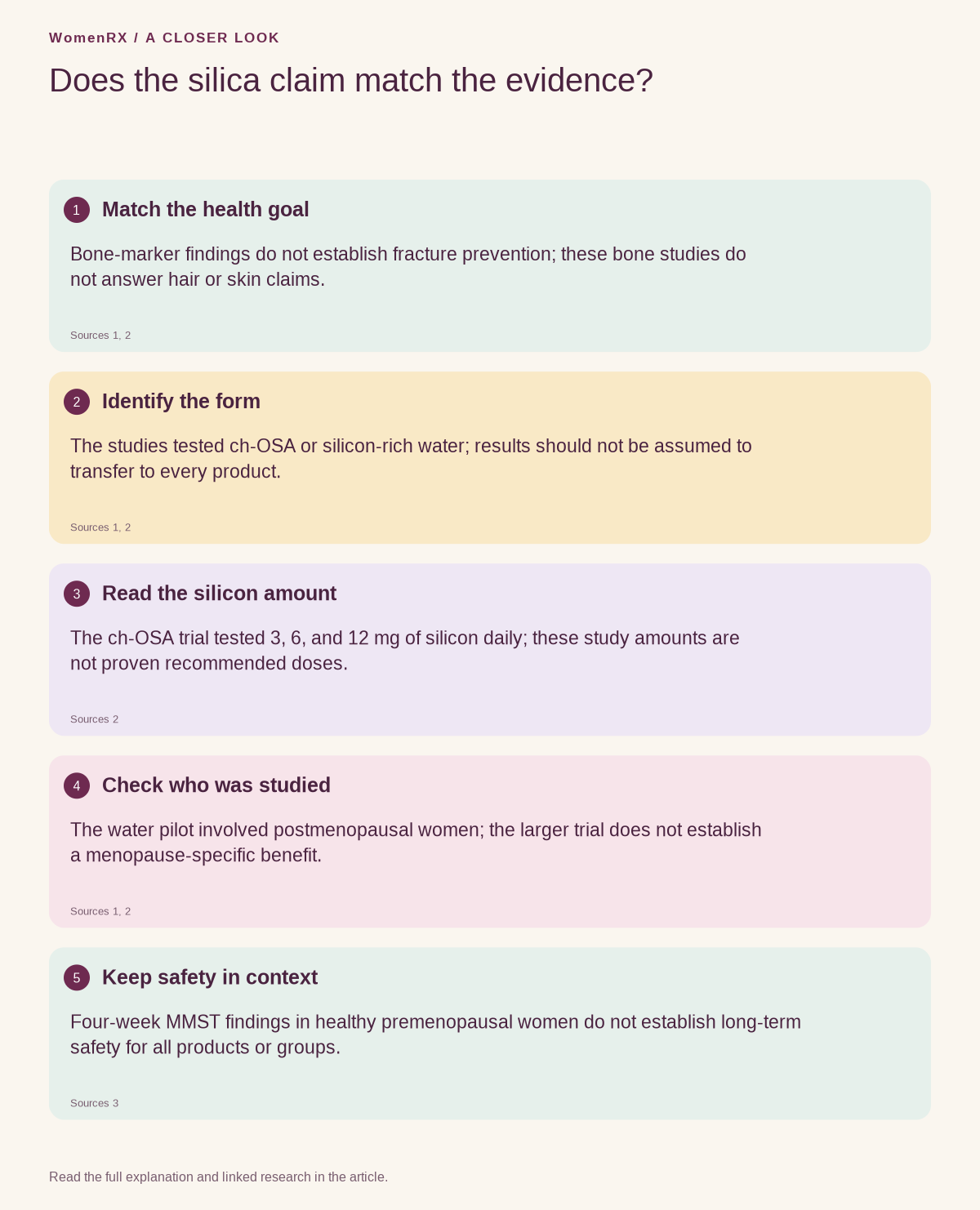
Match the health goal: Bone-marker findings do not establish fracture prevention; these bone studies do not answer hair or skin claims.12
Identify the form: The studies tested ch-OSA or silicon-rich water; results should not be assumed to transfer to every product.12
Read the silicon amount: The ch-OSA trial tested 3, 6, and 12 mg of silicon daily; these study amounts are not proven recommended doses.2
Check who was studied: The water pilot involved postmenopausal women; the larger trial does not establish a menopause-specific benefit.12
Keep safety in context: Four-week MMST findings in healthy premenopausal women do not establish long-term safety for all products or groups.3
Read the figure as text
Check the goal, product form, stated silicon amount, and study population before treating a supplement claim as relevant to you.- Match the health goal: Bone-marker findings do not establish fracture prevention; these bone studies do not answer hair or skin claims.12
- Identify the form: The studies tested ch-OSA or silicon-rich water; results should not be assumed to transfer to every product.12
- Read the silicon amount: The ch-OSA trial tested 3, 6, and 12 mg of silicon daily; these study amounts are not proven recommended doses.2
- Check who was studied: The water pilot involved postmenopausal women; the larger trial does not establish a menopause-specific benefit.12
- Keep safety in context: Four-week MMST findings in healthy premenopausal women do not establish long-term safety for all products or groups.3
More questions, answered
Is there a silica dose proven to protect bones?
No dose is established by these studies as proven to prevent fractures or osteoporosis. The ch-OSA trial compared groups receiving 3, 6, or 12 mg of silicon daily, but it found no significant overall change in lumbar spine bone density and did not establish a recommended dose. 2
Does the evidence apply specifically to postmenopausal women?
One small 12-week pilot did include postmenopausal women with low bone mass, but it found no change in measured bone-turnover markers. The larger ch-OSA trial was in women with low bone mass; the reported study information does not establish a specific perimenopausal or postmenopausal benefit. 1 2
Sources you can check
- Absorption of silicon from artesian aquifer water and its impact on bone health in postmenopausal women: a 12 week pilot study.Li Z, Karp H, Zerlin A, Lee TY, Carpenter C, Heber D. · Nutrition journal · 2010Return to first citation
- Choline-stabilized orthosilicic acid supplementation as an adjunct to calcium/vitamin D3 stimulates markers of bone formation in osteopenic females: a randomized, placebo-controlled trial.Spector TD, Calomme MR, Anderson SH, Clement G, Bevan L, Demeester N, Swaminathan R, Jugdaohsingh R, Berghe DA, Powell JJ. · BMC musculoskeletal disorders · 2008Return to first citation
- The silicon supplement 'Monomethylsilanetriol' is safe and increases the body pool of silicon in healthy Pre-menopausal women.Jugdaohsingh R, Hui M, Anderson SH, Kinrade SD, Powell JJ. · Nutrition & metabolism · 2013Return to first citation