What We Know About Long-Term Silica Supplement Safety
A 12-month study offers some reassurance for one specific oral silica form, but it can’t establish long-term safety for every product or life stage.
The available human evidence here is specific: a 12-month trial tested choline-stabilized orthosilicic acid in women with osteopenia, alongside calcium and vitamin D. Researchers reported no related adverse events, but that result doesn’t establish long-term safety for other silica forms, doses, or uses. The study also doesn’t report pregnancy or breastfeeding outcomes. Check a product’s form, amount, planned duration, and claims before deciding whether to continue it. 1
The safety answer depends on what “silica” means
“Silica supplement” isn’t a complete description of what you’re taking. The relevant human trial studied choline-stabilized orthosilicic acid, an oral formulation. It doesn’t automatically tell us about silicon dioxide, silicates, or engineered silica particles, which may have different properties and uses. Route matters, too: swallowing a supplement isn’t the same exposure as applying a cosmetic or using a product designed for the eye. 124
That distinction matters when you’re weighing a product for hair, skin, nails, bones, or another purpose. A safety finding for one formulation and use shouldn’t be treated as a blanket endorsement of every product with “silica” or “silicon” on its label.
What the 12-month study can tell you
In a randomized, placebo-controlled trial, 136 women with osteopenia completed 12 months of treatment. Participants received calcium and vitamin D along with either placebo or one of three daily amounts of choline-stabilized orthosilicic acid: 3, 6, or 12 milligrams of silicon. The study reported no adverse events related to the silica formulation, and measured biochemical safety parameters remained within the normal range. 1
That is useful, but narrow evidence. The participants had osteopenia, and the supplement was taken alongside calcium and vitamin D. The trial does not establish what happens with other formulations, different amounts, longer use, or use for cosmetic goals. Nor can a study of this size and duration settle questions about uncommon or delayed effects. The results offer a limited safety signal for the formulation studied, not proof that every silica supplement is safe indefinitely. 1
The trial was designed around bone markers and bone density, not cosmetic outcomes. It found a significant difference in one bone-formation marker at two studied amounts, but lumbar-spine bone density did not change significantly overall. That result doesn’t establish that silica supplements improve skin, hair, or nails. 1
Why other silica studies don’t fill the gap
Safety assessments are tied to the material and exposure being assessed. A 2025 cosmetic-ingredient assessment concluded that synthetically manufactured amorphous silica and hydrated silica are safe under current cosmetic uses and concentrations when formulated to be non-irritating. That assessment concerns ingredients in cosmetics, not swallowed supplements. 4
Likewise, research on silica eye drops or engineered nanoparticles concerns different products and routes. For example, a small eye-drop study followed 12 healthy volunteers for 15 days, while reviews of mesoporous silica nanoparticles discuss specialized materials used in biomedical research. Neither answers whether taking an oral beauty supplement for years is safe. 23
A practical label check before you continue
Look for four details, and pause if the label or manufacturer’s information leaves them unclear:
- Form: Is the product choline-stabilized orthosilicic acid, silicon dioxide, or another form? Don’t assume evidence for one applies to another.
- Amount: Does the stated amount refer to silicon itself or to the full compound? The trial reported its study amounts as milligrams of silicon, so keep that distinction in mind when comparing a product with the study. 1
- Duration: How long do you intend to take it, and does the evidence you’re relying on actually cover that length of time? The relevant trial lasted 12 months, not indefinitely. 1
- Claim: Is the product promising a cosmetic result? The trial described here doesn’t establish cosmetic benefits, so don’t mistake a safety finding for proof that a product works. 1
If you’re pregnant or breastfeeding, don’t use the bone study as reassurance for those stages: it doesn’t report outcomes for pregnancy or breastfeeding. It therefore can’t establish safety for either. 1
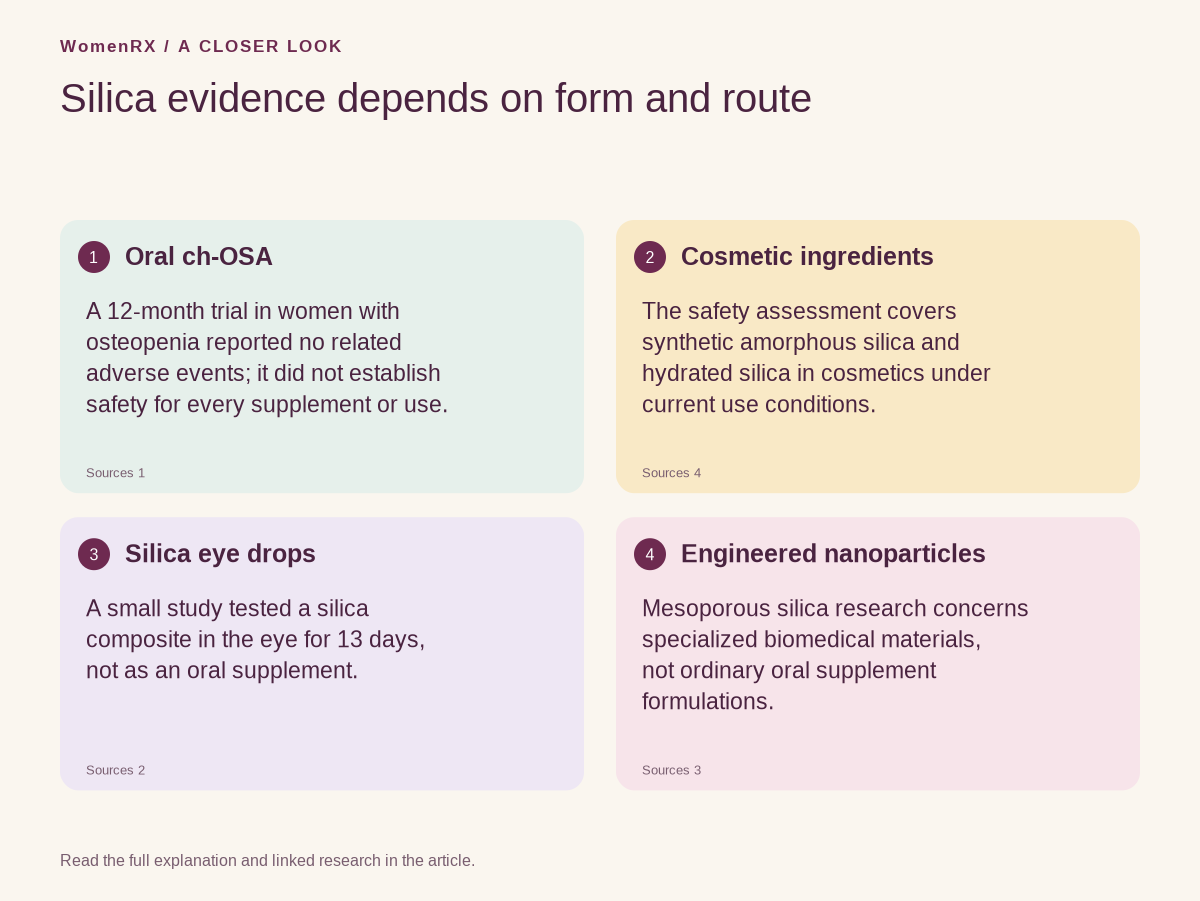
Silica evidence depends on form and route
Oral ch-OSA: A 12-month trial in women with osteopenia reported no related adverse events; it did not establish safety for every supplement or use.1
Cosmetic ingredients: The safety assessment covers synthetic amorphous silica and hydrated silica in cosmetics under current use conditions.4
Silica eye drops: A small study tested a silica composite in the eye for 13 days, not as an oral supplement.2
Engineered nanoparticles: Mesoporous silica research concerns specialized biomedical materials, not ordinary oral supplement formulations.3
Read the figure as text
These examples show why a finding about one silica product or exposure cannot automatically answer questions about an oral supplement.- Oral ch-OSA: A 12-month trial in women with osteopenia reported no related adverse events; it did not establish safety for every supplement or use.1
- Cosmetic ingredients: The safety assessment covers synthetic amorphous silica and hydrated silica in cosmetics under current use conditions.4
- Silica eye drops: A small study tested a silica composite in the eye for 13 days, not as an oral supplement.2
- Engineered nanoparticles: Mesoporous silica research concerns specialized biomedical materials, not ordinary oral supplement formulations.3
More questions, answered
Does a cosmetic silica safety assessment apply to a supplement?
No. The assessment described here covers synthetically manufactured amorphous silica and hydrated silica in cosmetic products under current use conditions. It does not assess swallowed supplements. 4
Does the 12-month trial show that silica improves skin or hair?
No. The trial studied bone-related outcomes in women with osteopenia. It doesn’t establish a cosmetic benefit for skin, hair, or nails. 1
Sources you can check
- Choline-stabilized orthosilicic acid supplementation as an adjunct to calcium/vitamin D3 stimulates markers of bone formation in osteopenic females: a randomized, placebo-controlled trial.Spector TD, Calomme MR, Anderson SH, Clement G, Bevan L, Demeester N, Swaminathan R, Jugdaohsingh R, Berghe DA, Powell JJ. · BMC musculoskeletal disorders · 2008Return to first citation
- Randomized, single-centre, double-blinded repeated dose investigation of safety and tolerability of ocular administrations of a novel silica eye drop product in healthy volunteers.Poluianova A, Akieh-Pirkanniemi MN, Hartikainen A, Arstila H, Kaarniranta K, Leino L. · Acta ophthalmologica · 2026Return to first citation
- Unlocking the potential of mesoporous silica nanoparticles: balancing biomedical applications and safety concerns.Hou Y, Zhu C, Shen Z, Cao D, Wei L, Yang J, Shi C, Wu M, Zheng S, Chen Y, Zhou X. · Drug delivery · 2026Return to first citation
- Amended Safety Assessment of Synthetically Manufactured Amorphous Silica and Hydrated Silica as Used in Cosmetics.Burnett CL, Bergfeld WF, Belsito DV, Klaassen CD, Liebler DC, Marks JG, Shank RC, Slaga TJ, Snyder PW, Fiume MM, Heldreth B. · International journal of toxicology · 2025Return to first citation