How to Read a Silica Supplement Label
Compare the stated silicon amount, not just the weight of a named ingredient, and treat testing claims as questions to verify.
Look for the specific silicon source and an amount of silicon per serving, rather than only the weight of a compound or blend. Research may report silicon in milligrams while describing a source such as choline-stabilized orthosilicic acid, or report silica in water, so the wording matters. Then ask what any product-testing claim covered. Bone studies in women measured specific outcomes, not hair or nails. 2 3
Start with the ingredient name and the amount
A label might name silica, silicon, or a silicon-containing form such as orthosilicic acid. Those words don’t tell you the same thing about the amount being reported. In a study of choline-stabilized orthosilicic acid, researchers described the study doses as milligrams of silicon. Another study reported the silica concentration in water and measured urinary silicon. 2 3
For a product comparison, look for an amount stated as silicon (or Si) per serving, as well as the serving size. If the label gives only the weight of a named ingredient or a combined blend, it may not show how much silicon that serving provides. Don’t treat the larger-looking number as automatically meaning more silicon.
A useful question for a company is: “How much silicon does one serving provide, and where is that amount shown on the label?” If the answer isn’t clear, you can’t make a straightforward comparison with a study that reports its dose as milligrams of silicon.
Check what a bone-health claim actually measured
One randomized, placebo-controlled trial followed women with a spine T-score below −1.5. Of the 184 women randomized, 136 completed the 12-month study. Participants received calcium and vitamin D along with placebo or one of three doses of choline-stabilized orthosilicic acid, reported as 3, 6, or 12 milligrams of silicon. The study did not establish that every participant had osteopenia. 3
At 12 months, one bone-formation marker, PINP, was significantly different from placebo in the 6- and 12-milligram silicon groups, without a clear dose-response pattern. Overall, lumbar-spine bone mineral density did not change significantly. The marker finding and the BMD result are different outcomes; neither establishes that a product prevents fractures. 3
A separate 12-week pilot studied 17 postmenopausal women with low bone mass who did not have osteopenia or osteoporosis by the study’s DEXA assessment. Women assigned to silicon-rich artesian water drank one liter daily; the water contained 86 mg/L silica. Urinary silicon increased, but the measured bone-resorption and bone-formation markers did not change. This was a water study, not a trial of a typical silica supplement. 2
These studies offer specific findings in women, including postmenopausal women, but they don’t settle whether a particular product improves bone health. A label that lists an ingredient and amount tells you what the company says is in the serving; it doesn’t show that the product produces the outcomes measured in a study.
Keep hair and nail promises separate
The bone studies above did not test hair growth or nail strength. A small trial of a silicon-containing product studied skin appearance, not hair or nails; its objective image assessments did not show statistically significant differences. A skin result, whether positive or not, can’t establish a hair or nail benefit. 4
When a label promises fuller hair, stronger nails, or better bones, check whether the study behind that particular claim tested the same outcome in people like you. “Women” isn’t one research group: a study in postmenopausal women with low bone mass doesn’t automatically answer a question about hair in cycling-age women, for example.
Make “tested” a specific claim
“Third-party tested” is easier to assess when the company explains the details. Ask who performed the testing, whether it applies to the product or a specific batch, and what the tests checked. For example, did they verify ingredient identity or amount, or test for contaminants? Look for a report or other explanation of the results rather than relying on a logo or broad phrase alone.
These are practical questions for comparing what a company discloses, not a guarantee that any particular testing program is complete. Testing information can help you assess the product’s identity and quality claims; it doesn’t demonstrate that silica or silicon will deliver a hair, nail, or bone benefit.
If your concern is bone loss, a supplement label can’t measure your bones. A bone-density scan is used to assess bone density and can show low bone density or osteoporosis. 1
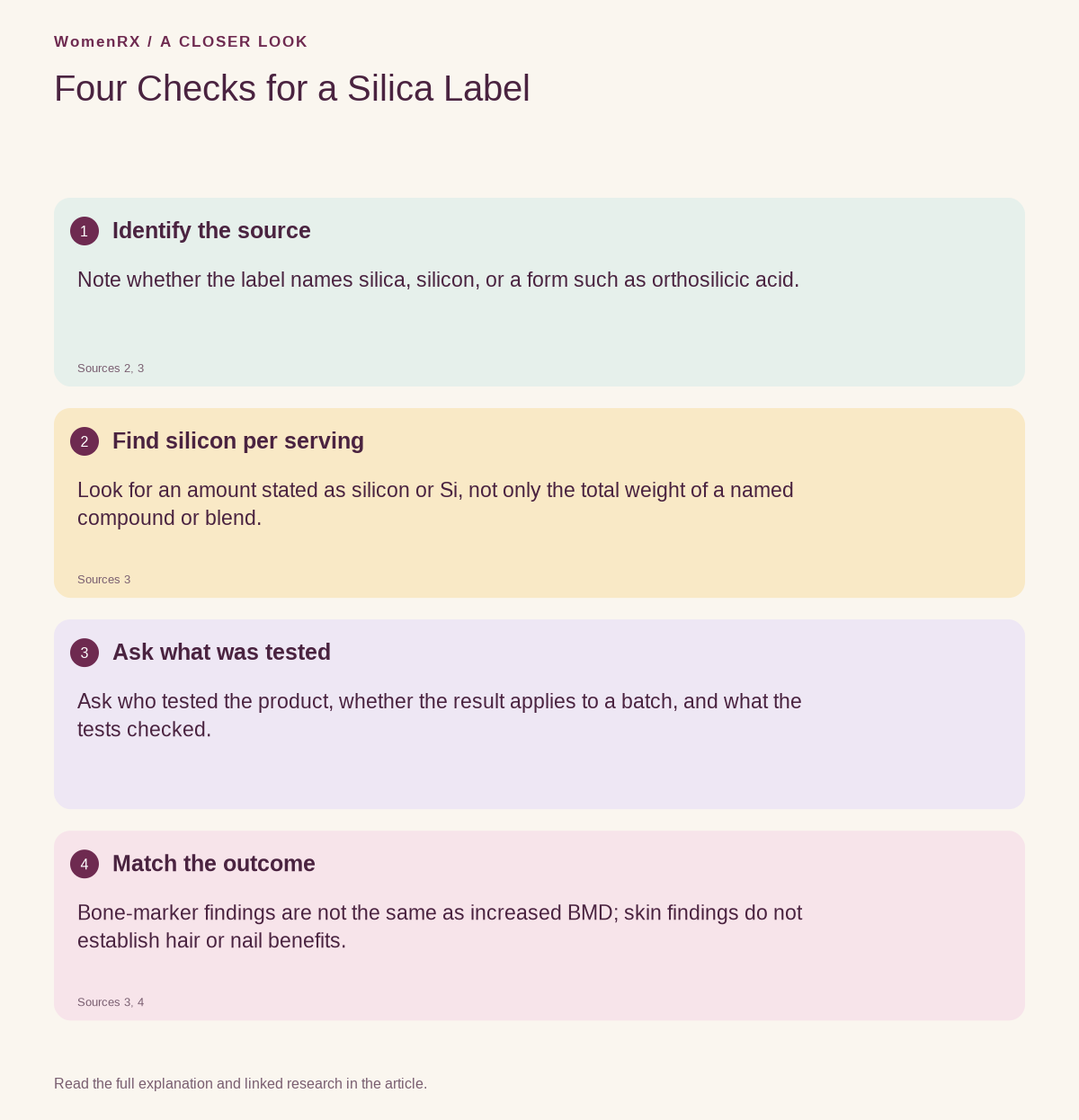
Four Checks for a Silica Label
Identify the source: Note whether the label names silica, silicon, or a form such as orthosilicic acid.23
Find silicon per serving: Look for an amount stated as silicon or Si, not only the total weight of a named compound or blend.3
Ask what was tested: Ask who tested the product, whether the result applies to a batch, and what the tests checked.
Match the outcome: Bone-marker findings are not the same as increased BMD; skin findings do not establish hair or nail benefits.34
Read the figure as text
Use these questions to separate ingredient disclosure, evidence, and product-testing details.- Identify the source: Note whether the label names silica, silicon, or a form such as orthosilicic acid.23
- Find silicon per serving: Look for an amount stated as silicon or Si, not only the total weight of a named compound or blend.3
- Ask what was tested: Ask who tested the product, whether the result applies to a batch, and what the tests checked.
- Match the outcome: Bone-marker findings are not the same as increased BMD; skin findings do not establish hair or nail benefits.34
More questions, answered
Can I compare a compound’s listed weight with a study dose?
Not reliably unless the label also states how much silicon the serving provides. The choline-stabilized orthosilicic acid trial reported its study doses in milligrams of silicon, not simply as the total weight of the compound. 3
Does a change in a bone marker mean bone density increased?
No. In the 12-month trial in women, PINP differed significantly from placebo at two silicon doses, but overall lumbar-spine bone mineral density did not change significantly. 3
Sources you can check
- Bone Density | Bone Mineral Density | BMD | MedlinePlusAccessed 2026-09-25Return to first citation
- Absorption of silicon from artesian aquifer water and its impact on bone health in postmenopausal women: a 12 week pilot study.Li Z, Karp H, Zerlin A, Lee TY, Carpenter C, Heber D. · Nutrition journal · 2010Return to first citation
- Choline-stabilized orthosilicic acid supplementation as an adjunct to calcium/vitamin D3 stimulates markers of bone formation in osteopenic females: a randomized, placebo-controlled trial.Spector TD, Calomme MR, Anderson SH, Clement G, Bevan L, Demeester N, Swaminathan R, Jugdaohsingh R, Berghe DA, Powell JJ. · BMC musculoskeletal disorders · 2008Return to first citation
- Evaluation of cutaneous rejuvenation associated with the use of ortho-silicic acid stabilized by hydrolyzed marine collagen.Petersen Vitello Kalil CL, Campos V, Cignachi S, Favaro Izidoro J, Prieto Herman Reinehr C, Chaves C. · Journal of cosmetic dermatology · 2018Return to first citation