Does Silica Need to Be Taken With Food?
Absorption findings don’t establish a meal-timing rule for silica supplements, so start with the form and your product’s directions.
Start with the directions for your exact product. “Silica” can refer to different silicon sources, and evidence that one form is absorbed doesn’t tell you whether taking it with food changes absorption or stomach comfort. If the label doesn’t name the form, clarify the ingredient before borrowing advice from another product. 1
Start with the form on the label
“Silica” is a broad label, not a single supplement ingredient. Products may use different silicon sources, including orthosilicic acid forms, silicon dioxide, silicic acid gel, or other compounds. Those forms shouldn’t be treated as interchangeable when deciding how to take a product. 1
Look for the full ingredient name and the directions on your bottle. If it says to take the product with food or on an empty stomach, follow that product-specific instruction. If it gives no meal instruction, don’t add an empty-stomach requirement based on the word “silica” alone.
What the absorption evidence does, and doesn’t, tell us
An EFSA assessment reported that silicon from an orthosilicic acid-vanillin complex was bioavailable after oral use in human volunteers, based on increased silicon levels in plasma. That finding shows absorption from this particular source; the assessment does not compare taking it with food versus fasting or report a comparison of digestive comfort. It concerned use in adults. 1
Another study used Caco-2 intestinal cells to examine transport of silicon supplied as the same orthosilicic acid-vanillin complex. The researchers observed transport across the cell model, but they did not compare doses taken with meals and without food in people. The human plasma finding and the cell-model finding address different parts of absorption; neither identifies a preferred meal schedule. 12
A separate laboratory study used simulated digestion and cells to examine silicon from vegetables and a supplement. Those in-vitro methods can explore bioaccessibility and transport, but they don’t answer whether a person should take a particular supplement with a meal. 3
If the label is vague
Check the complete label, including the named silicon source and other ingredients, rather than relying on the front-of-bottle word “silica.” If you still can’t tell which form it contains, ask the manufacturer or a pharmacist to identify it and clarify any meal instructions for that formulation. A timing suggestion for a different silicon compound isn’t a substitute for your product’s directions. 1
If taking it upsets your stomach
If discomfort seems to follow a dose, the absorption findings don’t establish whether food would help. Note when the discomfort occurs relative to the dose and whether the label specifies a meal schedule. The bottle can help a pharmacist review those details and the product’s other ingredients with you. A change in comfort after changing your routine would not, by itself, show whether food changed silicon absorption.
If you’re pregnant or breastfeeding, the adult assessment of the orthosilicic acid-vanillin complex does not establish safety for you. 1
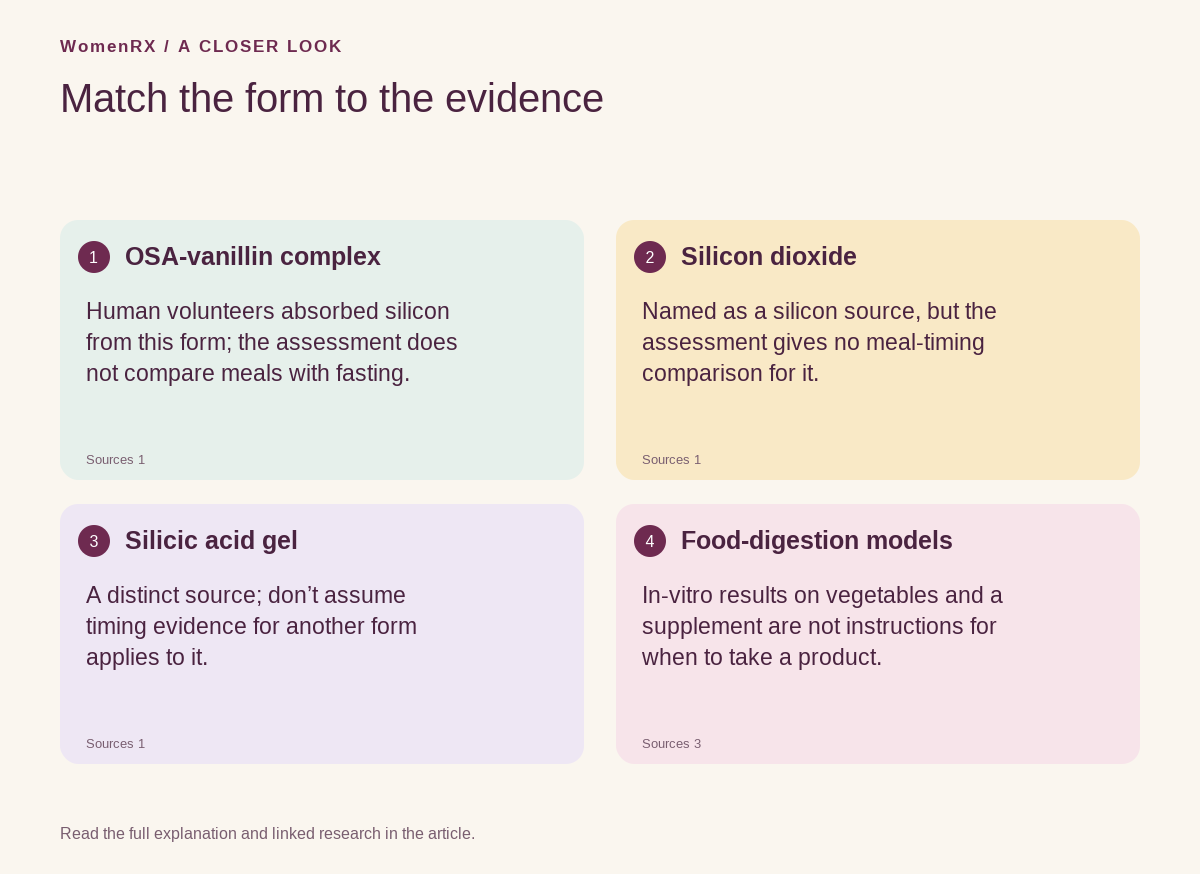
Match the form to the evidence
OSA-vanillin complex: Human volunteers absorbed silicon from this form; the assessment does not compare meals with fasting.1
Silicon dioxide: Named as a silicon source, but the assessment gives no meal-timing comparison for it.1
Silicic acid gel: A distinct source; don’t assume timing evidence for another form applies to it.1
Food-digestion models: In-vitro results on vegetables and a supplement are not instructions for when to take a product.3
Read the figure as text
Different ingredient forms and research methods answer different questions. Absorption findings for one form do not establish meal-timing advice for another.- OSA-vanillin complex: Human volunteers absorbed silicon from this form; the assessment does not compare meals with fasting.1
- Silicon dioxide: Named as a silicon source, but the assessment gives no meal-timing comparison for it.1
- Silicic acid gel: A distinct source; don’t assume timing evidence for another form applies to it.1
- Food-digestion models: In-vitro results on vegetables and a supplement are not instructions for when to take a product.3
Sources you can check
- Safety of orthosilicic acid-vanillin complex (OSA-VC) as a novel food ingredient to be used in food supplements as a source of silicon and bioavailability of silicon from the source.EFSA Panel on Food Additives and Nutrient Sources added to Food (ANS), Younes M, Aggett P, Aguilar F, Crebelli R, Dusemund B, Filipič M, Frutos MJ, Galtier P, Gundert-Remy U, Kuhnl... · EFSA journal. European Food Safety Authority · 2018Return to first citation
- In vitro investigation of intestinal transport mechanism of silicon, supplied as orthosilicic acid-vanillin complex.Sergent T, Croizet K, Schneider YJ. · Molecular nutrition & food research · 2017Return to first citation
- Integrated in vitro approaches to assess the bioaccessibility and bioavailability of silicon-biofortified leafy vegetables and preliminary effects on bone.D'Imperio M, Brunetti G, Gigante I, Serio F, Santamaria P, Cardinali A, Colucci S, Minervini F. · In vitro cellular & developmental biology. Animal · 2017Return to first citation