Should You Take Silica in the Morning or at Night?
Human studies show absorption after certain silicon supplements, but they haven’t established a better time of day to take them.
Neither morning nor night has a demonstrated advantage for the silicon forms studied. Researchers measured silicon in blood and urine for hours after a dose, rather than comparing dosing times. 1 2 Check your product’s form and directions first. If they don’t specify a time, choose one that fits your routine.
What the absorption studies can tell you
It’s easy to mistake a study that measures how long after a dose silicon appears in the blood for one that identifies the best time of day to take it. Those are different questions.
In one study, 26 healthy adults took silicon as orthosilicic acid. Researchers measured silicon in blood and urine over the following six hours. They examined absorption and differences by age and sex, not morning versus evening dosing. Overall, they found no marked difference in absorption or excretion by sex. That finding doesn’t establish a separate schedule for women. 2
Another study, described in a 2018 European Food Safety Authority assessment, followed 14 healthy people after they took an orthosilicic acid-vanillin complex or a placebo. Their blood silicon levels rose after the supplement, showing that silicon from this particular form was available after ingestion. The study did not test whether taking it at breakfast worked differently from taking it at bedtime. 1
The practical answer: don’t rearrange your day in pursuit of an unproven morning or nighttime advantage. If your product gives a timing instruction, use that as your starting point. If it doesn’t, a time you can remember is a reasonable choice.
Check the product before choosing a time
A label saying “silica” doesn’t tell you everything about the silicon-containing compound inside. The human findings above concern orthosilicic acid and an orthosilicic acid-vanillin complex. They don’t establish that every product sold as silica is absorbed in the same way. 1 2
Look for the named form, the serving size, the amount of silicon if listed, and any other active ingredients. Then read the product’s directions rather than borrowing a schedule from a study of a different form. For example, a morning routine might make a product easier to remember, while an evening routine might suit someone else. Neither example is a proven way to increase absorption.
The distinction matters even if you’re taking silica for hair, nails, skin, or bones: measuring silicon in the blood after a dose does not show that a particular dosing hour improves those outcomes. The biological functions and potential health benefits of supplemental silicon still need more research. 1 3
If you’re pregnant or breastfeeding, have a clinician or pharmacist check the specific product before you use it, including its other ingredients. The adult absorption studies and adult-focused assessment do not establish safety in pregnancy or while breastfeeding. 1 2
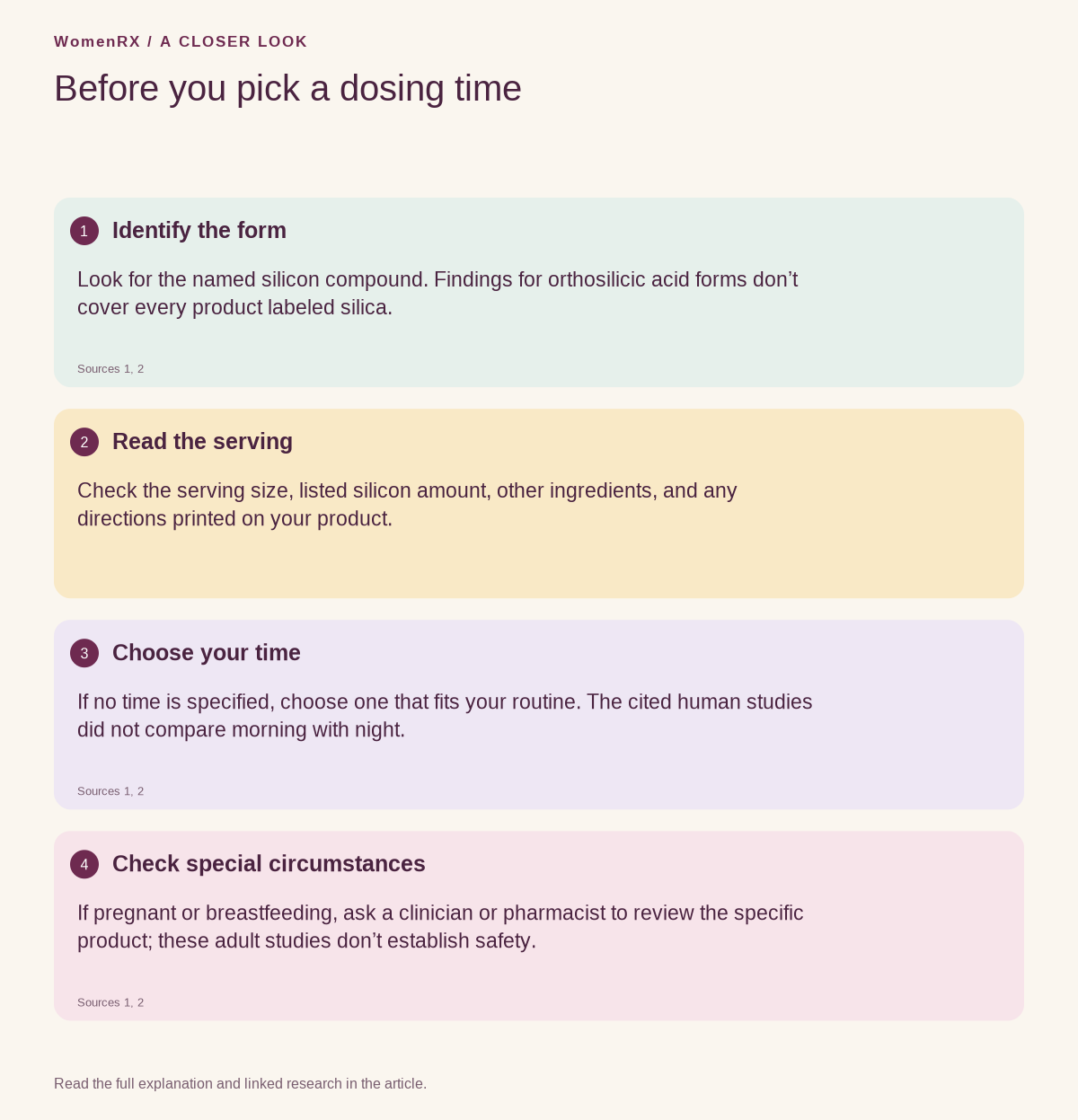
Before you pick a dosing time
Identify the form: Look for the named silicon compound. Findings for orthosilicic acid forms don’t cover every product labeled silica.12
Read the serving: Check the serving size, listed silicon amount, other ingredients, and any directions printed on your product.
Choose your time: If no time is specified, choose one that fits your routine. The cited human studies did not compare morning with night.12
Check special circumstances: If pregnant or breastfeeding, ask a clinician or pharmacist to review the specific product; these adult studies don’t establish safety.12
Read the figure as text
Four checks help distinguish what’s in your product from what the absorption studies tested.- Identify the form: Look for the named silicon compound. Findings for orthosilicic acid forms don’t cover every product labeled silica.12
- Read the serving: Check the serving size, listed silicon amount, other ingredients, and any directions printed on your product.
- Choose your time: If no time is specified, choose one that fits your routine. The cited human studies did not compare morning with night.12
- Check special circumstances: If pregnant or breastfeeding, ask a clinician or pharmacist to review the specific product; these adult studies don’t establish safety.12
More questions, answered
Should I take silica with food?
The human studies discussed above measured what happened after a dose; they did not compare taking these products with food against taking them on an empty stomach. 1 2 Check your own product’s directions rather than assuming a meal changes absorption.
Sources you can check
- Safety of orthosilicic acid-vanillin complex (OSA-VC) as a novel food ingredient to be used in food supplements as a source of silicon and bioavailability of silicon from the source.EFSA Panel on Food Additives and Nutrient Sources added to Food (ANS), Younes M, Aggett P, Aguilar F, Crebelli R, Dusemund B, Filipič M, Frutos MJ, Galtier P, Gundert-Remy U, Kuhnl... · EFSA journal. European Food Safety Authority · 2018Return to first citation
- Silicon absorption and excretion is independent of age and sex in adults.Jugdaohsingh R, Sripanyakorn S, Powell JJ. · The British journal of nutrition · 2013Return to first citation
- Silicon: the health benefits of a metalloid.Martin KR. · Metal ions in life sciences · 2013Return to first citation