Silica Supplements: What Human Studies Actually Show
The clearest human signal is a change in one bone-formation marker, not proof of stronger bones or better hair and nails.
Human evidence is limited and applies mainly to one form, choline-stabilized orthosilicic acid (CS-OSA). In a yearlong trial of women with low bone density, some bone-marker results favored CS-OSA, but lumbar spine bone density did not significantly improve. A smaller implant study examined people after surgery, not everyday bone health. These findings don’t establish that silica supplements improve hair or nails. 1 2
Silicon, silica, and orthosilicic acid are related terms, but they aren’t interchangeable descriptions of every supplement. The clearest human trial in women tested a particular form, choline-stabilized orthosilicic acid (CS-OSA), alongside calcium and vitamin D. Its results offer a possible bone-related signal, not a general endorsement of silica supplements for beauty or bone health. 2
Bone: a marker changed, but the main outcome was less clear
In a randomized, placebo-controlled trial, 184 women with low bone density were assigned to groups; 136 completed the 12-month study. Everyone received calcium and vitamin D, while groups also received different amounts of CS-OSA or placebo. The study measured bone-turnover markers and bone mineral density (BMD). 2
The clearest difference was in PINP, a marker of type I collagen formation. At 12 months, the marker was significantly higher than placebo in the two groups receiving the middle and higher CS-OSA amounts. But the results didn’t show a clear dose-response pattern. A change in a marker can help researchers understand a biological effect; it doesn’t by itself show that people will have fewer fractures or a meaningful improvement in daily function. 2
The bone-density results were more restrained. Lumbar spine BMD did not change significantly. A post-hoc analysis found a difference at the femoral neck for one CS-OSA group among women whose baseline femur T-score was below -1. Because that finding came from a subgroup analysis, it’s a lead for further study, not firm evidence that supplementation prevents osteoporosis. 2
This trial enrolled women, so its findings are directly relevant to women with the study’s bone-density profile. They shouldn’t automatically be applied to women with normal bone density, to other stages of life, or to people taking a different silica form. The study also tested CS-OSA as an add-on to calcium and vitamin D, not as a replacement for them. 2
Skin: a reported signal, not a broad promise
A prior study in photoaged women is described in the background of a later clinical report as finding improvements in skin surface and mechanical properties with CS-OSA compared with placebo. That is a human signal, but it doesn’t establish that all silica supplements improve skin, or that they reliably reduce wrinkles or other visible signs of aging. 1 2
Hair and nails: don’t mistake a rationale for a result
The studies discussed above measured bone markers, bone density, skin properties, or outcomes related to dental implants. They don’t establish a benefit for hair growth, hair thickness, or nail strength. A biological rationale involving collagen isn’t the same as a demonstrated improvement in those outcomes in people. 1 2
Why the implant study doesn’t answer everyday bone questions
A small exploratory randomized trial studied 21 people with peri-implantitis, an inflammatory condition affecting tissue around dental implants. Everyone had surgery, and the researchers compared CS-OSA with placebo afterward. The analysis included 18 patients. Some implant-related bone and tissue measurements favored CS-OSA, but this was a specific surgical setting with a small study group. It doesn’t show that silica supplements prevent bone loss or treat osteoporosis in the general population. 1
How to judge the claim on a supplement label
Start with the outcome being promised. A study of a bone marker is not proof of fewer fractures; a skin-measurement result is not proof of stronger nails. Then check the form tested: the human findings summarized here concern CS-OSA, so they can’t simply be transferred to every product labeled silica or silicon. The practical takeaway is modest: there’s a limited bone-marker signal in women with low bone density, while claims for hair and nails aren’t established by these results. 1 2
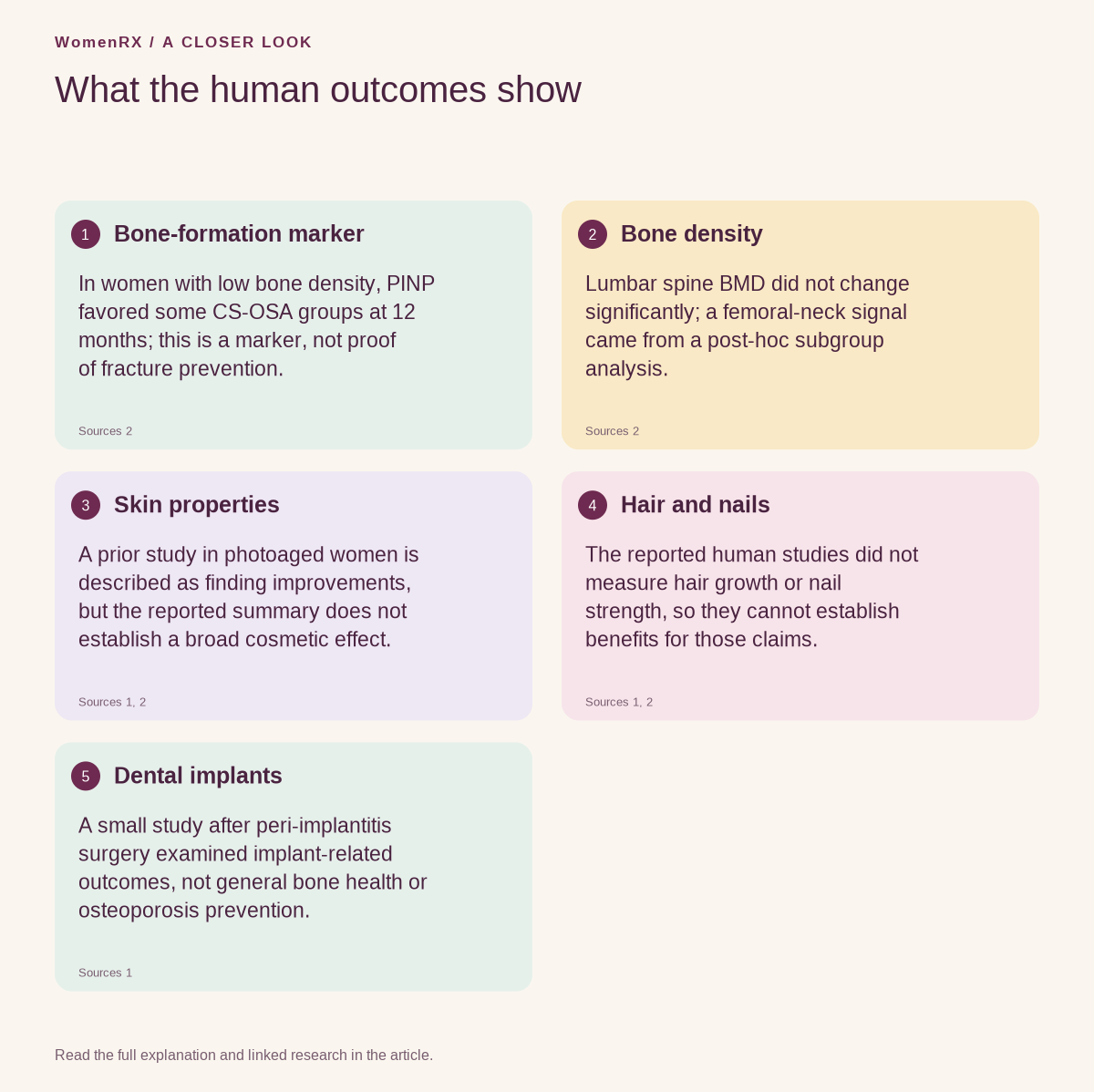
What the human outcomes show
Bone-formation marker: In women with low bone density, PINP favored some CS-OSA groups at 12 months; this is a marker, not proof of fracture prevention.2
Bone density: Lumbar spine BMD did not change significantly; a femoral-neck signal came from a post-hoc subgroup analysis.2
Skin properties: A prior study in photoaged women is described as finding improvements, but the reported summary does not establish a broad cosmetic effect.12
Hair and nails: The reported human studies did not measure hair growth or nail strength, so they cannot establish benefits for those claims.12
Dental implants: A small study after peri-implantitis surgery examined implant-related outcomes, not general bone health or osteoporosis prevention.1
Read the figure as text
The evidence depends on the outcome measured and the setting studied; a marker or surgical finding is not the same as a proven everyday benefit.- Bone-formation marker: In women with low bone density, PINP favored some CS-OSA groups at 12 months; this is a marker, not proof of fracture prevention.2
- Bone density: Lumbar spine BMD did not change significantly; a femoral-neck signal came from a post-hoc subgroup analysis.2
- Skin properties: A prior study in photoaged women is described as finding improvements, but the reported summary does not establish a broad cosmetic effect.12
- Hair and nails: The reported human studies did not measure hair growth or nail strength, so they cannot establish benefits for those claims.12
- Dental implants: A small study after peri-implantitis surgery examined implant-related outcomes, not general bone health or osteoporosis prevention.1
More questions, answered
Does evidence for orthosilicic acid apply to every silica supplement?
No. The bone trial tested choline-stabilized orthosilicic acid, a specific form. Its results don’t establish that other silicon or silica products have the same effects. 2
Sources you can check
- The effect of choline-stabilized orthosilicic acid in patients with peri-implantitis: an exploratory randomized, double-blind, placebo controlled study.Teughels W, Celik GU, Tarce M, De Cock I, Persyn SM, Haytac MC. · BMC oral health · 2021Return to first citation
- Choline-stabilized orthosilicic acid supplementation as an adjunct to calcium/vitamin D3 stimulates markers of bone formation in osteopenic females: a randomized, placebo-controlled trial.Spector TD, Calomme MR, Anderson SH, Clement G, Bevan L, Demeester N, Swaminathan R, Jugdaohsingh R, Berghe DA, Powell JJ. · BMC musculoskeletal disorders · 2008Return to first citation