Do You Need Biotin for Hair or Nails?
Biotin can help when you’re deficient, but hair shedding or brittle nails alone don’t tell you that you need more of it.
Biotin, also called vitamin B7, is relevant if a deficiency is identified, but there’s little clinical evidence that taking extra biotin improves hair or nails when you’re getting enough already. Start with the pattern and possible cause of the change rather than a supplement label. If you take biotin, tell the team ordering blood tests: it can distort some results.123
A hair change is a clue, not a biotin diagnosis
Biotin deficiency can cause thinning hair, brittle nails and a rash, but it’s rare. Those symptoms don’t establish a deficiency on their own. In particular, a bottle marketed for “hair, skin and nails” isn’t evidence that biotin addresses the reason your hair or nails have changed.12
What you notice can help point toward a better next step. For example, a widening part or gradual overall thinning may fit female pattern hair loss. Heavy shedding after an illness or childbirth may have a different course. Hair loss can also have more than one cause at once: postpartum shedding might be obvious while early hereditary thinning is less so. A dermatologist can use the history and an examination of the scalp and nails to decide whether testing for a deficiency, another condition or a scalp problem would help.34
A few months after delivery, increased shedding is often related to the fall in estrogen. It commonly peaks around four months after birth and is usually temporary; many women regain their usual fullness by their baby’s first birthday. If yours hasn’t returned by then, an assessment can look for another cause. That pattern does not, by itself, point to a need for biotin.52
When a supplement may make sense
The distinction is replacing something you lack versus adding more in the hope of faster growth. The American Academy of Dermatology advises that, when a blood test shows too little biotin, iron or zinc, a dermatologist may recommend the relevant supplement. It advises against taking those nutrients for hair loss when levels are normal. Low protein intake can matter for hair, too, but a biotin pill wouldn’t replace protein.34
A deficiency assessment becomes more relevant when hair or nail changes occur alongside other clues, such as a characteristic scaly rash, or in a setting that raises the possibility of inadequate biotin, such as long-term antibiotic or anticonvulsant use. These are reasons to consider the whole picture, not reasons to diagnose yourself or change a prescribed medicine. A clinician can decide which history, examination findings or tests are useful; not every person with shedding needs the same blood work.123
There’s a separate evidence question if no deficiency is found. The NIH Office of Dietary Supplements describes support for biotin’s hair and nail benefits as limited to a few case reports and small studies. The hair reports it discusses involved children with a rare hair-shaft disorder, not adults with common patterns of thinning. Small brittle-nail studies offer an uncertain signal, not a reliable prediction that a supplement will strengthen your nails.2
Check the label before the lab appointment
Biotin’s clearest practical downside for someone considering a hair supplement may have nothing to do with hair. Higher-dose biotin can interfere with certain laboratory immunoassays, including some tests used to measure thyroid hormones and the cardiac marker troponin. Depending on the test, a result may be falsely high or falsely low. That could send an investigation in the wrong direction.1
If you already take a hair-and-nails product, a multivitamin or biotin on its own, bring the label or a photo when blood tests are planned and tell the ordering team that you take it. The product name and listed biotin amount give them something specific to check against the tests being used. Don’t guess at a universal number of days to stop it: whether interference is possible and what to do before a particular test depend on the testing situation. And don’t delay an urgent test to sort out a supplement question; tell the care team about the biotin so they can interpret the result appropriately.1
There isn’t a well-supported “best biotin” dose or formulation for ordinary hair shedding or brittle nails in the clinical findings discussed here. A more useful purchase decision is whether biotin is indicated at all. If a deficiency is identified, the appropriate supplement can be chosen for that finding. If it isn’t, money spent on biotin could distract from finding a treatable cause of the change.23
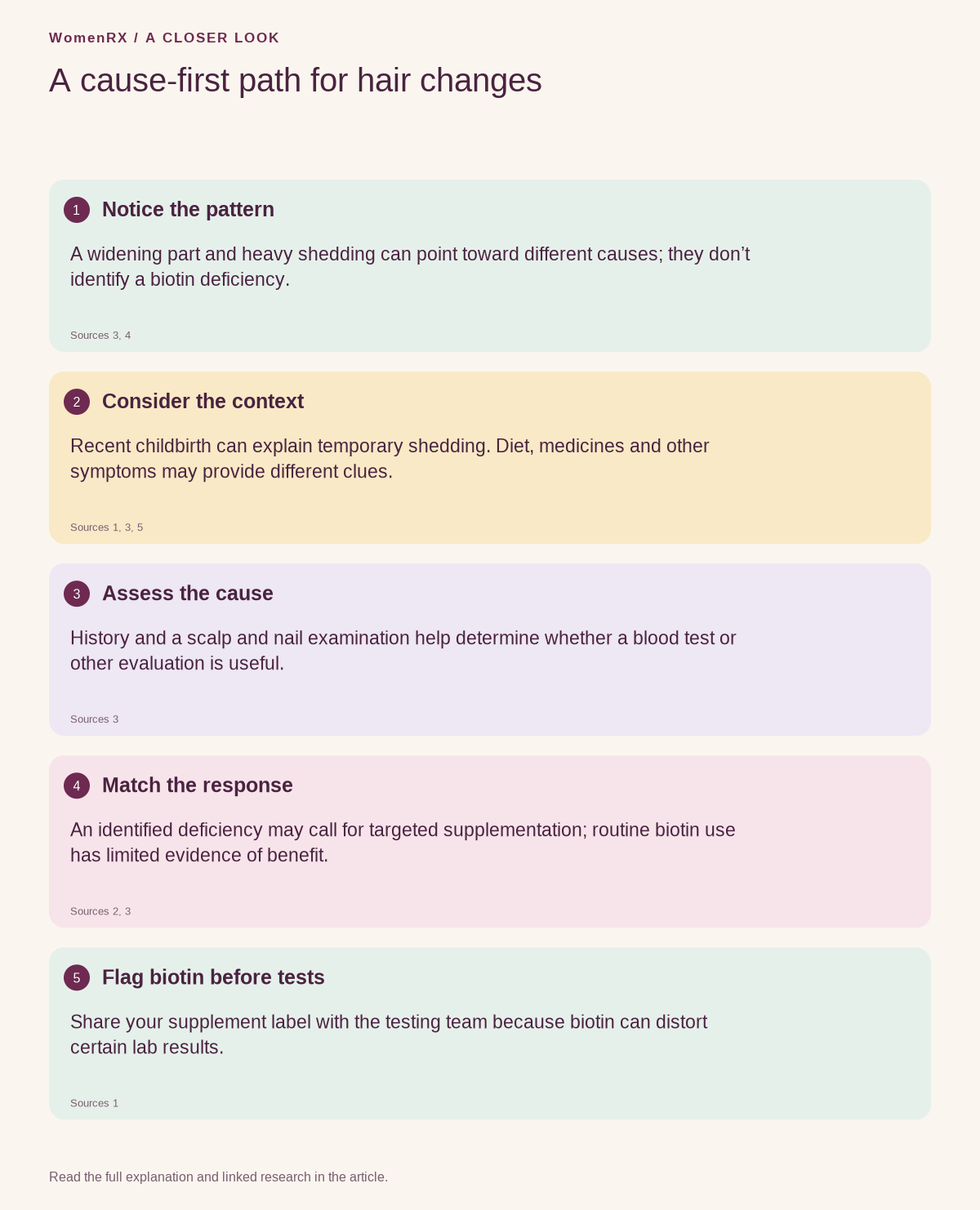
A cause-first path for hair changes
Notice the pattern: A widening part and heavy shedding can point toward different causes; they don’t identify a biotin deficiency.34
Consider the context: Recent childbirth can explain temporary shedding. Diet, medicines and other symptoms may provide different clues.135
Assess the cause: History and a scalp and nail examination help determine whether a blood test or other evaluation is useful.3
Match the response: An identified deficiency may call for targeted supplementation; routine biotin use has limited evidence of benefit.23
Flag biotin before tests: Share your supplement label with the testing team because biotin can distort certain lab results.1
Read the figure as text
The symptom starts the question; its pattern, possible causes and any planned testing shape the next move.- Notice the pattern: A widening part and heavy shedding can point toward different causes; they don’t identify a biotin deficiency.34
- Consider the context: Recent childbirth can explain temporary shedding. Diet, medicines and other symptoms may provide different clues.135
- Assess the cause: History and a scalp and nail examination help determine whether a blood test or other evaluation is useful.3
- Match the response: An identified deficiency may call for targeted supplementation; routine biotin use has limited evidence of benefit.23
- Flag biotin before tests: Share your supplement label with the testing team because biotin can distort certain lab results.1
More questions, answered
Do brittle nails mean I’m low in biotin?
Not necessarily. Brittle nails can occur with biotin deficiency, but that deficiency is rare. Studies of biotin for brittle nails have been small and don’t establish that routine supplementation will help someone whose biotin status is adequate.2
Should I stop biotin before a blood test?
Tell the team ordering the test what you take, including the amount on the label, and ask for instructions for that specific test. Biotin can interfere with some thyroid and cardiac-marker assays, but the evidence cited here doesn’t establish one stopping interval that works for every test or product. Don’t stop a prescribed product on your own.1
Sources you can check
- Biotin DeficiencyCervantes A, Daley SF. · 2025Return to first citation
- Biotin - Health Professional Fact SheetAccessed 2026-09-25Return to first citation
- Hair loss: Diagnosis and treatmentAccessed 2026-09-25Return to first citation
- Hair loss: Who gets and causesAccessed 2026-09-25Return to first citation
- Hair loss in new moms: Dermatologist tipsAccessed 2026-09-25Return to first citation