Biotin for Hair: Daily Needs and Blood-Test Risks
Most adults need only 30 micrograms of biotin a day, and supplements marketed for hair or nails have limited evidence of benefit.
For adult women, the adequate intake for biotin is 30 micrograms a day, including during pregnancy; breastfeeding women have an adequate intake of 35 micrograms. These are intake targets, not proof that a supplement will improve hair or nails. Biotin deficiency is rare, and higher-dose supplements can distort some blood-test results, so tell the clinician ordering a test and the laboratory what you take. 2
How much biotin do you need?
For women age 19 and older, the adequate intake (AI) is 30 micrograms (mcg) a day. It stays at 30 mcg during pregnancy and rises to 35 mcg while breastfeeding. An AI is used when there isn't enough evidence to set a recommended dietary allowance; it isn't a supplement dose or a target that requires a pill. Biotin is found in foods including eggs, fish, meat, seeds, and nuts. 2
Biotin deficiency is rare. Hair thinning and brittle nails can occur with deficiency, but those symptoms alone don't show that you have one. For most healthy people eating a varied diet, the evidence doesn't support taking extra biotin just to improve hair. 2
Hair and nail claims: what the evidence shows
Evidence for biotin as a hair treatment is especially limited: the reports described by the NIH Office of Dietary Supplements involved children with uncombable hair syndrome, a rare hair-shaft disorder. They don't show that biotin improves ordinary hair shedding or thinning in adults. 2
There are a few small reports of nail improvement, but they lacked a placebo group and didn't establish whether participants were biotin-deficient. That makes it hard to tell whether biotin caused the changes or whether the findings apply to people with typical brittle nails. 2 A physician survey also described the lack of randomized studies supporting biotin for hair, skin, or nail conditions; it surveyed clinicians, rather than testing biotin as a treatment. 4
So if you're considering biotin because your hair has changed, don't assume the cause is a deficiency. A supplement may not address the reason for the change, and the available evidence doesn't establish it as a general hair-growth treatment.
Why a supplement can matter before blood work
Some laboratory tests use biotin-streptavidin technology. Extra biotin in the blood can interfere with those tests, making results falsely high or falsely low depending on the test. Thyroid tests are one example; other tests can also be affected. A small study found interference in several assays after healthy adults took 10 mg of biotin daily for a week, and NIH notes that even one 10 mg dose affected thyroid tests done within 24 hours. Those study doses are examples of interference, not recommended amounts. 2
The effect depends on the test method, so there isn't one waiting period that fits every person and every test. Tell the clinician ordering your test and the lab about biotin before your blood is drawn. Share the product name and dose from the label, including biotin in a multivitamin or hair-and-nail product. The clinician or lab can tell you what to do for that specific test. 23
If you take biotin prescribed for a medical condition, don't stop or change it on your own. Contact the prescriber and the testing team so they can coordinate. For any blood test, follow the instructions you receive; other factors, including medicines and how you followed pre-test directions, can affect results too. 12
Check units, the reason for use and upcoming blood tests
Check the label before adding a supplement. Notice whether the amount is listed in micrograms or milligrams, what the product is meant to address, and whether you have an upcoming blood test. If the reason is hair or nail appearance, the evidence for benefit is weak; if the reason is a diagnosed deficiency or another medical condition, follow the plan from the clinician treating it. 2
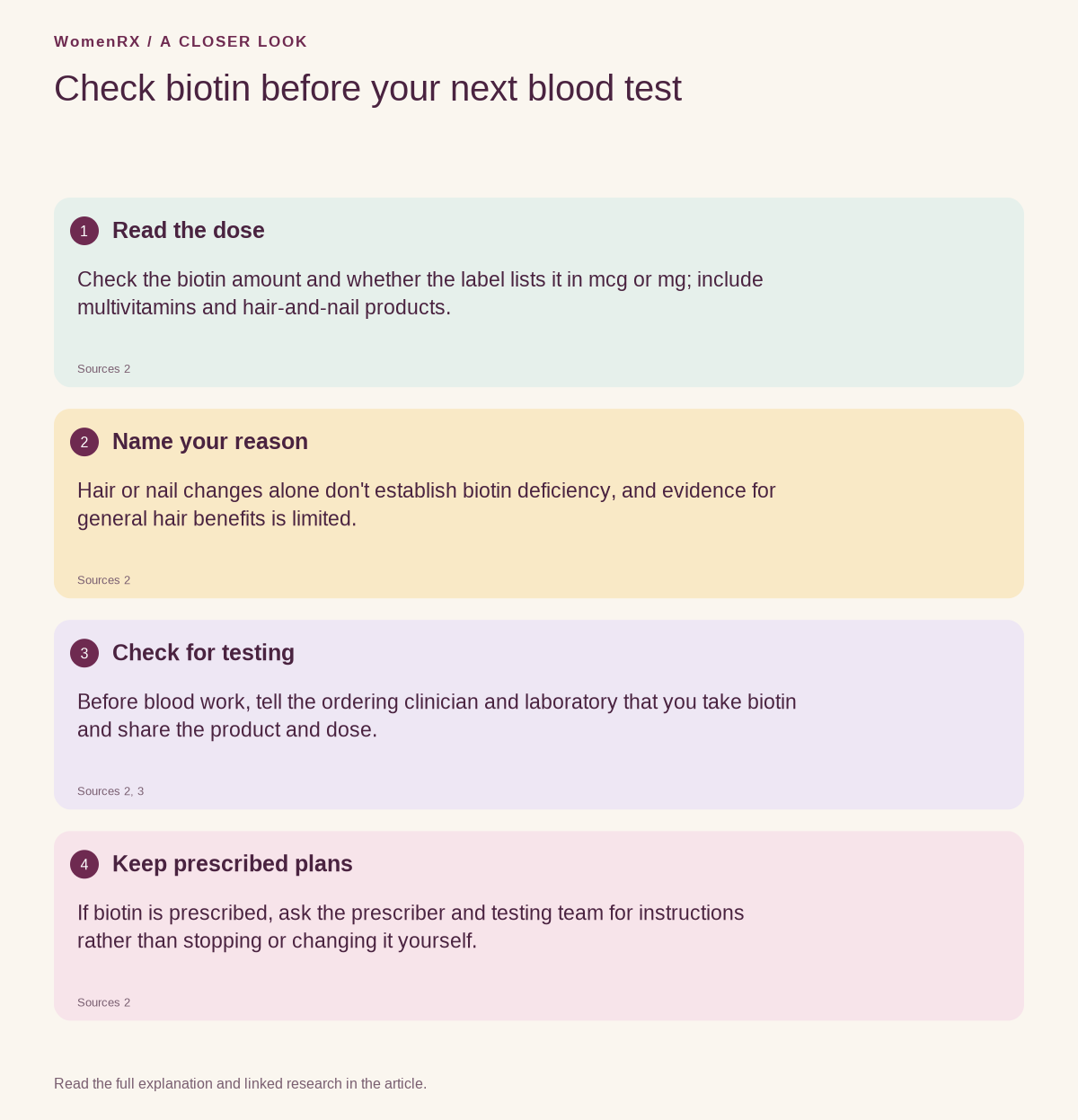
Check biotin before your next blood test
Read the dose: Check the biotin amount and whether the label lists it in mcg or mg; include multivitamins and hair-and-nail products.2
Name your reason: Hair or nail changes alone don't establish biotin deficiency, and evidence for general hair benefits is limited.2
Check for testing: Before blood work, tell the ordering clinician and laboratory that you take biotin and share the product and dose.23
Keep prescribed plans: If biotin is prescribed, ask the prescriber and testing team for instructions rather than stopping or changing it yourself.2
Read the figure as text
Use this quick check to distinguish a routine intake target from a supplement dose and make sure the testing team knows what you take.- Read the dose: Check the biotin amount and whether the label lists it in mcg or mg; include multivitamins and hair-and-nail products.2
- Name your reason: Hair or nail changes alone don't establish biotin deficiency, and evidence for general hair benefits is limited.2
- Check for testing: Before blood work, tell the ordering clinician and laboratory that you take biotin and share the product and dose.23
- Keep prescribed plans: If biotin is prescribed, ask the prescriber and testing team for instructions rather than stopping or changing it yourself.2
More questions, answered
Should I cancel a blood test if I took biotin?
Not automatically. Tell the clinician who ordered the test and the laboratory what you took and when. They can advise you based on the test method and your circumstances; don't change a prescribed biotin treatment without the prescriber's guidance. 23
Sources you can check
- Laboratory Tests: MedlinePlusAccessed 2026-09-25Return to first citation
- Biotin - Health Professional Fact SheetAccessed 2026-09-25Return to first citation
- Biotin Supplementation-The Cause of Hypersensitivity and Significant Interference in Allergy Diagnostics.Lis K. · Nutrients · 2025Return to first citation
- A survey-based study of physician practices regarding biotin supplementation.Waqas B, Wu A, Yim E, Lipner SR. · The Journal of dermatological treatment · 2022Return to first citation