Biotin Long-Term Use and the Blood-Test Question
Biotin hasn’t shown toxicity at the intakes studied, but supplements can distort some blood-test results.
Human studies reported by the NIH have not found toxicity at the biotin intakes studied, but that doesn’t prove every dose is safe indefinitely. The more immediate concern is blood work: biotin can make results from some tests falsely high or low. Before testing, share the amount you take and when you last took it so the care team can check whether your assay is susceptible. 12

Biotin, also called vitamin B7, is a nutrient found in food and supplements. Taking enough to meet a nutritional need is different from taking a high-dose supplement for months or years. That distinction matters most when you’re interpreting a supplement label or preparing for blood work. 1
What long-term safety findings can tell you
The Food and Nutrition Board did not set a tolerable upper intake level for biotin because it found no evidence of toxicity in humans on which to base one. The NIH Office of Dietary Supplements reports that several human studies found no adverse effects at 10-50 mg a day. That’s reassuring for the intakes studied, but it doesn’t establish that every dose is harmless indefinitely. An absent upper limit is not a proven safe limit. 1
For most people eating a mixed diet, biotin deficiency is rare. And while biotin is often sold for hair, skin, and nails, evidence that supplements help with those concerns in people without a deficiency is limited. The nail studies described by the NIH were small and lacked placebo groups; evidence for hair and skin benefits is even thinner. If that’s why you take it, it’s reasonable to weigh an uncertain benefit against the inconvenience and potential consequences of test interference. 1
Why the lab method matters more than the word “biotin”
Some laboratory tests use a biotin-based method to measure substances in a blood sample. Extra biotin can disrupt certain versions of that method, making a result appear falsely high or falsely low. Thyroid tests are a well-documented example; some tests for vitamin D and other substances can also be affected. A misleading result could prompt further testing or an incorrect treatment decision. 12
But biotin does not affect every blood test. Assays vary, including between laboratory platforms. A 2026 in-vitro study found that some assays using biotin were affected and others weren’t; a few showed interference below the levels stated in manufacturer notices. Because this was testing in one laboratory, it doesn’t give you a universal dose cutoff for your own blood work. 23
Amount and timing still matter. The NIH fact sheet describes thyroid-test interference after a single 10 mg dose when the test was performed within 24 hours. It also describes a small study of six healthy adults taking 10 mg daily for one week in which several assays were affected. Neither finding means every person taking 10 mg will get a misleading result, or that lower amounts can never matter. 1
What to share before blood work
You don’t need to identify the lab’s assay yourself. Give the ordering clinician or lab the details they need to check it. A bottle or clear photo of the label can help:
- Which products contain biotin? Check the labels of anything you take, including a multivitamin, B-complex, hair-and-nail product, or prenatal. Disclose the products that list biotin or vitamin B7, rather than assuming every product in those categories contains it. Biotin can appear in single-ingredient and combination supplements. 1
- How much do you take? Share the labeled amount, serving size, and number of servings you use. Check whether the amount is written in micrograms (mcg) or milligrams (mg).
- When did you last take it? Give the time if you know it; don’t guess if you don’t. Timing has mattered in documented cases of interference. 1
- Which test is planned? Name the test, particularly if you’re having thyroid blood work, and ask whether the lab needs anything else to assess its specific method. 12
There isn’t one stopping interval that works for every supplement and test. Ask the clinician who ordered the blood work or the lab what to do for yours. If biotin was prescribed for a medical condition, don’t stop it on your own. 12
Does pregnancy change the answer?
For adults age 19 and older, the adequate intake for biotin is 30 mcg a day, including during pregnancy; during lactation, it’s 35 mcg a day. Those are nutritional reference values, not a reason by themselves to add a separate high-dose supplement. 1
Biochemical signs of marginal biotin deficiency have been reported during pregnancy despite normal intakes, and biotin concentrations in plasma and breast milk can decrease during lactation. The clinical significance is unclear. These findings don’t establish that routine extra biotin improves pregnancy or lactation outcomes. If a product you take during pregnancy lists biotin, include it in the details you share before blood testing. 1
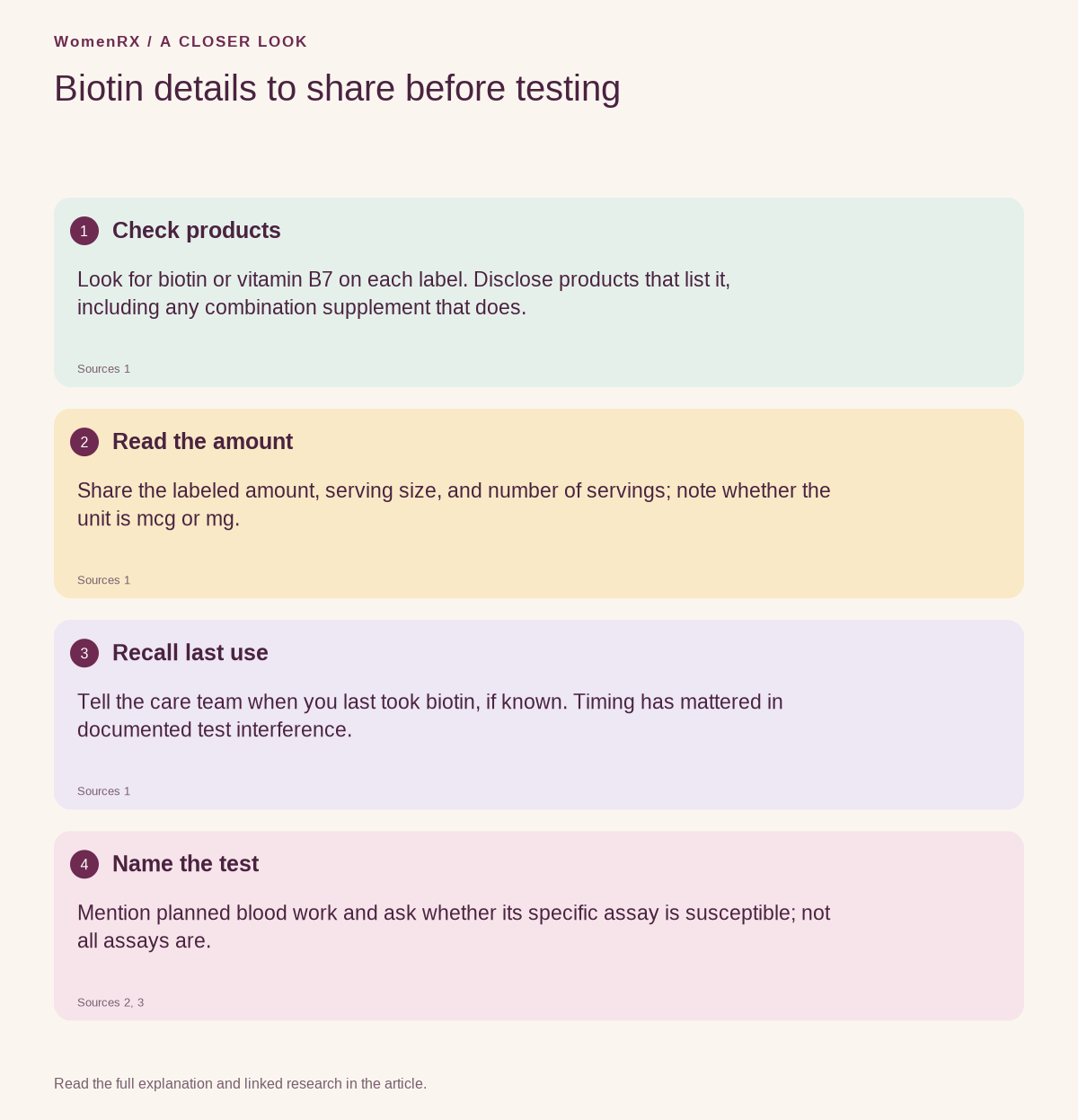
Biotin details to share before testing
Check products: Look for biotin or vitamin B7 on each label. Disclose products that list it, including any combination supplement that does.1
Read the amount: Share the labeled amount, serving size, and number of servings; note whether the unit is mcg or mg.1
Recall last use: Tell the care team when you last took biotin, if known. Timing has mattered in documented test interference.1
Name the test: Mention planned blood work and ask whether its specific assay is susceptible; not all assays are.23
Read the figure as text
Check your labels and share these details so the care team can assess the test actually being used.- Check products: Look for biotin or vitamin B7 on each label. Disclose products that list it, including any combination supplement that does.1
- Read the amount: Share the labeled amount, serving size, and number of servings; note whether the unit is mcg or mg.1
- Recall last use: Tell the care team when you last took biotin, if known. Timing has mattered in documented test interference.1
- Name the test: Mention planned blood work and ask whether its specific assay is susceptible; not all assays are.23
More questions, answered
Should I stop biotin before a blood test?
Don’t assume every test requires the same pause. Tell the ordering clinician or lab what you take and ask what applies to your specific test. If biotin was prescribed, check with the prescriber before changing it. 12
Could biotin explain a thyroid result that doesn’t fit how I feel?
It’s one possibility, not an explanation to assume. Thyroid assay interference can produce misleading results, and clinical guidance recommends reviewing supplements and working with the laboratory when results don’t fit the clinical picture. Tell the clinician about any biotin you take so the result can be assessed appropriately. 2
Sources you can check
- Biotin - Health Professional Fact SheetAccessed 2026-09-25Return to first citation
- 2026 ETA guideline on interference in immunoassay measurements used in assessment of thyroid function.Campi I, Feldt-Rasmussen U, Gruson D, Halsall D, Raverot V, van den Berg S, Moran C. · European thyroid journal · 2026Return to first citation
- In-vitro verification of tolerance limits for biotin interference of routine biochemistry and immunology assays.Swallow K, Wild G, Sargur R. · Annals of clinical biochemistry · 2026Return to first citation