Biotin After 40: Will It Help Your Hair or Nails?
Hair thinning and brittle nails don’t automatically mean you need biotin, and the supplement can affect some blood-test results.
Biotin deficiency can affect hair and nails, but it’s rare, and extra biotin hasn’t been shown to reliably improve hair growth or brittle nails in people without a known deficiency. If a change concerns you, finding its cause is more useful than assuming it’s menopause or buying a supplement. If you take biotin, mention it before blood tests because it can distort some results. 1 2 3
Start with the change, not the supplement
Perhaps you’re seeing more hair in the shower, a widening area of thinning, or nails that split more easily. Those are real changes, but none is a test for low biotin. Hair loss can be temporary, part of getting older, or related to a medical condition. Female pattern hair loss and other forms of hair loss are also possible. Being over 40 doesn’t tell you which explanation fits, and it doesn’t mean menopause is automatically responsible. 1 5
Biotin deficiency is rare. Its possible signs include thinning hair, brittle nails, and a red, scaly rash around areas such as the eyes, nose, or mouth. Hair or nail changes alone can’t establish a deficiency, and assessing biotin status isn’t straightforward: there are few reliable indicators, while serum biotin may miss marginal deficiency. 2
If the change is worrying you, an examination is a better starting point than a hair-and-nail product. A clinician may be able to identify the type or cause of hair loss by looking at your hair. For example, a history of illness or substantial weight loss may matter when making sense of new shedding; it doesn’t, by itself, point specifically to biotin. 1 4
What the supplement studies actually show
Biotin is an essential B vitamin. That’s different from showing that more biotin improves hair when you already get enough. A 2024 review found three eligible studies of oral biotin for hair growth or quality. The strongest, a double-blind, placebo-controlled study, found no difference in hair growth between biotin and placebo. The other two studied particular groups, including women after sleeve gastrectomy, and had limitations that prevent a clear conclusion for typical midlife hair concerns. 3
The nail case is uncertain too. Three small studies summarized by the NIH Office of Dietary Supplements had no placebo group and didn’t establish participants’ biotin status before treatment. Some reported improvement, but without those comparisons, they can’t show whether biotin caused it or who might benefit. 2
The adequate intake for adult women is 30 micrograms a day; there’s no higher category beginning at 40. This is a nutrition reference, not a dose proven to treat hair or nails. Foods containing biotin include cooked eggs, fish, meat, nuts, and seeds. 2
When low biotin deserves a closer look
A hair or nail change may be worth discussing alongside anything else that could affect nutrition or biotin status. Chronic alcohol exposure can inhibit biotin absorption. Research in people with epilepsy has also associated long-term use of certain anticonvulsants with lower serum biotin. These are reasons to give your care team the fuller picture, not reasons to assume biotin is the answer or change a prescribed medicine. 2
The same distinction matters after substantial weight loss or bariatric surgery. Hair loss in that setting can involve nutritional and metabolic stress, with more than one potential contributor. A biotin-only purchase may miss the more useful question: what’s behind the hair change? 4
Before blood work, mention biotin
This is the practical catch even if you’re taking biotin for cosmetic reasons. Supplemental biotin can interfere with certain lab assays, making a result falsely high or falsely low. Some thyroid tests are affected; not every blood test is. Tell the person ordering your tests and the lab about any biotin-containing hair-and-nail product or multivitamin, particularly if a result doesn’t seem to fit your symptoms. The testing team can advise you on the specific test rather than leaving you to guess when to stop or restart a supplement. 2
If you’re deciding whether to buy biotin, separate two questions: Is there a reason to suspect low biotin? And is there evidence extra biotin will fix this particular change? For an otherwise unexplained midlife hair or nail concern, the answer to the second question is not established. Looking into the change first gives you a better chance of choosing a response that fits its cause. 1 2 3
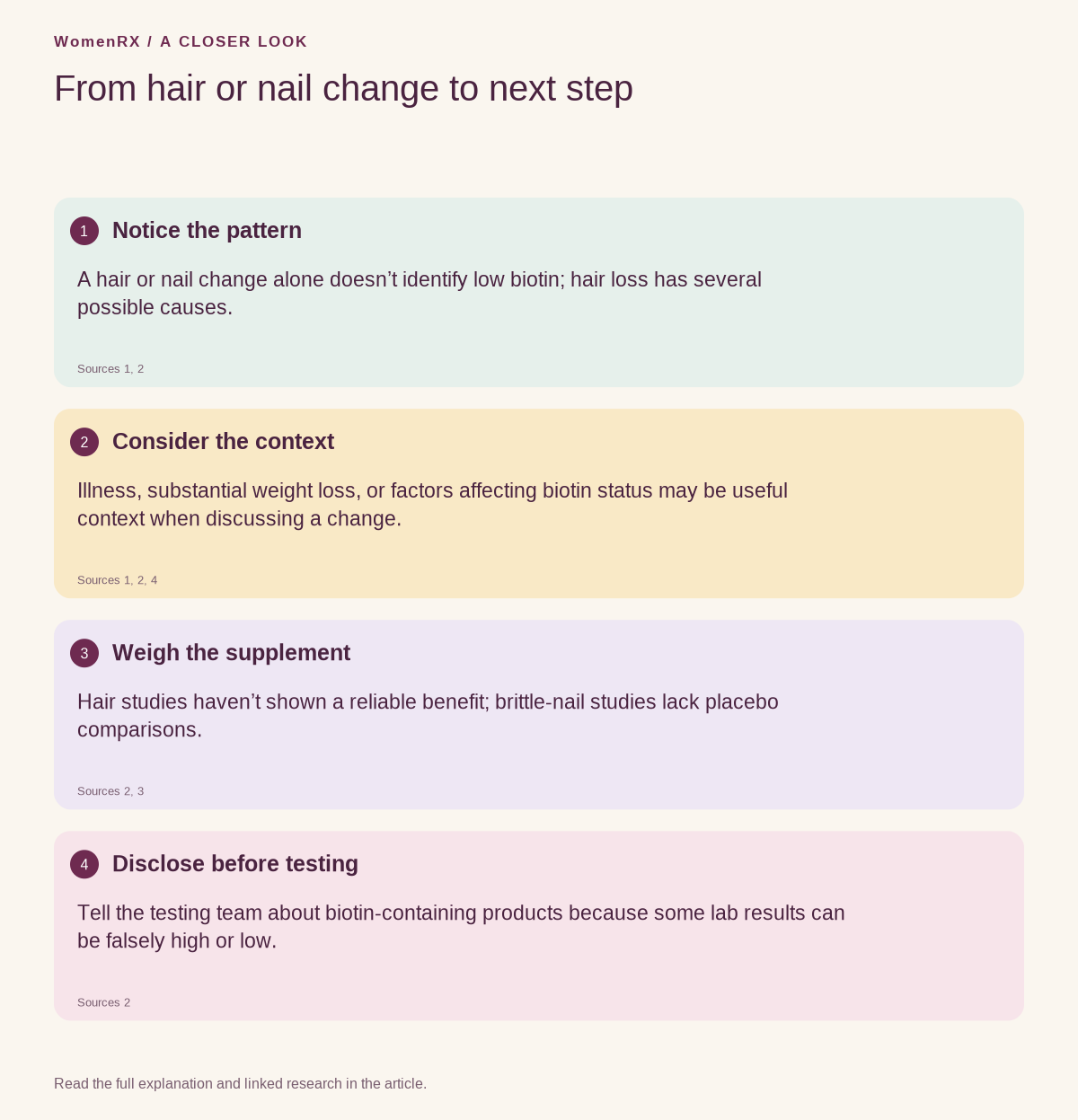
From hair or nail change to next step
Notice the pattern: A hair or nail change alone doesn’t identify low biotin; hair loss has several possible causes.12
Consider the context: Illness, substantial weight loss, or factors affecting biotin status may be useful context when discussing a change.124
Weigh the supplement: Hair studies haven’t shown a reliable benefit; brittle-nail studies lack placebo comparisons.23
Disclose before testing: Tell the testing team about biotin-containing products because some lab results can be falsely high or low.2
Read the figure as text
A route that keeps the cause of the change separate from the decision to take biotin.- Notice the pattern: A hair or nail change alone doesn’t identify low biotin; hair loss has several possible causes.12
- Consider the context: Illness, substantial weight loss, or factors affecting biotin status may be useful context when discussing a change.124
- Weigh the supplement: Hair studies haven’t shown a reliable benefit; brittle-nail studies lack placebo comparisons.23
- Disclose before testing: Tell the testing team about biotin-containing products because some lab results can be falsely high or low.2
Sources you can check
- Hair loss - NHSAccessed 2026-09-25Return to first citation
- Biotin - Health Professional Fact SheetAccessed 2026-09-25Return to first citation
- Biotin for Hair Loss: Teasing Out the Evidence.Yelich A, Jenkins H, Holt S, Miller R. · The Journal of clinical and aesthetic dermatology · 2024Return to first citation
- [Hair loss during treatment of obesity: current state of the problem and potential solutions].Troshina EA, Suplotova LA, Dzgoeva FK, Ruyatkina LA, Gadzhigoroeva AG, Gromova OA, Romanova YY. · Problemy endokrinologii · 2026Return to first citation
- Addressing the Root Causes of Female Hair Loss and Non-Pharmaceutical Interventions.Leavitt A, Hawkins SD, Kindred C, Frey C, Gainers M, Grekin SK, Leavitt M. · Journal of drugs in dermatology : JDD · 2025Return to first citation