Do Vitamin D3 and K2 Supplements Affect Weight?
A trial of a product containing both vitamins tested vitamin status, not weight, so it can’t support a claim that the combination causes weight loss or gain.
A randomized trial tested a multivitamin product containing D3 and K2 in people with cystic fibrosis, but measured vitamin levels and vitamin-K-related markers, not body weight. It therefore can’t show whether D3 plus K2 changes weight. Findings from vitamin D used with exercise are indirect: they don’t test the D3-and-K2 combination itself. 3 4
What the combination trial can tell you
A randomized trial in people with cystic fibrosis compared a multivitamin formulation containing D3 and K2 with standard vitamin preparations. Both groups received D3, while the product also differed in how it delivered other fat-soluble vitamins. The researchers focused on vitamin status and markers related to vitamin K, not weight change. The trial therefore offers no answer about whether taking D3 and K2 together makes someone lose or gain weight. 3
Women made up about 63% of participants who completed the trial, but the study did not report a women-specific weight effect. More fundamentally, weight wasn’t an outcome for any participant, so the proportion of women in the study can’t fill that gap. 3
Why vitamin D studies aren’t proof about D3 and K2
Some research looks at vitamin D alongside exercise, but that’s a different question from whether a D3-and-K2 supplement affects weight. A systematic review and meta-analysis in people with type 2 diabetes reported lower BMI in an exercise-plus-vitamin-D group compared with control. Because exercise was part of the intervention, that finding doesn’t establish that vitamin D caused the difference. It also doesn’t test K2 or the D3-and-K2 combination. 4
It’s reasonable to treat results from one nutrient, or from a supplement paired with exercise, as indirect rather than as proof about a different product. A weight claim for D3 plus K2 would need a study that actually tests that combination against a suitable comparison and measures weight over time. If the claim is about fat loss rather than the number on the scale, the study would also need an appropriate body-composition measure. Body weight includes muscle, bone, fat, and water, so a scale change alone doesn’t tell the whole story. 1
What to take from this when choosing a product
Don’t count on D3 plus K2 as a weight-control supplement based on these findings. The direct trial shows that a product containing both can be studied for vitamin-related outcomes, but it doesn’t demonstrate an effect on weight. Vitamin D has established roles that include helping the body absorb calcium; that is a separate reason people may consider vitamin D, not evidence that it changes body weight. 2 3
For a product’s weight claim to be persuasive, look for evidence that measures weight directly and compares the combination with a group that helps separate its effect from other changes, such as exercise or a broader multivitamin formula. Until there is such evidence, the effect of D3 plus K2 on weight remains unestablished.
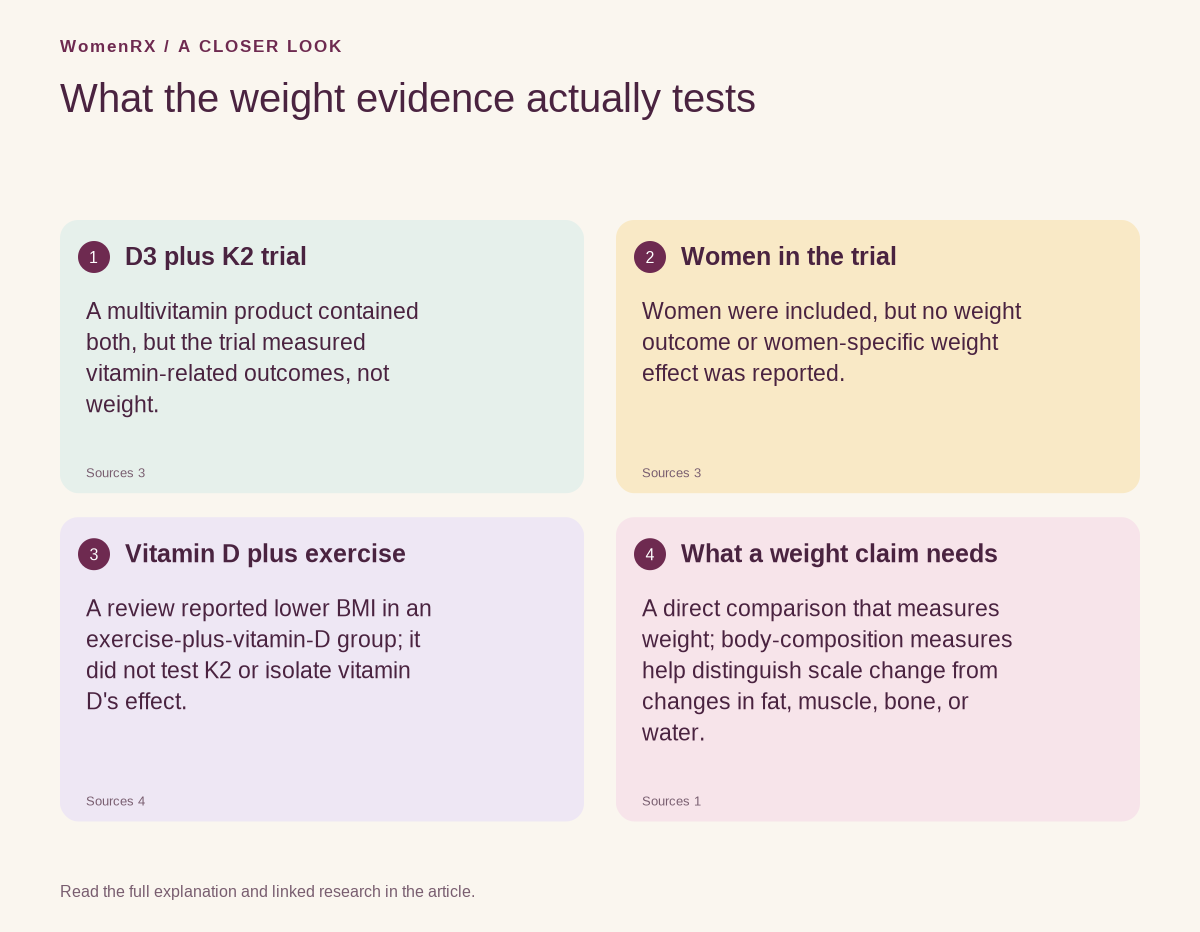
What the weight evidence actually tests
D3 plus K2 trial: A multivitamin product contained both, but the trial measured vitamin-related outcomes, not weight.3
Women in the trial: Women were included, but no weight outcome or women-specific weight effect was reported.3
Vitamin D plus exercise: A review reported lower BMI in an exercise-plus-vitamin-D group; it did not test K2 or isolate vitamin D's effect.4
What a weight claim needs: A direct comparison that measures weight; body-composition measures help distinguish scale change from changes in fat, muscle, bone, or water.1
Read the figure as text
The key distinction is whether a study tests D3 plus K2 and measures weight, or tests a different intervention or outcome.- D3 plus K2 trial: A multivitamin product contained both, but the trial measured vitamin-related outcomes, not weight.3
- Women in the trial: Women were included, but no weight outcome or women-specific weight effect was reported.3
- Vitamin D plus exercise: A review reported lower BMI in an exercise-plus-vitamin-D group; it did not test K2 or isolate vitamin D's effect.4
- What a weight claim needs: A direct comparison that measures weight; body-composition measures help distinguish scale change from changes in fat, muscle, bone, or water.1
Sources you can check
- Body Weight: MedlinePlusAccessed 2026-09-25Return to first citation
- Vitamin D: MedlinePlusAccessed 2026-09-25Return to first citation
- Fat-Soluble Vitamins in Standard vs. Liposomal Form Enriched with Vitamin K2 in Cystic Fibrosis: A Randomized Multi-Center Trial.Nowak JK, Krzyżanowska-Jankowska P, Drzymała-Czyż S, Goździk-Spychalska J, Wojsyk-Banaszak I, Skorupa W, Sapiejka E, Miśkiewicz-Chotnicka A, Brylak J, Zielińska-Psuja B, Lisowska A... · Journal of clinical medicine · 2022Return to first citation
- Effects of Exercise Combined With Vitamin D Interventions on Glucose-Lipid Metabolism and Obesity in Individuals With Type 2 Diabetes Mellitus: A Systematic Review and Meta-Analysis.Liu R, Dong C, Li R, Wang Q, Sun A, Huang Z. · Nutrition reviews · 2026Return to first citation