D3 and K2: Take Them With Food or at Night?
A meal with some fat can support vitamin D3 absorption; choosing morning or evening is mainly a practical routine decision.
If your product directions don’t say otherwise, take a combined D3-and-K2 supplement at a time you can remember. Taking it with a meal or snack that contains some fat can support vitamin D absorption, although some is absorbed without dietary fat. The guidance here doesn’t specify a best clock time for the combination, and the cited studies don’t compare morning and evening dosing in people. 3456
Food has a clearer role than the clock
Vitamin D3 is fat-soluble, and having fat in your digestive tract can improve its absorption. Some vitamin D is absorbed even without dietary fat, so taking a supplement with food isn’t an all-or-nothing requirement. A meal or snack that naturally includes some fat is a practical option if it works with your routine. 34
For vitamin K2, the guidance is less specific about taking a supplement with food. Vitamin K is fat-soluble, but the NIH Office of Dietary Supplements says data on the relative bioavailability of different vitamin K supplement forms are limited; it does not give a meal-timing rule for K2 supplements. 1
So, taking a D3-and-K2 product with a meal that contains some fat has a clear rationale for D3. That rationale shouldn’t be stretched into a proven meal-related benefit for K2 or for the combination as a whole.
Morning or evening? Choose what fits
The cited vitamin guidance doesn’t specify a preferred time of day for a D3-and-K2 combination. A study of a chewable product containing D3, K2, and magnesium measured blood levels after administration in male rats; it did not compare morning with evening dosing in people. A separate study tested vitamin uptake in cultured cells, which also doesn’t answer which clock time works better for a person. 56
That leaves a straightforward practical choice: pick a time you’re likely to remember, and, when convenient, pair it with a meal or snack containing some fat. For example, if breakfast is usually just coffee but dinner includes food with some fat, dinner may be an easier time to take it with a meal. Follow the directions on your specific product if they differ.
Check the product and your medicines
Combined supplements can use different forms of K2, including MK-4 and MK-7. Research on the relative bioavailability of vitamin K supplement forms is limited, so don’t assume that findings about one formulation apply to every product. Check the label for its form and directions. 1
Vitamin K can affect how blood thinners work. If you take one, check with your prescriber or pharmacist before starting or changing a supplement containing K2. 2
Some medicines can also reduce vitamin K absorption. The NIH fact sheet identifies the bile acid sequestrants cholestyramine and colestipol, as well as orlistat; orlistat can reduce absorption of fat-soluble vitamins more broadly. If you take one of these medicines, get advice about whether the supplement and its timing fit your medication instructions. 1
If you’re pregnant or breastfeeding, follow the vitamin D guidance for your situation and any supplement instructions you’ve been given. MedlinePlus lists 600 IU as the daily recommended amount during pregnancy and breastfeeding; the meal and clock-time discussion here doesn’t determine how much you need. 4
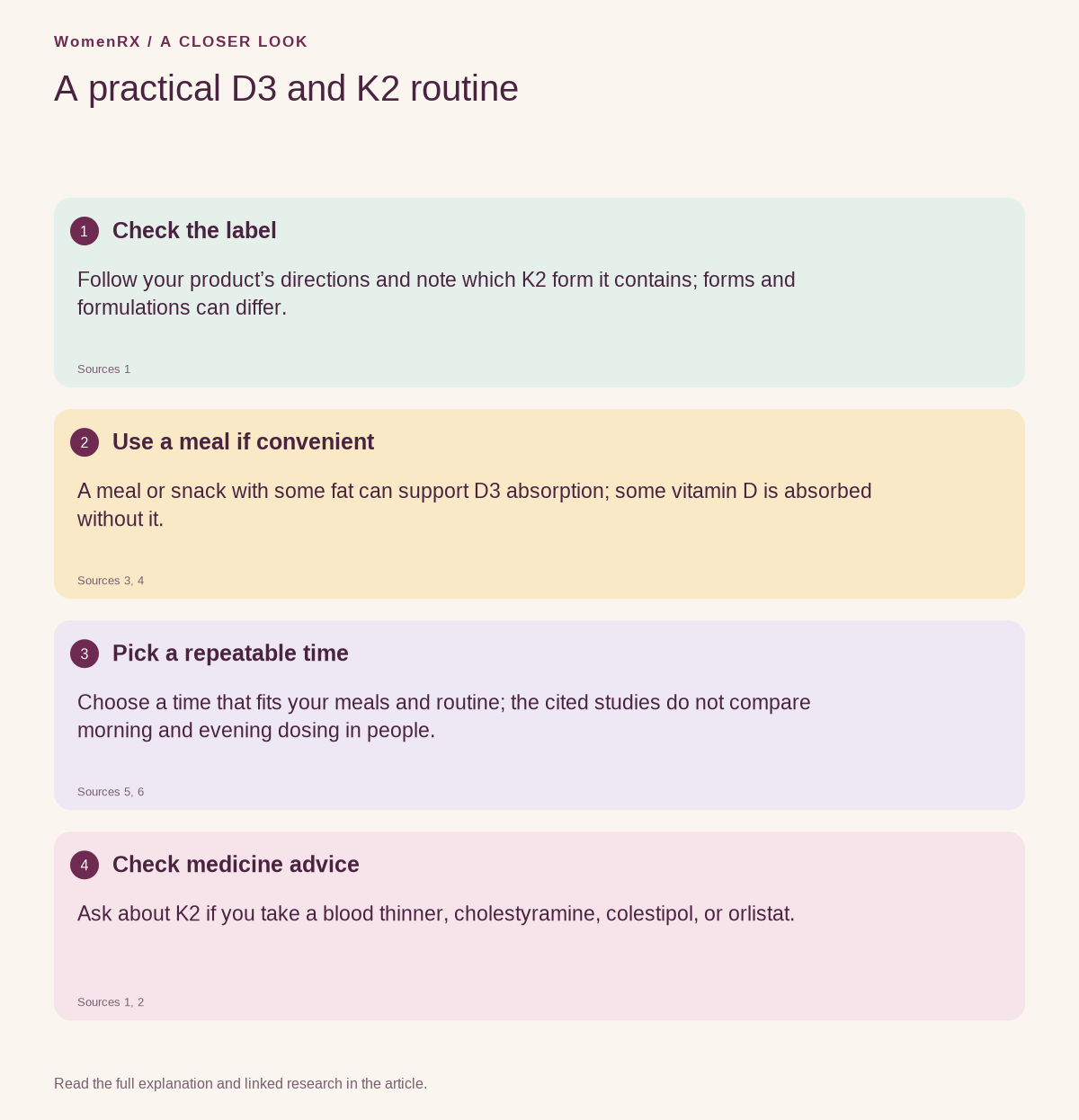
A practical D3 and K2 routine
Check the label: Follow your product’s directions and note which K2 form it contains; forms and formulations can differ.1
Use a meal if convenient: A meal or snack with some fat can support D3 absorption; some vitamin D is absorbed without it.34
Pick a repeatable time: Choose a time that fits your meals and routine; the cited studies do not compare morning and evening dosing in people.56
Check medicine advice: Ask about K2 if you take a blood thinner, cholestyramine, colestipol, or orlistat.12
Read the figure as text
Use these checks to make the meal and timing choice practical without assuming that a particular hour improves results.- Check the label: Follow your product’s directions and note which K2 form it contains; forms and formulations can differ.1
- Use a meal if convenient: A meal or snack with some fat can support D3 absorption; some vitamin D is absorbed without it.34
- Pick a repeatable time: Choose a time that fits your meals and routine; the cited studies do not compare morning and evening dosing in people.56
- Check medicine advice: Ask about K2 if you take a blood thinner, cholestyramine, colestipol, or orlistat.12
More questions, answered
Do I need a high-fat meal?
No. Dietary fat can improve vitamin D absorption, but some vitamin D is absorbed without it. A meal or snack containing some fat is a practical option, not a requirement for all absorption. 34
What if I take a blood thinner?
Vitamin K can affect blood thinners, so check with your prescriber or pharmacist before starting or changing a supplement that contains K2. 2
Sources you can check
- Vitamin K - Health Professional Fact SheetAccessed 2026-09-25Return to first citation
- Vitamin K: MedlinePlusAccessed 2026-09-25Return to first citation
- Vitamin D - Health Professional Fact SheetAccessed 2026-09-25Return to first citation
- Vitamin D: MedlinePlusAccessed 2026-09-25Return to first citation
- Development, optimization and characterization of chewable tablet containing synergistic combination of magnesium orotate dihydrate with cholecalciferol and menaquinone-7 for management of hyperglycemia and its pharmacokinetic study.Verma H, Garg R. · Magnesium research · 2021Return to first citation
- Differential Enhancement of Fat-Soluble Vitamin Absorption and Bioefficacy via Micellization in Combination with Selected Plant Extracts In Vitro.Steinbauer S, Wallner M, Karl LM, Gramatte T, Essl K, Iken M, Weghuber J, Blank-Landeshammer B, Röhrl C. · Nutrients · 2025Return to first citation