Does Biotin Help Hair Growth? When It May Matter
Biotin can help when a true deficiency is causing hair loss, but it isn’t a general treatment for thinning or shedding.
Biotin deficiency can cause hair loss, but deficiency is rare, and research doesn’t support taking biotin routinely for hair growth when you aren’t deficient. Hair loss can have different patterns and causes. After childbirth, for example, note when shedding began and whether it’s diffuse, patchy, or patterned; don’t assume biotin is the answer. 2 5
Biotin, also called vitamin B7, is essential to the body, and hair loss can be a sign of deficiency. But deficiency is rare, and that doesn’t make biotin a reliable fix for hair loss in general. A 2024 review found only three eligible studies of biotin for hair growth or quality. The best-quality study found no difference between biotin and placebo; the review concluded that high-quality evidence doesn’t support biotin as a general hair supplement. 2 5
Start with the pattern, not the supplement
Hair loss can mean increased shedding across the scalp, gradual thinning, or hair missing in distinct patches. These patterns can have different explanations. In women, possible causes include female-pattern hair loss, other nutritional deficiencies, and endocrine disorders. A careful history and examination can help sort through the possibilities. 1 4
Female-pattern hair loss may run in families and can be persistent. Biotin won’t address that pattern unless a biotin deficiency is also present. A supplement shouldn’t take the place of finding out what’s behind gradual thinning. 1 4 5
Diffuse shedding doesn’t automatically point to biotin deficiency either. In one small case-control study, researchers found no significant difference in biotin levels between people with telogen effluvium, a type of diffuse shedding, and control participants. A separate study of women who came in with hair loss found low biotin levels in some participants, but that selected group can’t tell us how common deficiency is among women generally. 4 6
If shedding starts after childbirth
Treat postpartum shedding as its own context, not as proof of a biotin deficiency. If you notice diffuse shedding after childbirth, note when it began, whether it’s spread across the scalp or forming patches, and whether you’re also seeing gradual patterned thinning. Share the timing and whether you’re breastfeeding when seeking an assessment. Those details help frame the question; they don’t establish the cause.
There is a specific nutrition finding to keep separate: NIH reports that at least a third of pregnant women develop marginal biotin deficiency despite normal intake. During lactation, biotin concentrations in blood and breast milk can decrease even when dietary intake exceeds the adequate intake. The clinical significance of these findings needs more research, and they don’t show that postpartum shedding is caused by biotin deficiency or that taking a supplement will help. 2
If hair loss is patchy, continues, worsens, or is worrying you, seek an assessment rather than relying on a hair supplement. The pattern and your health history matter; hair loss can have more than one contributing factor. 1 4
When biotin may be relevant
Biotin is worth considering when deficiency is suspected or established, rather than as a default response to shedding. Deficiency can cause hair loss and may occur with other signs, such as a scaly red rash or neurological symptoms. It’s uncommon in healthy people eating a mixed diet. 2
A single blood result may not settle the question. NIH notes that serum biotin levels aren’t good indicators of marginal deficiency and that reliable measures of biotin status are limited. A clinician can consider your history and examination alongside any testing that fits your situation. 2 4
If you already take biotin, mention it before blood tests. It can interfere with some laboratory assays, including certain thyroid tests, and produce misleading results. Tell the person ordering the test what your supplement contains rather than guessing whether or when to stop it. 2
One study of women after sleeve gastrectomy illustrates why context matters: 112 of 156 participants reported hair loss, but the study found no significant difference in biotin’s effect between those with and without deficiency. Those findings apply to women after that surgery, not to every woman with hair loss. 3
The practical takeaway is simple: identify the kind of hair loss and consider its timing and context before deciding biotin is relevant. When the loss is patchy, persistent, or concerning, finding the cause matters more than starting a supplement automatically. 1 4 5
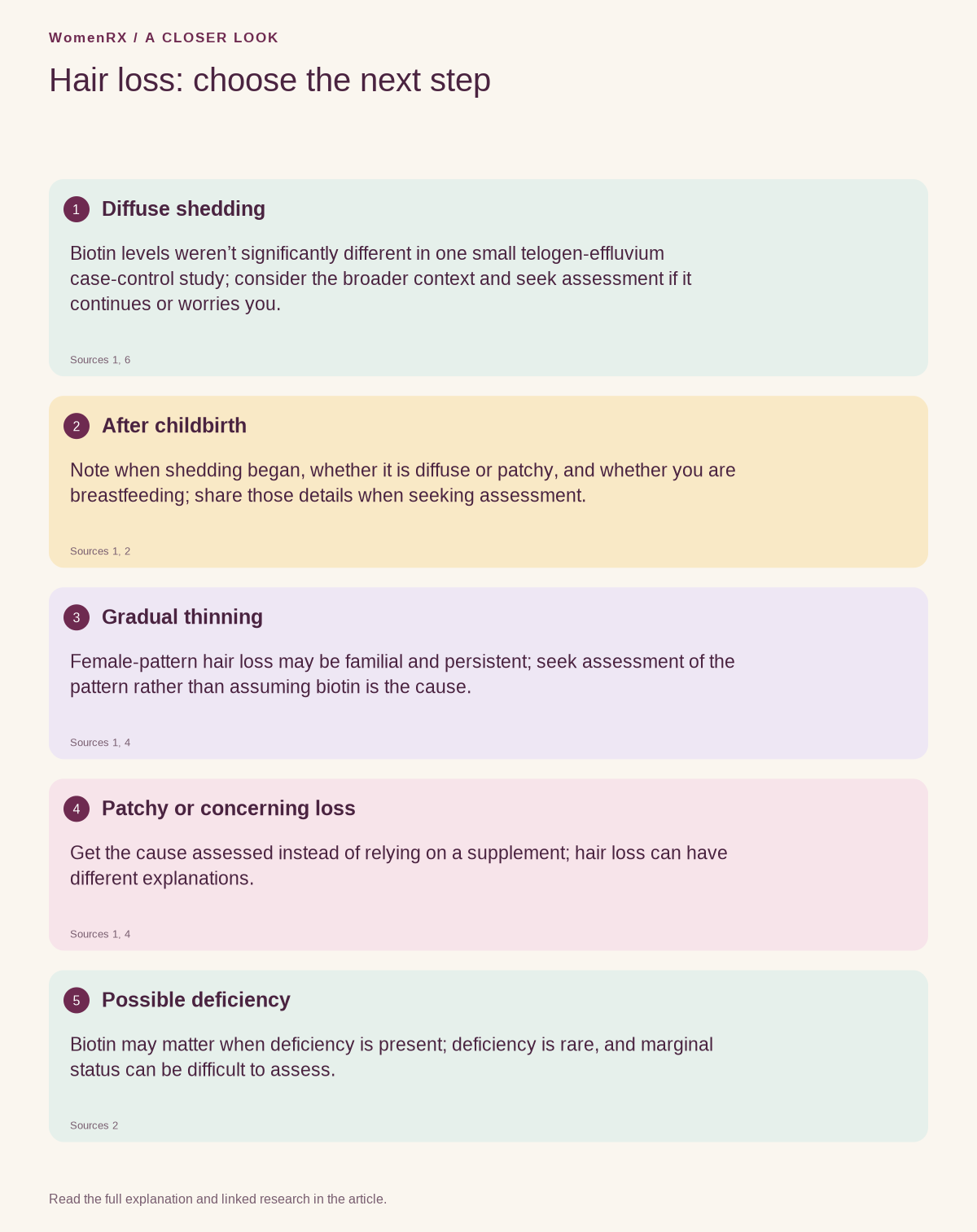
Hair loss: choose the next step
Diffuse shedding: Biotin levels weren’t significantly different in one small telogen-effluvium case-control study; consider the broader context and seek assessment if it continues or worries you.16
After childbirth: Note when shedding began, whether it is diffuse or patchy, and whether you are breastfeeding; share those details when seeking assessment.12
Gradual thinning: Female-pattern hair loss may be familial and persistent; seek assessment of the pattern rather than assuming biotin is the cause.14
Patchy or concerning loss: Get the cause assessed instead of relying on a supplement; hair loss can have different explanations.14
Possible deficiency: Biotin may matter when deficiency is present; deficiency is rare, and marginal status can be difficult to assess.2
Read the figure as text
Use the pattern and timing to decide what to discuss; don’t treat every kind of hair loss as a biotin problem.- Diffuse shedding: Biotin levels weren’t significantly different in one small telogen-effluvium case-control study; consider the broader context and seek assessment if it continues or worries you.16
- After childbirth: Note when shedding began, whether it is diffuse or patchy, and whether you are breastfeeding; share those details when seeking assessment.12
- Gradual thinning: Female-pattern hair loss may be familial and persistent; seek assessment of the pattern rather than assuming biotin is the cause.14
- Patchy or concerning loss: Get the cause assessed instead of relying on a supplement; hair loss can have different explanations.14
- Possible deficiency: Biotin may matter when deficiency is present; deficiency is rare, and marginal status can be difficult to assess.2
More questions, answered
Can a blood test tell me whether biotin is causing my hair loss?
Not on its own. Serum biotin levels aren’t a good indicator of marginal deficiency, and reliable measures of biotin status are limited. Results need to be considered alongside your history and examination. 2 4
Should I mention a hair supplement before lab tests?
Yes. Biotin can interfere with some lab assays, including certain thyroid tests, and make results misleading. Tell the person ordering the test that you take it. 2
Sources you can check
- Hair loss - NHSAccessed 2026-09-25Return to first citation
- Biotin - Health Professional Fact SheetAccessed 2026-09-25Return to first citation
- Hair Loss After Sleeve Gastrectomy and Effect of Biotin Supplements.Şen O, Türkçapar AG. · Journal of laparoendoscopic & advanced surgical techniques. Part A · 2021Return to first citation
- Serum Biotin Levels in Women Complaining of Hair Loss.Trüeb RM. · International journal of trichology · 2016Return to first citation
- Biotin for Hair Loss: Teasing Out the Evidence.Yelich A, Jenkins H, Holt S, Miller R. · The Journal of clinical and aesthetic dermatology · 2024Return to first citation
- Biotin Deficiency in Telogen Effluvium: Fact or Fiction?Abdel Rahman SH, Mohammed Salem R, Hassan Sabry J. · The Journal of clinical and aesthetic dermatology · 2020Return to first citation