Hair Growth Supplements: Match the Product to the Cause
A supplement is most useful when it addresses a real nutritional need, not when it replaces finding out why your hair is changing.
Start with the pattern and timing of your hair loss, not a supplement label. Shedding after childbirth, gradual thinning, and sudden bald patches can point to different causes. An exam may be enough to identify the cause; testing is useful when a deficiency or another condition is suspected. Correcting an identified nutrient deficiency is a different decision from buying a blend that promises regrowth. 159
First, notice what kind of change you're seeing
If you're finding more hair in the shower a few months after giving birth, the timing matters. Postpartum shedding happens as estrogen falls and is usually temporary. It often peaks around four months after delivery, and most women regain their usual fullness by their baby's first birthday. If yours hasn't returned by then, an assessment can look for another cause. A volumizing shampoo or lighter conditioner may help your hair look fuller while you wait, but it won't make hair grow faster. 1
Gradual, ongoing thinning deserves a different look. Female-pattern hair loss can be hereditary and may need treatment rather than a nutrient product. Postpartum shedding and early hereditary loss can also happen together, so a recent birth doesn't explain every change you notice. A dermatologist can use the history and scalp exam to sort out likely causes; blood tests are considered when findings suggest a deficiency, hormonal problem, disease, or infection. 39
A sudden, distinct bald patch is different again. Alopecia areata, an immune-mediated condition, commonly appears as a well-defined patch. That pattern is a reason to seek an assessment rather than assume a hair vitamin will address it. 5
A deficiency is not the same as ordinary thinning
Iron deficiency is one possible cause of temporary hair loss, as are illness and weight loss. That makes recent changes in health or eating relevant to the conversation, but it doesn't mean every woman who sheds needs iron. The useful question is whether there is a reason to suspect a deficiency and, if so, how to check for it. 39
The same distinction applies to other nutrients on hair-product labels. Vitamin D deficiency can be identified with a blood test when there's a reason to investigate it, and too much supplemental vitamin D can be harmful. Zinc status takes more interpretation: a blood level can be affected by factors such as time of day, illness, and hormonal changes. High zinc intake over weeks can also interfere with copper absorption. More isn't automatically better, even when a nutrient is essential. 24
Research on telogen effluvium, the kind of widespread shedding that can follow a disruption to the hair-growth cycle, illustrates why testing and treatment shouldn't be treated as the same question. A 2026 review found lower average ferritin, a marker of iron stores, and vitamin D levels in people with telogen effluvium than in controls. The included patients were predominantly female, but the studies varied considerably. Those associations don't show that giving iron or vitamin D to every woman with shedding will improve her hair. 8
What have hair-growth supplement studies actually shown?
Commercial blends aren't all the same intervention. A 2026 systematic review brought together 14 studies of several oral products in 967 adults with hair thinning or loss. Some pooled hair-growth measures favored supplements over placebo, while total hair count did not show a statistically significant difference. The studies covered different products and types of hair loss, and the findings don't establish a reliable benefit specifically for women with female-pattern loss or postpartum shedding. 7
A smaller study followed 20 people with telogen effluvium who took a blend containing arginine, l-cystine, zinc, and vitamin B6; 18 were evaluated after three months. Hair measurements and assessments improved, but this before-and-after study does not establish what would have happened without the supplement, and it does not provide a women-specific treatment result. It isn't a reason to choose zinc or that particular blend for all shedding. 6
There are options beyond supplements when a specific hair-loss pattern is identified. For example, the American Academy of Dermatology describes minoxidil as a treatment that can help early hair loss, while noting that no one treatment works for everyone. The relevant next step depends on the diagnosis, not on which ingredient appears most often in ads. 9
Make the next step fit the change
For shedding that began a few months after childbirth and is following the expected course, a hair-growth purchase may offer less value than knowing what recovery commonly looks like. If fullness hasn't returned by your baby's first birthday, get the persistent change assessed. 1
For gradual thinning, sudden patches, or shedding that doesn't have a clear explanation, start with an assessment of the pattern. Mention when it began and any recent illness, weight loss, or childbirth; those details help distinguish temporary shedding from other causes. If an exam points toward a nutrient problem, targeted testing can guide whether a supplement has a job to do. Otherwise, an impressive ingredient list is still no substitute for knowing which kind of hair loss you have. 359
Start with the hair change
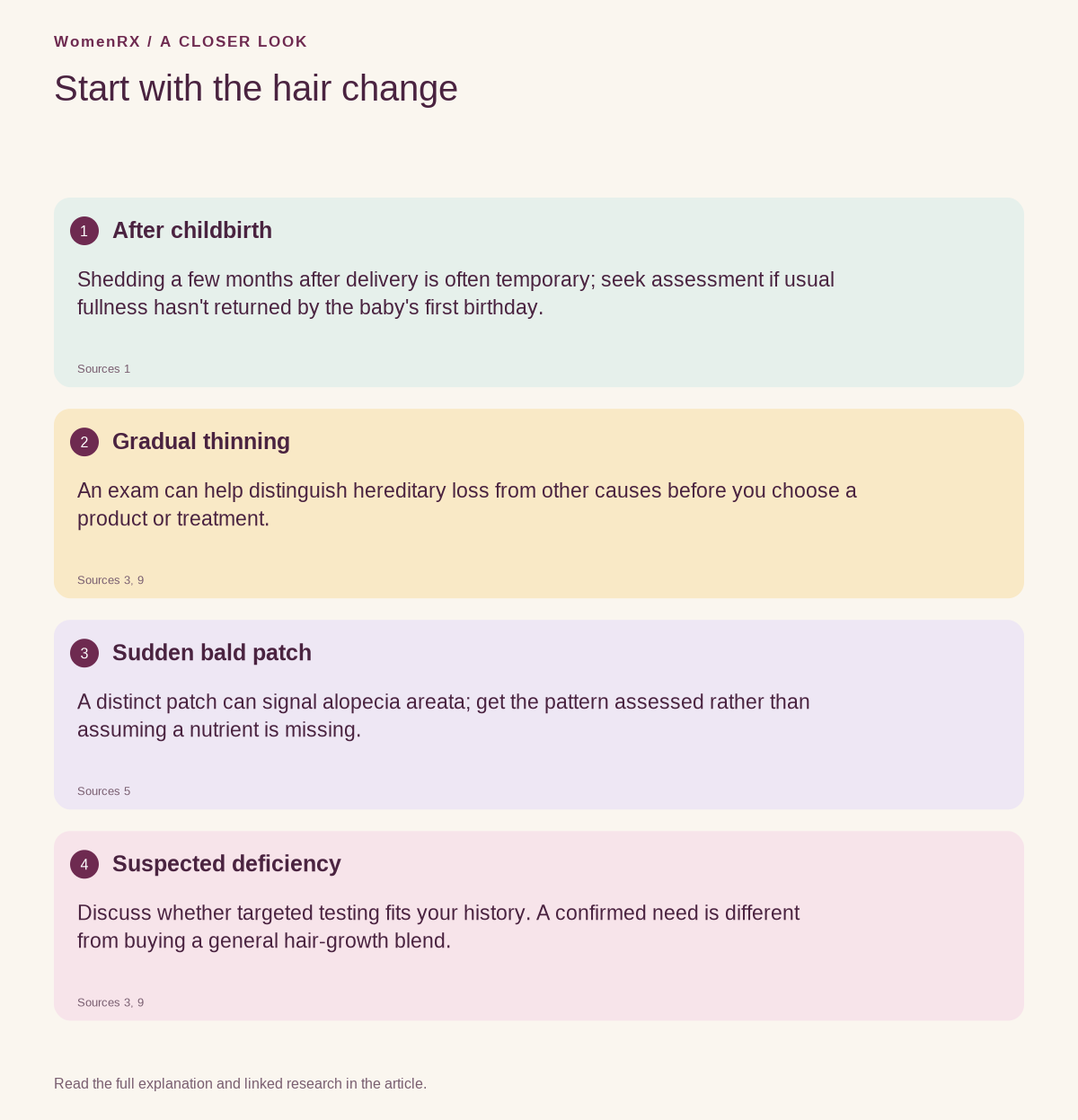
After childbirth: Shedding a few months after delivery is often temporary; seek assessment if usual fullness hasn't returned by the baby's first birthday.1
Gradual thinning: An exam can help distinguish hereditary loss from other causes before you choose a product or treatment.39
Sudden bald patch: A distinct patch can signal alopecia areata; get the pattern assessed rather than assuming a nutrient is missing.5
Suspected deficiency: Discuss whether targeted testing fits your history. A confirmed need is different from buying a general hair-growth blend.39
Read the figure as text
The pattern helps decide whether to watch for recovery, seek an assessment, or investigate a possible nutrient need.- After childbirth: Shedding a few months after delivery is often temporary; seek assessment if usual fullness hasn't returned by the baby's first birthday.1
- Gradual thinning: An exam can help distinguish hereditary loss from other causes before you choose a product or treatment.39
- Sudden bald patch: A distinct patch can signal alopecia areata; get the pattern assessed rather than assuming a nutrient is missing.5
- Suspected deficiency: Discuss whether targeted testing fits your history. A confirmed need is different from buying a general hair-growth blend.39
Sources you can check
- Hair loss in new moms: Dermatologist tipsAccessed 2026-09-25Return to first citation
- Vitamin D Deficiency: MedlinePlusAccessed 2026-09-25Return to first citation
- Hair loss - NHSAccessed 2026-09-25Return to first citation
- Zinc - Health Professional Fact SheetAccessed 2026-09-25Return to first citation
- Alopecia Areata: Advances in Clinical Evaluation and Pathogenesis.Maas D, Spindler AJ, Zappi I, Lawrence CN, Brinks AL, Kearney CA, Occidental MA, Garshick MS, Gould P, Petukhova L, Grant-Kels JM, Shapiro J, Lo Sicco KI. · Journal of the American Academy of Dermatology · 2026Return to first citation
- Clinical study on the efficacy and tolerability of an oral supplement based on arginine, l-cystine, zinc and B6 vitamin (Cystiphane®) in patients with telogen effluvium.Starace M, Cedirian S, Bruni F, Alessandrini AM, Quadrelli F, Sechi A, Piraccini BM. · Italian journal of dermatology and venereology · 2023Return to first citation
- Evaluating the Effectiveness of Commercial Oral Supplements for Hair Growth: A Systematic Review and Meta-Analysis.Alanazi R, Alshammari S, Aldossari K, Alwatban R, Aljeribah D, Alanazi S, Alsalhi A, Alhumam A, Alajlan A. · Journal of cosmetic dermatology · 2026Return to first citation
- Association between Serum Trace Elements and Telogen Effluvium: A Systematic Review and Meta-Analysis.Ahmed A, Alali A, Alahmadi M, Alghamdi S, Khawaji Z, Humedi A, Alqurashi S. · Skin appendage disorders · 2026Return to first citation
- Hair loss: Diagnosis and treatmentAccessed 2026-09-25Return to first citation