Hair Growth Supplements: When Do They Make Sense?
Supplements make the clearest sense when they address a real deficiency; the kind of hair loss you have helps determine whether that’s the right place to start.
A supplement is most likely to be useful when it corrects a nutrient deficiency, not simply because hair is thinning. Iron may be worth discussing if you have heavy periods, recent pregnancy or breastfeeding, or blood loss. Biotin deficiency is rare, and evidence for routine biotin is limited. Gradual pattern thinning and diffuse shedding can have different causes, so match the next step to the pattern. 2 4 5
Start with the pattern, not the bottle
Hair loss can be temporary or longer-lasting. Diffuse shedding may follow an illness, weight loss, or iron deficiency; pattern hair loss tends to be progressive and can run in families. These causes aren’t interchangeable, and a supplement aimed at one won’t necessarily address another. 1 5
If you’re postpartum, mention when the shedding began and whether you had significant blood loss, ongoing heavy bleeding, or a restricted diet. Pregnancy and breastfeeding are relevant to iron needs, and blood loss can contribute to iron deficiency, but hair changes alone don’t show that iron is the cause. 3 4
An examination of your hair and scalp can help clarify the type of loss. If thinning is progressing or you’re worried, getting the cause assessed is more useful than trying several supplements at once. 1
Iron: consider your risk, don’t guess
Iron deficiency is more common among women of reproductive age and during pregnancy. Heavy periods, blood loss, and difficulty absorbing iron can also raise the chance of low iron. If any of those apply, bring them up when discussing whether your iron status should be assessed. 3 4
If iron deficiency is found, addressing it makes sense for your health. That’s different from taking iron just because your hair is shedding. Too much supplemental iron can cause nausea, constipation, and other digestive problems, and severe excess can be dangerous. 3 4
Iron deficiency can also develop before hemoglobin falls: iron stores may be depleted while hemoglobin remains within the usual range. So, a normal hemoglobin result alone doesn’t describe every stage of iron depletion. 3
Biotin: a popular ingredient with a narrow case
Biotin deficiency is rare, and the evidence for biotin supplements promoting hair growth is limited to case reports in children with a rare hair-shaft condition. That doesn’t establish a benefit for routine use in adults whose biotin status is adequate. 2
There’s a practical safety point, too: high-dose biotin can interfere with some lab tests, including thyroid tests, and may produce misleading results. If you take a biotin-containing product, mention it before blood work so the people interpreting your results know. 2
What about multi-ingredient hair supplements?
Some trials of specific multi-ingredient products have reported improvements in measures such as hair density. But the products and study outcomes vary, and results for one formulation don’t establish that another product, or a single ingredient such as biotin or iron, will help. 5 6
The findings aren’t all the same: a 2026 systematic review and meta-analysis reported improvements in several hair-cycle measures across 14 studies, but found no significant difference in total hair count versus placebo. A separate review focused on pattern hair loss reported density improvements for some specific supplements. Taken together, those results are a reason for further study, not proof that supplements work as a group or replace identifying the cause of your hair loss. 5 6
A useful way to judge a product is to ask what exact ingredient and hair-loss type were studied, whether the result was measured against a placebo, and whether the measured outcome was total hair count, density, or something else. A positive result for one measure or formulation is not a guarantee of visible regrowth for you. 5 6
A practical next step
Write down whether you’re seeing gradual thinning or more diffuse shedding, when it began, and whether heavy periods, pregnancy, breastfeeding, recent blood loss, illness, or weight loss might be relevant. Then focus the discussion on the likely cause and whether a deficiency is present. If a deficiency is identified, a targeted supplement has a clearer rationale than a general hair-growth blend. 1 3 4 5
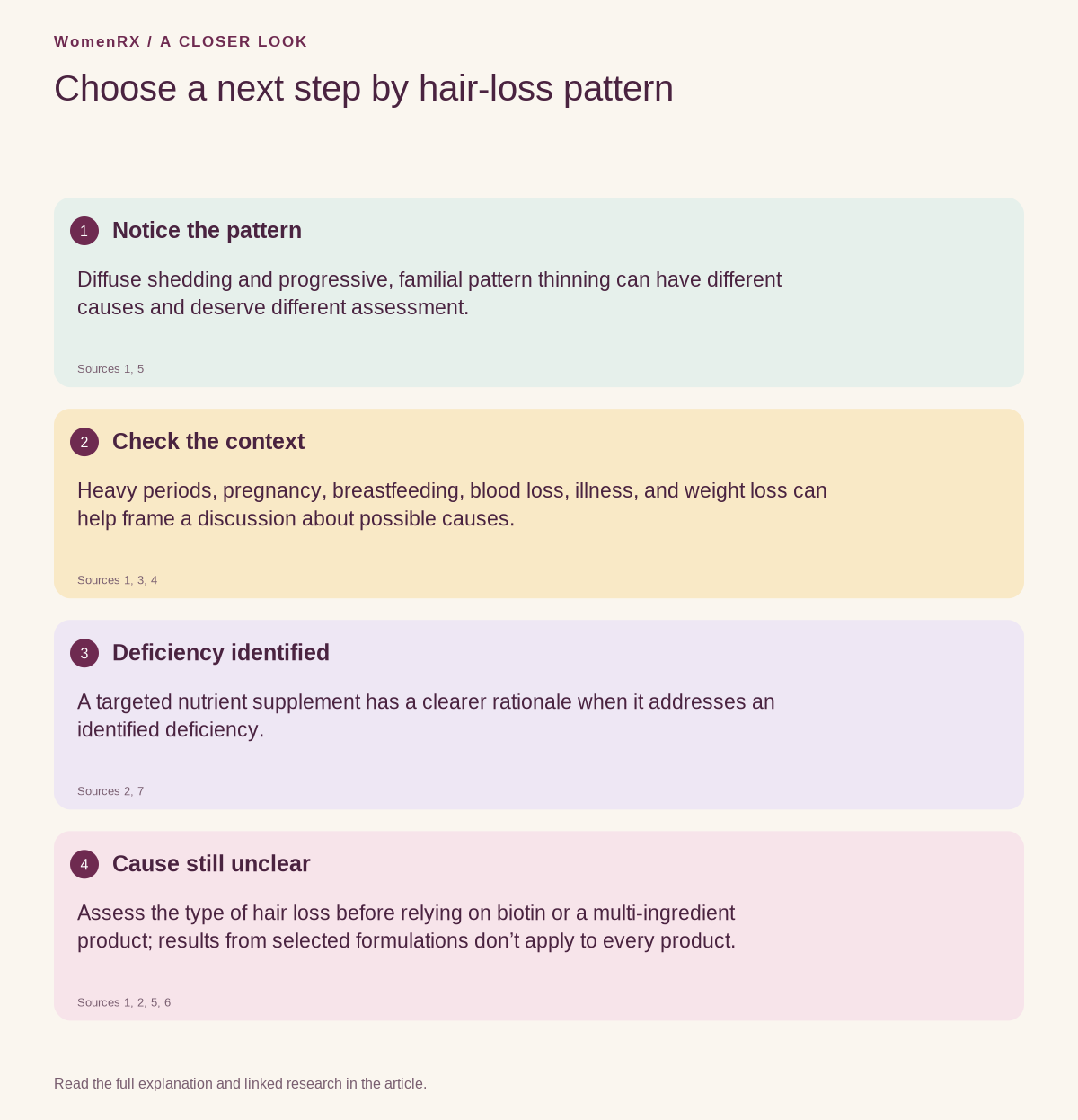
Choose a next step by hair-loss pattern
Notice the pattern: Diffuse shedding and progressive, familial pattern thinning can have different causes and deserve different assessment.15
Check the context: Heavy periods, pregnancy, breastfeeding, blood loss, illness, and weight loss can help frame a discussion about possible causes.134
Deficiency identified: A targeted nutrient supplement has a clearer rationale when it addresses an identified deficiency.27
Cause still unclear: Assess the type of hair loss before relying on biotin or a multi-ingredient product; results from selected formulations don’t apply to every product.1256
Read the figure as text
This flow separates diffuse shedding, progressive pattern thinning, and possible iron risk so a supplement isn’t treated as a one-size-fits-all answer.- Notice the pattern: Diffuse shedding and progressive, familial pattern thinning can have different causes and deserve different assessment.15
- Check the context: Heavy periods, pregnancy, breastfeeding, blood loss, illness, and weight loss can help frame a discussion about possible causes.134
- Deficiency identified: A targeted nutrient supplement has a clearer rationale when it addresses an identified deficiency.27
- Cause still unclear: Assess the type of hair loss before relying on biotin or a multi-ingredient product; results from selected formulations don’t apply to every product.1256
More questions, answered
Does hair shedding mean I’m low in iron?
No. Iron deficiency is one possible contributor to temporary hair loss, but illness, weight loss, and other causes can also be involved. Heavy periods, blood loss, pregnancy, or breastfeeding are useful context when discussing whether to assess iron status. 1 3 4
Should I stop biotin before a blood test?
Don’t make a change based on a general rule here. Tell the person ordering or interpreting the test that you take biotin, since it can interfere with some lab results; they can advise you based on the test and product. 2
Sources you can check
- Hair loss - NHSAccessed 2026-09-25Return to first citation
- Biotin - Health Professional Fact SheetAccessed 2026-09-25Return to first citation
- Iron - Health Professional Fact SheetAccessed 2026-09-25Return to first citation
- Iron: MedlinePlusAccessed 2026-09-25Return to first citation
- Evaluating the Effectiveness of Commercial Oral Supplements for Hair Growth: A Systematic Review and Meta-Analysis.Alanazi R, Alshammari S, Aldossari K, Alwatban R, Aljeribah D, Alanazi S, Alsalhi A, Alhumam A, Alajlan A. · Journal of cosmetic dermatology · 2026Return to first citation
- Effects of dietary supplements on androgenetic alopecia: a systematic review and network meta-analysis.Zhou L, Zhu W, Chen Y. · Frontiers in nutrition · 2025Return to first citation
- Vitamins and hair: Sham or science?Ravipati A, Tosti A. · Clinics in dermatology · 2026Return to first citation