Hair Supplements: What to Check Before You Buy
The right question isn’t just what’s in the bottle, but whether it addresses your kind of hair loss without complicating other care.
Before buying a hair supplement, identify each ingredient and its amount, then ask what reason you have to take it. A suspected deficiency isn’t the same as one that’s been established. Research on some supplement blends is promising but product-specific, while evidence that biotin helps ordinary adult hair thinning is weak. Biotin can also interfere with lab tests. 1 3 4
First, what kind of hair loss are you trying to address?
A widening part, sudden heavy shedding, and distinct bald patches don’t necessarily have the same cause. Female pattern hair loss often involves gradual thinning around the central part. Sudden shedding can follow pregnancy or a major physical or psychological stressor; well-defined patches can point to another condition. Nutritional deficiencies and thyroid problems are also among the possible contributors. A hair supplement isn’t a shortcut to sorting out which of these is happening. 4
That distinction matters most when a label promises to “correct” a nutrient shortfall. Do you know you have a relevant deficiency, or do you only suspect one because your hair is thinning? A clinical review recommends addressing iron deficiency and thyroid dysfunction when they’re present. It doesn’t follow that taking extra iron, or any other nutrient, improves hair growth when you aren’t deficient. You don’t need to assume you need a battery of tests before buying anything, but unexplained hair loss is a better reason to investigate the cause than to guess at a deficiency. 4
If hair loss is rapid without an apparent trigger, extensive, or accompanied by scalp pain, itching, or burning, seek a prompt assessment rather than trying supplements first. Those features can call for a closer look at conditions that need different care. 4
Match the research to the actual product
Read the Supplement Facts panel for the amount of each ingredient, not just a prominent ingredient name or the total amount of a blend. Then ask whether the research tested that ingredient or finished product in people with your type of hair loss. A result for one multi-ingredient formula doesn’t establish that a different formula, or one ingredient taken alone, will do the same thing. 3 5
There is some encouraging research, but “hair supplements work” is too broad a conclusion. A 2026 systematic review covered 14 studies involving 967 adults with alopecia or hair thinning. It found improvements in some measures compared with placebo, but not a statistically significant difference in total hair count. Its authors called for more rigorous, independent studies. 3
A separate analysis of 19 randomized trials involving 1,658 people with androgenetic alopecia, or pattern hair loss, found improvements in certain hair-density measures for some supplements compared with placebo. Its reported results weren’t broken out for women, so they don’t tell you how well those products worked specifically for women. The trials also examined different supplements, which is another reason not to treat their findings as an endorsement of any bottle on a shelf. 5
Biotin is a useful test case
Biotin deficiency can cause hair loss, but it’s rare. The NIH Office of Dietary Supplements says the evidence that biotin supplements promote hair health is limited to case reports in children with a rare hair-shaft condition. That’s not evidence that biotin improves common hair thinning in adults who aren’t deficient. 1
The Daily Value for biotin is 30 micrograms for adults. It’s a reference for comparing nutrient amounts on labels, not a dose shown to grow hair. And a routine serum biotin result isn’t a reliable way to identify marginal biotin deficiency. 1
Check what else is in your routine
Biotin has a practical downside even if you haven’t noticed any effects from taking it: it can distort some lab results. The NIH fact sheet reports that even a single 10 mg dose interfered with thyroid function tests performed within 24 hours. Tell the person ordering a test and the lab about any biotin-containing supplement, and ask for guidance specific to that test rather than guessing when to stop or restart a product. 1
Look at your other supplements alongside the new label, too. One documented nutrient interaction is that taking 25 mg or more of elemental iron at the same time as a zinc supplement can reduce zinc absorption and plasma zinc concentrations. That finding is about simultaneous supplemental iron and zinc, not a claim that all hair supplements interfere with medications. 2
Pregnancy and breastfeeding deserve a separate ingredient check. Results from studies of adults with hair loss don’t establish that a particular hair-growth blend is effective or suitable during either period. If you’re already taking supplements as part of pregnancy or breastfeeding care, check the full ingredient list and amounts with the clinician helping you manage that care before adding another blend. Hair shedding after pregnancy can also have a different explanation from gradual pattern thinning. 3 4 5
Use these questions at the label
- What exactly is in it, and how much? Look for amounts for individual ingredients, including biotin, iron, and zinc.
- Why would I need that ingredient? Separate an established relevant deficiency from a hunch based on hair loss alone. 1 4
- Does the study fit my situation? Check the product, type of hair loss, people studied, and outcome measured. 3 5
- Could it complicate testing or overlap with what I take? Flag biotin before lab work and check whether another supplement contains iron or zinc. 1 2
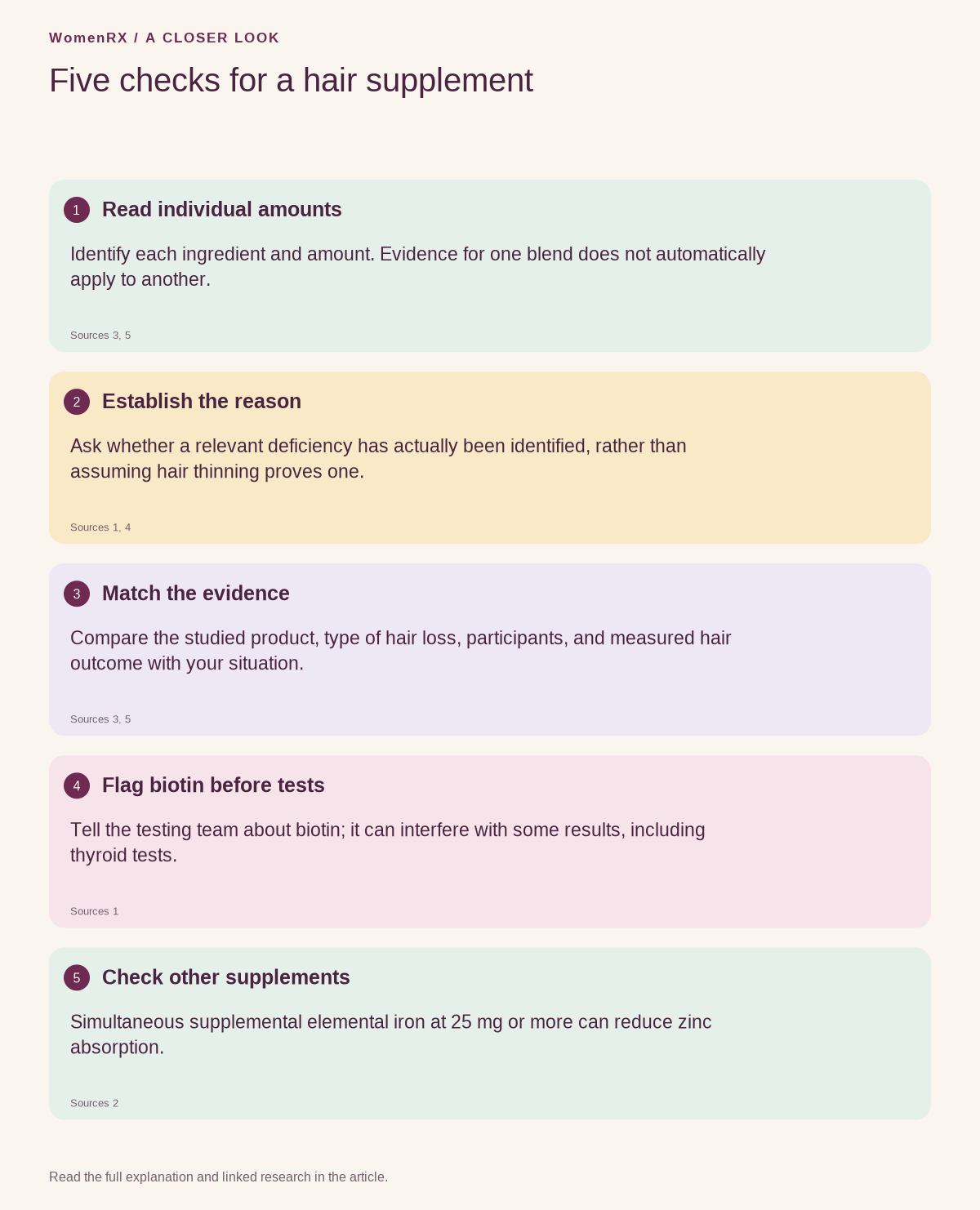
Five checks for a hair supplement
Read individual amounts: Identify each ingredient and amount. Evidence for one blend does not automatically apply to another.35
Establish the reason: Ask whether a relevant deficiency has actually been identified, rather than assuming hair thinning proves one.14
Match the evidence: Compare the studied product, type of hair loss, participants, and measured hair outcome with your situation.35
Flag biotin before tests: Tell the testing team about biotin; it can interfere with some results, including thyroid tests.1
Check other supplements: Simultaneous supplemental elemental iron at 25 mg or more can reduce zinc absorption.2
Read the figure as text
Use the label to test whether the product fits your reason for taking it and whether it could complicate other care.- Read individual amounts: Identify each ingredient and amount. Evidence for one blend does not automatically apply to another.35
- Establish the reason: Ask whether a relevant deficiency has actually been identified, rather than assuming hair thinning proves one.14
- Match the evidence: Compare the studied product, type of hair loss, participants, and measured hair outcome with your situation.35
- Flag biotin before tests: Tell the testing team about biotin; it can interfere with some results, including thyroid tests.1
- Check other supplements: Simultaneous supplemental elemental iron at 25 mg or more can reduce zinc absorption.2
More questions, answered
Can a routine blood test show whether I’m low in biotin?
Not reliably if the concern is marginal deficiency. The NIH fact sheet says serum biotin concentrations aren’t good indicators of marginal biotin deficiency and describes other markers as more reliable. 1
Sources you can check
- Biotin - Health Professional Fact SheetAccessed 2026-09-25Return to first citation
- Zinc - Health Professional Fact SheetAccessed 2026-09-25Return to first citation
- Evaluating the Effectiveness of Commercial Oral Supplements for Hair Growth: A Systematic Review and Meta-Analysis.Alanazi R, Alshammari S, Aldossari K, Alwatban R, Aljeribah D, Alanazi S, Alsalhi A, Alhumam A, Alajlan A. · Journal of cosmetic dermatology · 2026Return to first citation
- Male and female pattern hair loss.Iyengar L, Li J. · Australian prescriber · 2025Return to first citation
- Effects of dietary supplements on androgenetic alopecia: a systematic review and network meta-analysis.Zhou L, Zhu W, Chen Y. · Frontiers in nutrition · 2025Return to first citation