Can Supplements Help With Menopausal Skin and Hair Changes?
A supplement makes most sense when it addresses a nutritional shortfall, not simply because a skin or hair change appeared around menopause.
Sometimes, but the change matters more than the word “menopause” on a bottle. Dryness or itching has different possible causes from a distinctive deficiency-related rash; hair shedding and gradual thinning also call for different questions. A nutrient shortfall may be worth assessing, especially with ongoing blood loss or a condition that affects absorption. Biotin hasn’t been shown to treat typical thinning around menopause. Iron and zinc are worth assessing when a shortfall is plausible, while vitamin D intake recommendations concern bone health rather than cosmetic changes. 12378
Start with the change you can see
It’s understandable to connect a new skin or hair change with perimenopause or postmenopause. The timing is a clue, though, not a diagnosis. Hair density can change during the menopause years, but hair loss may also have a nutritional, medical, or hair-care cause. A dermatologist can use the pattern of loss and a scalp exam to decide whether testing would help. 57
Skin deserves the same distinction. Ordinary dryness, persistent itching, and a new rash aren’t interchangeable signs that you need a vitamin. Skin can become drier and thinner with age, while sunlight also contributes substantially to visible skin aging. Itching may come from dry skin or irritation, but eczema, medication reactions, and other conditions are possible too. 69
Dry or itchy skin: address the symptom, not a presumed deficiency
If your skin feels dry and itchy, moisturizing lotion and lukewarm baths are practical first steps. Sun protection addresses a major cause of skin aging; a vitamin D supplement isn’t a reason to seek more sun, since excess exposure can age skin and increase skin-cancer risk. 964
Biotin illustrates why the type of skin change matters. True biotin deficiency can cause a scaly, red rash around the eyes, nose, mouth, or other body openings, often alongside other symptoms such as hair loss. But biotin deficiency is rare, and the evidence that supplements improve skin in otherwise healthy people is limited to a small number of case reports in infants. An ordinary patch of dry skin doesn’t identify biotin deficiency. 2
If itching is severe, lasts more than a few weeks, or has no clear cause, get it assessed rather than cycling through beauty supplements. Treating an underlying cause, when there is one, is more useful than guessing which nutrient might help. 9
Hair shedding versus gradual thinning
Notice how your hair is changing. Increased shedding across the scalp, a gradually widening part, and loss confined to an area under a tight hairstyle may point to different causes. A hair-loss assessment looks at when the change began, your scalp and nails, and whether a disease, deficiency, hormone imbalance, or infection might warrant testing. Hair-care habits can matter, and there are treatments for some forms of hair loss that aren’t supplements. 7
Iron is a particularly useful question if you’re still having menstrual bleeding, especially if it’s substantial. Iron deficiency is more common among women of reproductive age, and blood loss is one possible cause. Ferritin is a measure of iron stores that can help identify deficiency before iron-deficiency anemia develops. That makes assessing a plausible shortfall more informative than taking iron because you’re shedding hair. Iron supplements can cause stomach upset and constipation, particularly at high doses; evidence of low iron also doesn’t prove it is the only cause of hair loss. 87
Zinc deserves a similarly targeted approach. A vegetarian or vegan diet, a gastrointestinal condition, or certain bariatric surgeries can increase the chance of inadequate zinc status. That’s a reason to look at nutrition and the wider picture, not proof that zinc will regrow hair. If you’re considering a multi-ingredient product, check what it contains: taking a supplement with a substantial amount of iron at the same time as a zinc supplement can reduce zinc absorption. 1
Vitamin D is important for bone health, a consideration that remains relevant beyond the final menstrual period. Its intake recommendations were established for bone health and calcium metabolism, not hair growth or wrinkle reduction. A review of nutrition and hair loss around menopause cites a finding of low vitamin D levels in women aged 18 to 45 with prolonged or telogen hair loss. That finding is not specific to perimenopausal or postmenopausal women and doesn’t show that vitamin D supplements restore hair in women who already have enough. 35
Why a biotin-heavy beauty blend is a poor shortcut
Biotin deficiency can cause hair loss, yet the evidence for biotin supplements as a hair treatment consists of case reports in children with a rare hair-shaft disorder, not trials showing benefit for typical thinning around menopause. High biotin intake can also distort some laboratory results, including thyroid tests. If you’re having blood work to investigate hair loss, tell the testing team about any hair, skin, or nail supplements you take. 2
The useful question, then, isn’t “Which menopause beauty blend covers everything?” It’s “Is this dryness, itching, shedding, or patterned thinning, and is there a credible reason to suspect a nutrient shortfall?” Correcting an identified deficiency and treating a specific skin or scalp condition are different decisions. Neither requires assuming that every change appearing during menopause was caused by menopause. 2789
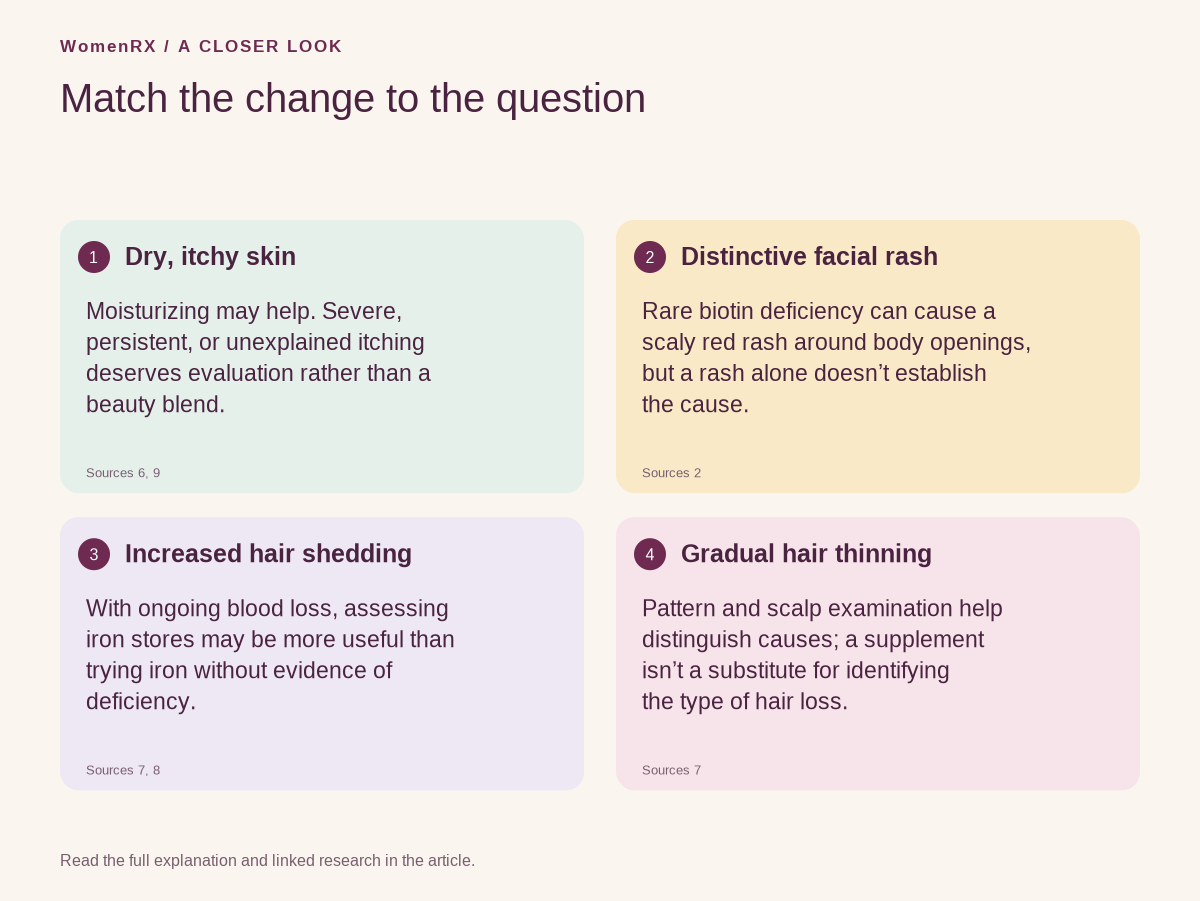
Match the change to the question
Dry, itchy skin: Moisturizing may help. Severe, persistent, or unexplained itching deserves evaluation rather than a beauty blend.69
Distinctive facial rash: Rare biotin deficiency can cause a scaly red rash around body openings, but a rash alone doesn’t establish the cause.2
Increased hair shedding: With ongoing blood loss, assessing iron stores may be more useful than trying iron without evidence of deficiency.78
Gradual hair thinning: Pattern and scalp examination help distinguish causes; a supplement isn’t a substitute for identifying the type of hair loss.7
Read the figure as text
These distinctions help sort a possible nutrient question from a skin or scalp problem; none diagnoses a deficiency.- Dry, itchy skin: Moisturizing may help. Severe, persistent, or unexplained itching deserves evaluation rather than a beauty blend.69
- Distinctive facial rash: Rare biotin deficiency can cause a scaly red rash around body openings, but a rash alone doesn’t establish the cause.2
- Increased hair shedding: With ongoing blood loss, assessing iron stores may be more useful than trying iron without evidence of deficiency.78
- Gradual hair thinning: Pattern and scalp examination help distinguish causes; a supplement isn’t a substitute for identifying the type of hair loss.7
Sources you can check
- Zinc - Health Professional Fact SheetAccessed 2026-09-25Return to first citation
- Biotin - Health Professional Fact SheetAccessed 2026-09-25Return to first citation
- Vitamin D - Health Professional Fact SheetAccessed 2026-09-25Return to first citation
- Vitamin D: MedlinePlusAccessed 2026-09-25Return to first citation
- Nutrition of women with hair loss problem during the period of menopause.Goluch-Koniuszy ZS. · Przeglad menopauzalny = Menopause review · 2016Return to first citation
- Aging Skin | Sunlight | MedlinePlusAccessed 2026-09-25Return to first citation
- Hair loss: Diagnosis and treatmentAccessed 2026-09-25Return to first citation
- Iron - Health Professional Fact SheetAccessed 2026-09-25Return to first citation
- Itching | Pruritus | Itchy skin | MedlinePlusAccessed 2026-09-25Return to first citation