Hair Loss Supplements: Check the Cause Before You Buy
A supplement may help when it corrects a confirmed deficiency, but thinning has many possible causes, and a hair vitamin isn’t a substitute for finding yours.
Supplements make the most sense when your health history and testing point to a deficiency. Low ferritin was associated with recent hair loss in a study of menstruating women, but that doesn’t show iron pills regrow hair; evidence also doesn’t support universal iron testing or routine iron treatment for hair loss without anemia. Biotin or zinc shouldn’t be assumed to help either. Start with the pattern and possible causes. 5 6
First, separate shedding from thinning
Finding more hair in the shower can be unsettling, but it doesn’t tell you which supplement, if any, would help. Hair loss can be related to nutrition, illness, medicines, stress, or inherited patterns, and treatment depends on the cause. 1 4
The shape and timing offer useful clues, not a diagnosis. A gradual change in overall density can have different causes from sudden bare patches. Alopecia areata, for example, is an immune-mediated condition that can begin with abrupt, patchy hair loss. 7 If your loss is sudden, patchy, progressing, or worrying you, get the cause assessed rather than starting a supplement trial first. 4 7
Iron is different from a general “hair vitamin”
Iron is worth discussing when hair loss occurs alongside possible iron deficiency. Heavy periods and pregnancy are common causes of iron-deficiency anemia. A cross-sectional study of 554 non-anemic menstruating women found an association between lower ferritin and recent hair loss. It did not test whether iron supplements brought hair back. 2 5
That distinction matters: an association can point to something worth checking without proving that a supplement treats the symptom. A review of research on iron and hair loss found conflicting results across studies. It concluded there wasn’t enough evidence to recommend universal iron screening for everyone with hair loss, or iron supplements specifically to treat hair loss in people with iron deficiency who don’t have iron-deficiency anemia. Iron-deficiency anemia itself should be treated. 6
Those iron findings don’t establish that biotin, zinc, or a multinutrient hair product will help. Don’t treat the word “hair” on a label as evidence that a product addresses your cause. Hair loss can have several explanations, and treatment depends on which one applies. 1
So the useful question isn’t simply, “Could iron help?” It’s, “Is iron deficiency likely or confirmed, and what’s causing it?” A blood count can check for anemia, while ferritin helps assess iron stores. Ferritin can be affected by inflammation and other conditions, so results need to be interpreted in context. 2 6
Life stage gives context, not a diagnosis
Pregnancy and menstruation can be relevant to iron status, but they don’t establish the cause of an individual’s hair loss. If you’re noticing shedding after childbirth, mention when it began and whether it is improving, continuing, or changing into visible thinning or distinct patches; postpartum timing is context, not proof that a supplement is needed. A sudden, patchy, or progressing change deserves assessment rather than a supplement trial. 4 7
Menopause can be useful context when describing when hair changes began, but it doesn’t prove a deficiency. Hair loss can also relate to aging or inherited female-pattern loss. If thinning is gradual or patterned, or keeps progressing, ask about its cause and what treatments fit that pattern instead of assuming a supplement is the answer. 1 4
A practical conversation before you supplement
You can make the discussion more useful by bringing a short, specific account of what’s changed:
- When it started: Did the change begin suddenly or gradually? Has it continued or changed over time?
- What it looks like: Is hair coming out diffusely, is overall density changing, or are there distinct patches?
- Relevant context: Mention pregnancy, menstruation, changes after childbirth, major illness, weight loss, diet changes, and medicines. These can help identify possible causes; they don’t prove one. 1 2
- Whether tests fit: Ask whether a blood count or ferritin test makes sense given your symptoms and history. Lab results are interpreted alongside factors such as medicines and other health information. 3 6
- What a result would change: If a deficiency is found, ask about addressing it and its cause. If tests don’t point to a deficiency, ask what other explanations or treatments fit the pattern.
Don’t start iron simply because hair loss and low iron can be linked. Iron replacement is appropriate for iron-deficiency anemia, but unnecessary or excessive iron can be harmful; a review specifically cautions against excessive supplementation. 6
Choose the next step, not a promise on a bottle
If a deficiency is confirmed, correcting it may be appropriate for your overall health. Whether it will resolve hair loss depends on whether that deficiency is actually contributing to the problem. For hair loss without an identified deficiency, don’t assume a supplement will promote regrowth. The iron research does not answer whether biotin, zinc, or other products help; finding the cause is a more useful next step than choosing a product by its label. 1 5 6
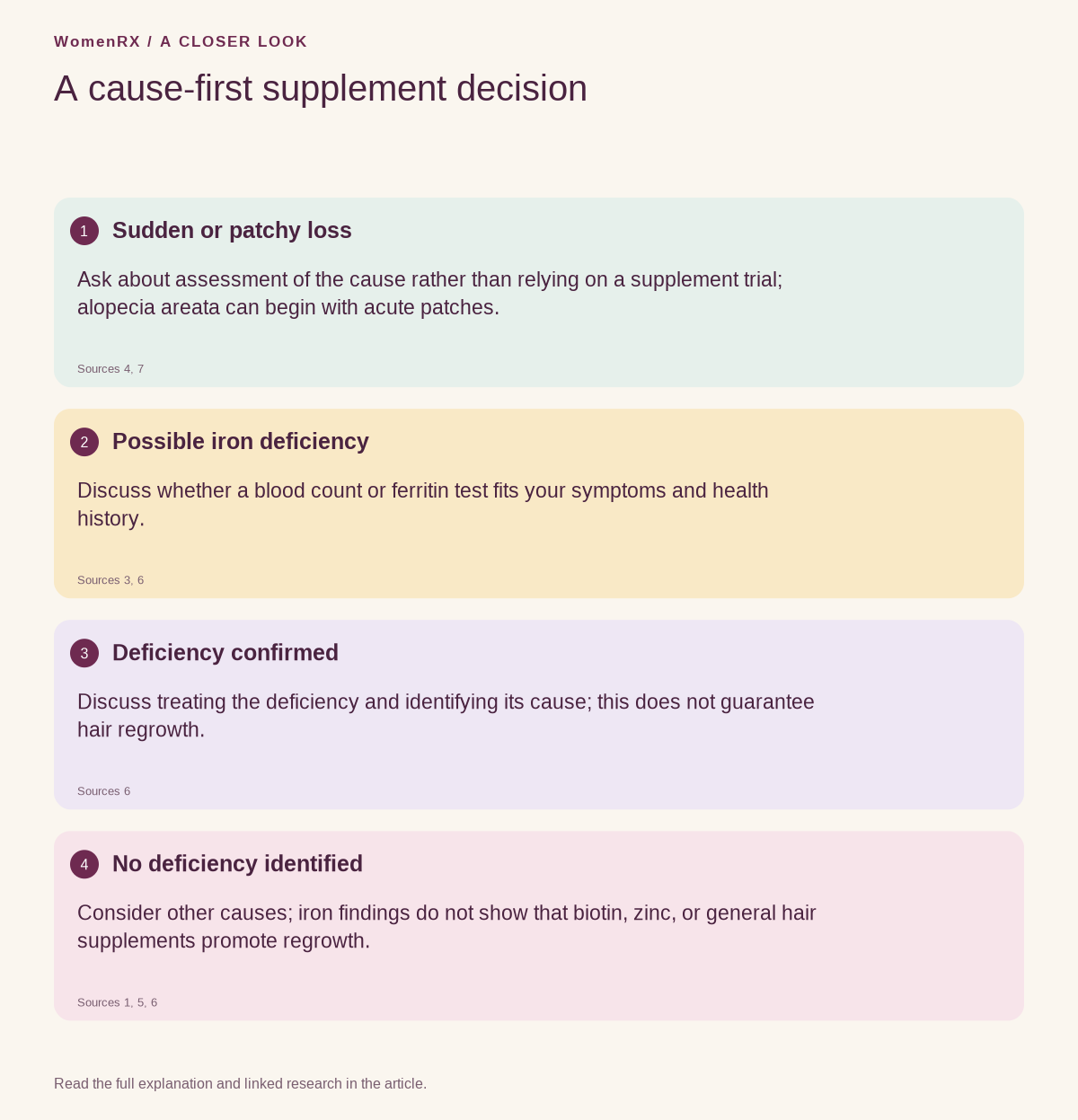
A cause-first supplement decision
Sudden or patchy loss: Ask about assessment of the cause rather than relying on a supplement trial; alopecia areata can begin with acute patches.47
Possible iron deficiency: Discuss whether a blood count or ferritin test fits your symptoms and health history.36
Deficiency confirmed: Discuss treating the deficiency and identifying its cause; this does not guarantee hair regrowth.6
No deficiency identified: Consider other causes; iron findings do not show that biotin, zinc, or general hair supplements promote regrowth.156
Read the figure as text
Use the hair-loss pattern and possible deficiency to decide what belongs in your next health discussion. Iron evidence does not establish benefits for other hair supplements.- Sudden or patchy loss: Ask about assessment of the cause rather than relying on a supplement trial; alopecia areata can begin with acute patches.47
- Possible iron deficiency: Discuss whether a blood count or ferritin test fits your symptoms and health history.36
- Deficiency confirmed: Discuss treating the deficiency and identifying its cause; this does not guarantee hair regrowth.6
- No deficiency identified: Consider other causes; iron findings do not show that biotin, zinc, or general hair supplements promote regrowth.156
More questions, answered
Does low ferritin mean iron will regrow my hair?
Not necessarily. A cross-sectional study found an association between lower ferritin and recent hair loss in menstruating women, but it did not test iron treatment. A review found insufficient evidence to recommend iron specifically for hair loss in people with iron deficiency who don’t have anemia. 5 6
Does the iron research tell me whether biotin or zinc will help?
No. The cited findings concern iron status and hair loss, not whether biotin or zinc promotes regrowth. Don’t assume a supplement will help without considering the cause of your hair loss. 1 5 6
Should everyone with hair loss get iron testing?
A review found insufficient evidence to recommend universal iron screening for hair loss. Whether testing makes sense depends on your pattern, symptoms, and health history; a clinician can consider a blood count and ferritin in that context. 3 6
Sources you can check
- Hair Loss | Alopecia | Alopecia Areata | MedlinePlusAccessed 2026-09-25Return to first citation
- Iron deficiency anaemia - NHSAccessed 2026-09-25Return to first citation
- Laboratory Tests: MedlinePlusAccessed 2026-09-25Return to first citation
- Hair loss - NHSAccessed 2026-09-25Return to first citation
- Non-anemic iron deficiency: correlations between symptoms and iron status parameters.Beatrix J, Piales C, Berland P, Marchiset E, Gerbaud L, Ruivard M. · European journal of clinical nutrition · 2022Return to first citation
- The diagnosis and treatment of iron deficiency and its potential relationship to hair loss.Trost LB, Bergfeld WF, Calogeras E. · Journal of the American Academy of Dermatology · 2006Return to first citation
- S3 guideline diagnostics and therapy of alopecia areata - Part 1: Diagnostics and epidemiology.Blume-Peytavi U, Constantinou A, Tomova-Simitchieva T, Tanew A, Sticherling M, Girschick H, Vogt A, Schwichtenberg U, Gieler U, Märtens A, Zienert K, Stenders C, Werner RN, Wilborn... · Journal der Deutschen Dermatologischen Gesellschaft = Journal of the German Society of Dermatology : JDDG · 2026Return to first citation