Can Food Improve Hair Growth? When to Check Hair Loss
A balanced diet can help meet your hair’s nutrient needs, but food or supplements aren’t a proven fix for every kind of shedding or thinning.
Food may help when your diet is falling short of nutrients, but evidence doesn’t show that particular foods reliably regrow hair when no deficiency is present. Research links some nutrient levels with hair loss, yet much of it is observational, so a link doesn’t prove that eating more or taking supplements will help. Consider an assessment if you’re worried about ongoing shedding or a changing pattern. 5 8 1
Food can support adequacy, not promise regrowth
Hair is made of protein, and nutrients are part of the body’s normal growth processes. A varied eating pattern can help you meet nutritional needs; it doesn’t guarantee thicker hair or reverse hair loss that has another cause. 2 4
A 2026 systematic review of 17 studies, with 61,332 participants who were predominantly women, found associations between higher iron and vitamin D levels and less alopecia. But the studies assessed different dietary factors and hair outcomes, and some reported associations from cross-sectional data. That kind of finding can point to a question worth studying; it can’t show that a food or supplement prevents or reverses hair loss. 5
Iron is a good example of why the distinction matters. An EFSA opinion on a hair-growth claim proposed for non-menopausal women assessed observational studies with mixed findings and concluded that a cause-and-effect relationship between iron intake and normal hair growth had not been established. One study found an association, while other studies did not find a relationship. Those results don’t establish that iron supplements will help everyone with shedding. 8
Review your usual meals before choosing a supplement
Take a look at what you typically eat over several days. Do your meals include protein-containing foods, and are there food groups you regularly avoid or long stretches when you eat very little? This isn’t a test for a deficiency; it can help you notice a possible intake gap to discuss. For zinc, foods include meat, seafood, eggs, dairy, beans, nuts, and whole grains. Zinc from plant foods is generally less available for absorption than zinc from animal foods. 2 3
A documented shortfall and a general “hair growth” claim are different things. If an assessment identifies a deficiency, addressing it is a nutrition question worth discussing; it still doesn’t guarantee that hair will regrow. If no shortfall has been identified, taking more of a nutrient isn’t a demonstrated way to treat hair loss. High-dose zinc can cause stomach symptoms, and taking 50 mg or more for weeks can interfere with copper absorption. 3 8
If you’ve recently had a baby or your menstrual bleeding has become heavier, you can mention when the hair change began alongside those details. They’re prompts for describing timing, not proof of a nutrient deficiency or cause. A change around menopause also deserves context: hormonal changes may be one part of the picture, but nutrition alone shouldn’t be assumed to explain it. 4
The pattern can point beyond food
A gradual widening part or thinning concentrated around the center of the scalp can fit a female-pattern hair-loss pattern. Female pattern hair loss has genetic and other influences, and its exact causes aren’t fully settled; it isn’t simply a sign that your diet is poor. 6
Hair changes can have more than one possible explanation. When you describe them, include when they began, whether you’re seeing overall shedding or a gradual change in density, and any major life or health changes. Those details help frame the question without diagnosing the cause.
When an assessment is useful
You don’t have to prove that your hair loss is severe before asking about it. NHS guidance recommends seeing a doctor if you’re worried; some types of hair loss are temporary, while others may relate to a medical condition or follow a different pattern. 1
An assessment can be useful when shedding continues, you notice a distinct change in density or pattern, or you’re considering a supplement to treat it. In one study of 108 women with diffuse hair loss, researchers examined iron-related markers, thyroid tests, and other factors. They didn’t find significant correlations between hair measurements and TSH or vitamin B12 levels. That study doesn’t establish one blood test as an explanation for every woman’s hair loss. 7
The practical goal is to work out whether there’s a nutritional shortfall to address or another explanation to consider. Bring the timing of the change, relevant dietary restrictions, recent childbirth or changes in menstrual bleeding, and any supplements you already use into the conversation. Those details help frame the question; they don’t diagnose the cause.
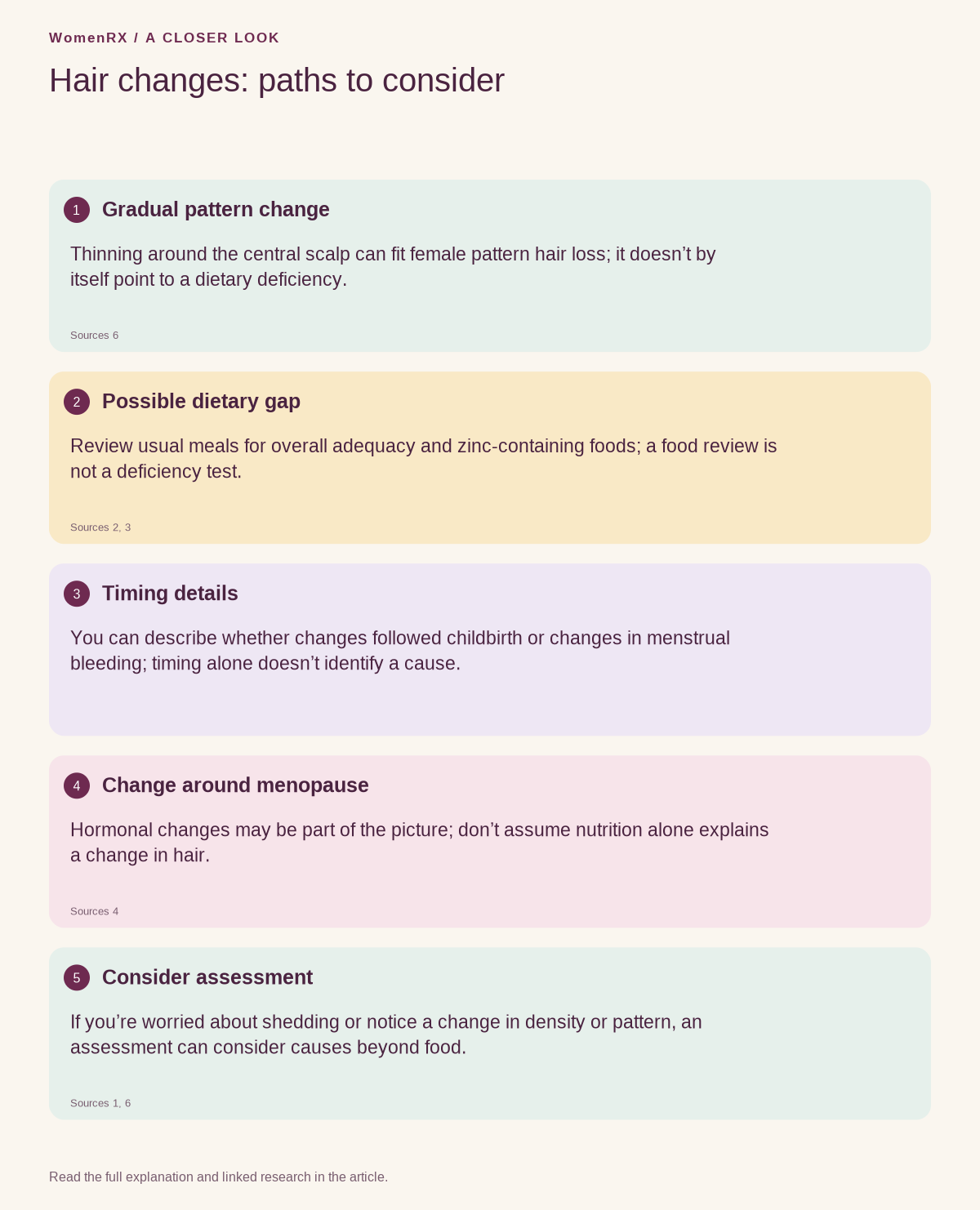
Hair changes: paths to consider
Gradual pattern change: Thinning around the central scalp can fit female pattern hair loss; it doesn’t by itself point to a dietary deficiency.6
Possible dietary gap: Review usual meals for overall adequacy and zinc-containing foods; a food review is not a deficiency test.23
Timing details: You can describe whether changes followed childbirth or changes in menstrual bleeding; timing alone doesn’t identify a cause.
Change around menopause: Hormonal changes may be part of the picture; don’t assume nutrition alone explains a change in hair.4
Consider assessment: If you’re worried about shedding or notice a change in density or pattern, an assessment can consider causes beyond food.16
Read the figure as text
Use the pattern, dietary context, and life-stage timing as separate clues. None of them alone identifies the cause; an assessment can help when the change worries you.- Gradual pattern change: Thinning around the central scalp can fit female pattern hair loss; it doesn’t by itself point to a dietary deficiency.6
- Possible dietary gap: Review usual meals for overall adequacy and zinc-containing foods; a food review is not a deficiency test.23
- Timing details: You can describe whether changes followed childbirth or changes in menstrual bleeding; timing alone doesn’t identify a cause.
- Change around menopause: Hormonal changes may be part of the picture; don’t assume nutrition alone explains a change in hair.4
- Consider assessment: If you’re worried about shedding or notice a change in density or pattern, an assessment can consider causes beyond food.16
More questions, answered
Does low iron always cause hair loss?
No. Studies have reported mixed findings, and an EFSA review concluded that a cause-and-effect relationship between iron intake and normal hair growth had not been established. A possible deficiency is a different question from whether iron supplements help hair loss in general. 8
Should I take zinc for thinning hair?
Whether extra zinc will help depends on the cause of the hair change; more zinc doesn’t automatically mean more hair. High zinc intakes can cause stomach symptoms, and taking 50 mg or more for weeks can interfere with copper absorption. 3
Sources you can check
- Hair loss - NHSAccessed 2026-09-25Return to first citation
- Nutrition: MedlinePlusAccessed 2026-09-25Return to first citation
- Zinc - Health Professional Fact SheetAccessed 2026-09-25Return to first citation
- Nutrition of women with hair loss problem during the period of menopause.Goluch-Koniuszy ZS. · Przeglad menopauzalny = Menopause review · 2016Return to first citation
- Assessing the relationship between dietary factors and hair health: A systematic review.Gomes N, Silva N, Teixeira B. · Nutrition and health · 2026Return to first citation
- Female Pattern Hair Loss: An Overview with Focus on the Genetics.Ho CY, Chen JY, Hsu WL, Yu S, Chen WC, Chiu SH, Yang HR, Lin SY, Wu CY. · Genes · 2023Return to first citation
- Evaluation of the relationship of digital phototrichogram findings of patients with diffuse hair loss with blood TSH, ferritin and vitamin B12 levels.Bilik L, Kokcam I, Esen M. · Northern clinics of Istanbul · 2024Return to first citation
- Scientific Opinion on the substantiation of a health claim related to iron and maintenance of normal hair growth pursuant to Article 13(5) of Regulation (EC) No 1924/2006.EFSA Panel on Dietetic Products, Nutrition and Allergies (NDA). · EFSA journal. European Food Safety Authority · 2012Return to first citation